
German playwright details history of 1848 revolutionary
Erich Becker shares the story of Ludwig Bogen
Ludwig Bogen, a German lawyer who became a journalist in New Ulm, is remembered for his dedication to democracy, free speech, and advocacy for Native American rights and labor issues. He took over the "New Ulm Post," an "Independent People's Journal for Freedom, Law and Progress.” His gravestone even depicts him with a writing instrument, symbolizing his life's work. (Photo by Amy Zents)
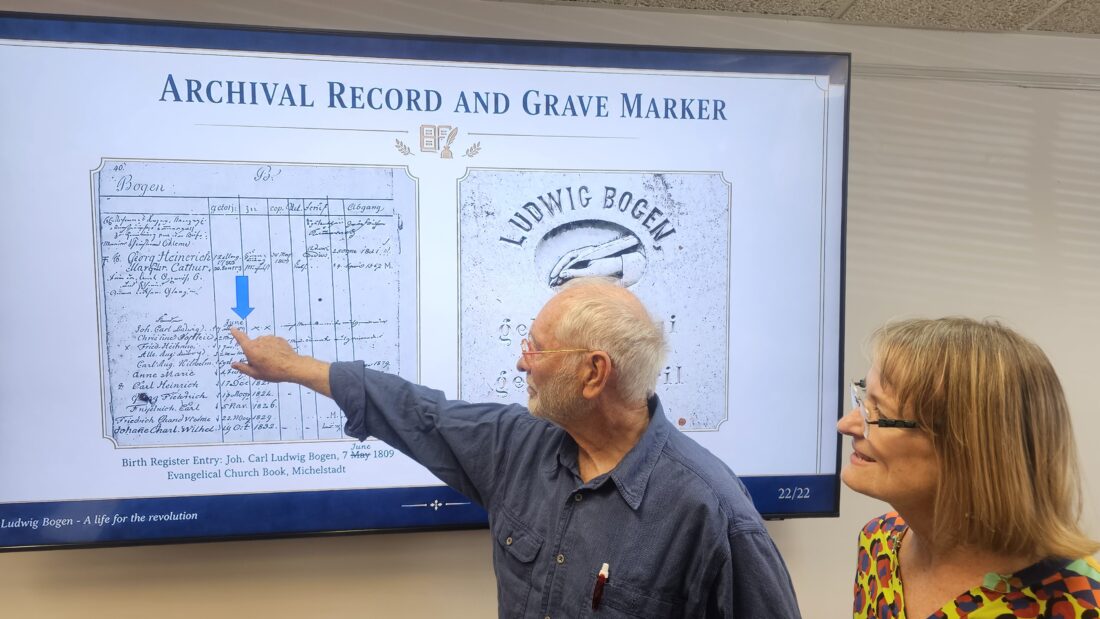
German playwright Erich Becker points to Ludwig Bogen’s June 7, 1809, birth record in a Michelstadt church register, shown alongside Bogen’s New Ulm grave marker during Thursday’s “Lunch and a Bite of History” program at the Brown County Historical Society Museum Annex. His wife, harpist Valerie Cribbs, looks on. (Photo by Amy Zents)
Becker placed Bogen in the left wing of the Frankfurt Parliament of 1848, where figures such as Robert Blum fought for revolutionary change. He noted that Bogen’s core principles, democracy, free speech and tolerance, strongly align with his own (Photo by Amy Zents)
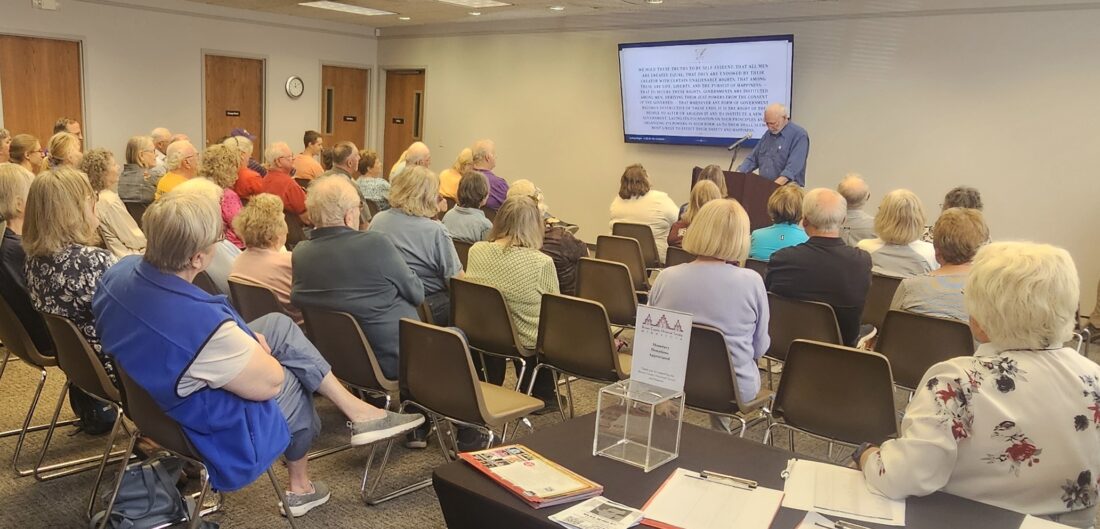
A well-attended event drew a full house Thursday at the Brown County Historical Society Museum Annex in New Ulm for German playwright Erich Becker’s “Lunch and a Bite of History” presentation. (Photo by Amy Zents)
Ludwig Bogen, a German lawyer who became a journalist in New Ulm, is remembered for his dedication to democracy, free speech, and advocacy for Native American rights and labor issues. He took over the "New Ulm Post," an "Independent People's Journal for Freedom, Law and Progress.” His gravestone even depicts him with a writing instrument, symbolizing his life's work. (Photo by Amy Zents)
German playwright Erich Becker points to Ludwig Bogen’s June 7, 1809, birth record in a Michelstadt church register, shown alongside Bogen’s New Ulm grave marker during Thursday’s “Lunch and a Bite of History” program at the Brown County Historical Society Museum Annex. His wife, harpist Valerie Cribbs, looks on. (Photo by Amy Zents)
Becker placed Bogen in the left wing of the Frankfurt Parliament of 1848, where figures such as Robert Blum fought for revolutionary change. He noted that Bogen’s core principles, democracy, free speech and tolerance, strongly align with his own (Photo by Amy Zents)
A well-attended event drew a full house Thursday at the Brown County Historical Society Museum Annex in New Ulm for German playwright Erich Becker’s “Lunch and a Bite of History” presentation. (Photo by Amy Zents)
Trending
NEW ULM -- German playwright Erich Becker detailed the historical events behind his drama, “A Life for the Revolution,” during a presentation Thursday at the Museum Annex.
The program, hosted by the Brown County Historical Society, focused on the life of Ludwig Bogen, a German revolutionary who became a prominent editor in New Ulm.
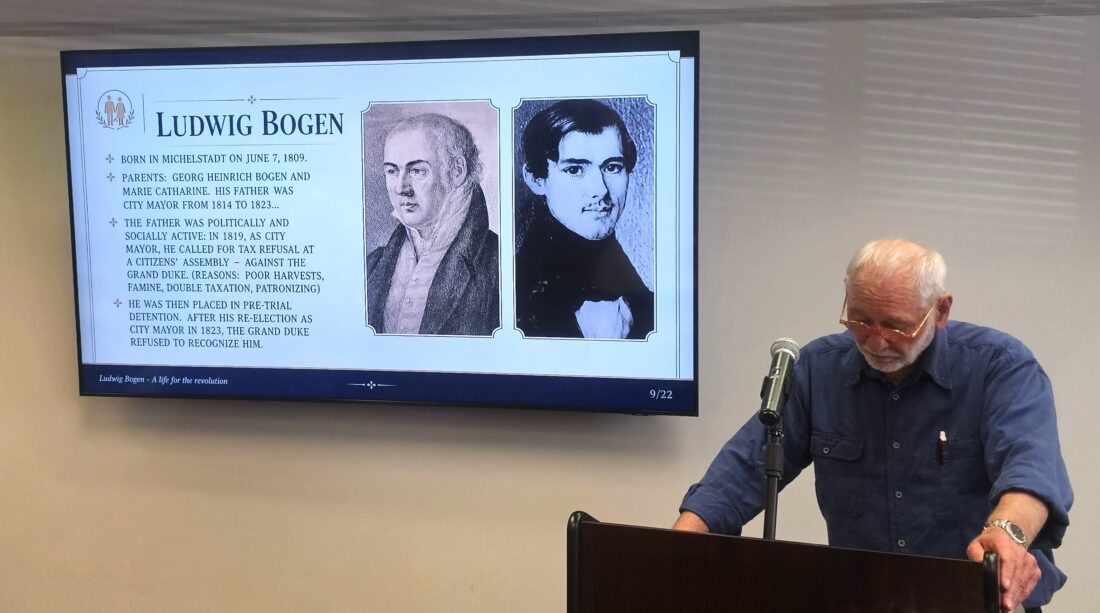
Becker said he first encountered Bogen's story while working as a history teacher and tour guide in Michelstadt, Germany. Bogen was born there on June 7, 1809.
"Ludwig Bogen is a person who has in a lot of things the same meaning as me," Becker said. "Democracy, free speech, tolerance."
Becker's presentation used a series of slides to trace Bogen's life from the 1848-49 German revolutions to his arrival in Minnesota.
Becker said that in the mid-19th century, most of Europe consisted of 39 kingdoms, principalities, and duchies.
He said these states were ruled by monarchs, and approximately 99 percent of the population lacked democratic rights while paying taxes to the church and aristocracy.
Becker said Bogen was influenced by his father, a mayor who once called for a tax revolt to reduce the suffering of the people.
As a student in the 1830s, Bogen participated in movements seeking a unified Germany, free speech, and an end to absolute monarchy.
Bogen was eventually elected as a representative to the Frankfurt National Assembly, the first freely elected parliament in Germany, which met at St. Paul's Church.
Becker said Bogen's seat in the parliament was located on the democratic left side of the assembly.
After the revolutions failed, Bogen faced imprisonment and eventually chose to emigrate.
Becker shared a newspaper advertisement from 1849 that offered passage to America on three-masted ships departing on the Rhine River every Saturday for New york and New Orleans.
Bogen arrived in America in 1853. He married Margaretha Nix in Cincinnati on May 21, 1854.
Becker said his research suggests the two had known each other since 1848 when Bogen lived in Frankfurt and Nix lived in nearby Offenbach.
The family lived in Stillwater before moving to New Ulm in 1864.
At the time of Bogen's arrival, New Ulm was still recovering from the U.S.-Dakota War of 1862.
Becker said Bogen chose the settlement because it was founded by the Chicago Turnverein as a place for German revolutionaries with liberal and anti-slavery values.
Bogen took over the New Ulm Post, a German-language weekly newspaper.
The publication's subtitle was "Independent People's Journal for Freedom, Law and Progress."
Becker said Bogen wrote roughly 1,000 editorials between 1876 and 1886. His writings advocated for labor issues and reform.
"Many of the freedoms Bogen fought for are things we are still fighting for today," Becker said.
Becker said Bogen was a controversial figure at times because he also used his platform to advocate for Native American rights.
Becker said this commitment to equality for all people was a central part of Bogen's democratic principles.
The presentation included details regarding Bogen's death. Becker translated a report from the April 9, 1886, edition of the New Ulm Post
The report stated Bogen died of a heart attack on Tuesday, April 6, shortly after returning from the post office. He was sitting at his desk about to write an article when he passed away.
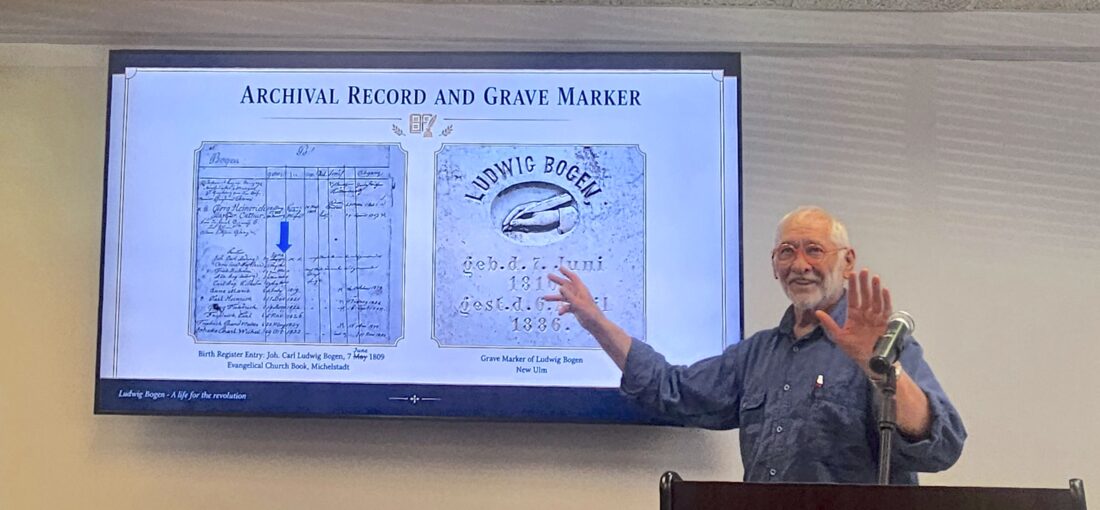
Becker highlighted a discrepancy between European and local records regarding Bogen’s age. A church register in Michelstadt lists his birth as 1809. However, Bogen's grave marker in New Ulm lists his birth year as 1810.
The gravestone itself is unique because it features a “station of life” symbol. Becker said the marker depicts a journalist holding a writing instrument, a rare feature for the time.
During the question-and-answer session, Becker explained that unifying Germany was difficult because the 39 separate states were fighting against established monarchies to create a democracy.
"They want to unite Germany," Becker said. "They want a democracy with free speech, free press and tolerance."
Becker said he was inspired to write the play because his own values align with Bogen's history. He noted that the principles of free speech and democracy are timeless connections between Germany and the United States.
Lori Jewell, the director, also emphasized the unique musical elements of the production.
"We also have his wife Valerie Cribbs with us, and she's going to be playing the harp throughout the scene changes in the show, which is amazing," Jewell said.
Performances of A Life for the Revolution are scheduled for 7 p.m. today and 2 p.m. Sunday at State Street Theater. A talk-back session with the playwright and director will follow the Sunday matinee.