
Fort Ridgely, an outpost on the prairie
Trending
FORT RIDGELY -- Fort Ridgely, a U.S. military post built in 1953 near the southern border of the Dakota reservation and northwest of the German settlement of New Ulm, was originally designed to keep peace as colonists settled on former Dakota land.
Yielding to U.S. government pressure in 1851, the Eastern Dakota sold 35 million acres of their land in southern and western Minnesota.
The Dakota moved onto a much smaller reservation along the Minnesota River, stretching from just north of New Ulm to the South Dakota border.
In 1862, unkept promises by the U.S. government, corrupt behavior by fur traders, and crop failure, helped create tension that erupted into the U.S.-Dakota War of 1862.
Dakota attacked Fort Ridgely twice, on Aug. 20 and Aug. 22. Fort Ridgely's 280 military and civilian defenders held out until Army reinforcements ended the seige.
The Army abandoned the fort in 1867. Civilians occupied the remaining buildings and later took them apart for their own use.
Fort Ridgely State Park was established in 1911.
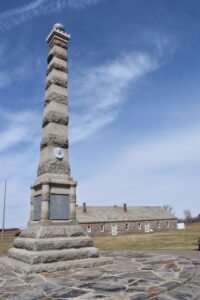
From 1935 to 1942, the Civilian Conservation Corps (CCC) excavated the site, restored the foundations of eight fort buildings, and rebuilt the entire commissary building which still stands.
In 1970, the fort was added to the National Register of Historic Places. The CCC built picnic shelters and other structures were added in 1989. The Minnesota Historical Society assumed stewardship of the site in 1986.
The restored commissary building housed interpretive exhibits a number of years ago. A popular June event, the Rendezvous, included many Civil War-era actors for a number of years.
The state park golf course was closed due to declining revenue in September 2016. A group of area residents including the Friends of Fort Ridgely launched a campaign hoping to raise enough money to lease the course from the Minnesota Department of Natural Resources (DNR) and re-open it.
The group failed to win the support of the Fairfax City Council that voted not to support the project.
The DNR later restored the former golf course property in the park to native prairie.
However, a number of markers around the former fort tell much of the history of Fort Ridgely.
The state park still has a lot of offer including hiking and horseback trails, stocked trout steam fishing, camping with drive-in and walk-inn sites and a renovated farmhouse available for rent. Winter brings snowshoeing, snowmobiling and staying overnight at the chalet.
White-tail deer can be seen bounding through tall grass prairie. Gray foxes sleep nearby, beavers build dams along the creek, red-tailed hawks soar in the sky, snapping turtles bury eggs in the sandy creek banks. The summer singing of Eastern Bluebirds create a chorus of nesting birds.
For more information visit https://www.dnr.state.mn.us/state_parks/.