Too cool to tool around fields
Cool soil, late rains stall planting
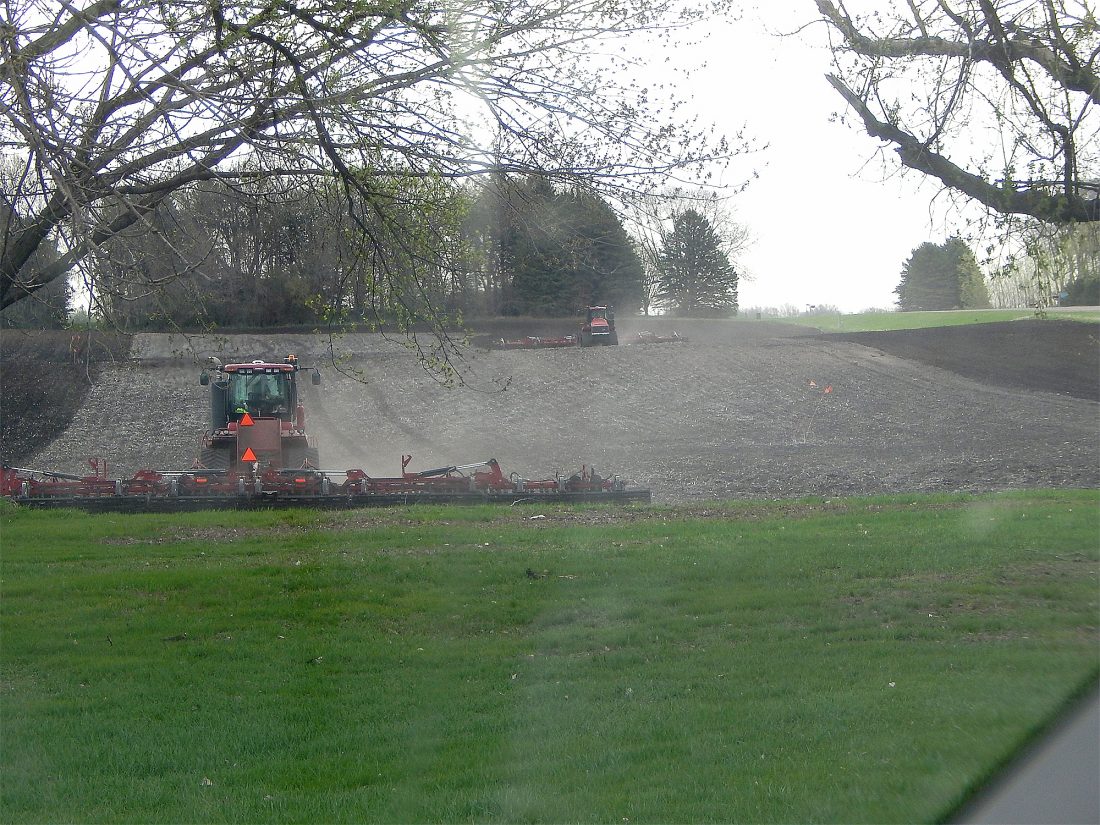
Staff photo by Fritz Busch Two tractors pull plows tilling a field just east of Sleepy Eye Tuesday morning in preparation for this year’s planting season that’s been put on hold.
Staff photo by Fritz Busch
Two tractors pull plows tilling a field just east of Sleepy Eye Tuesday morning in preparation for this year’s planting season that’s been put on hold.
Too cool to tool around fields
By Fritz Busch
and Deb Gau
NEW ULM — First the good news. There isn’t any spring flooding in southern Minnesota this year.
The news that isn’t quite as good is that due to cooler-than-normal weather, spring planting is a bit behind.
“We’re definitely delayed. We’re just on the cusp of starting to move,” said South Central College Farm Business Management instructor Wayne Schoper.
“Soil temperatures are too cold for corn germination. Corn could be planted about April 20. Here we are May 6 with almost no corn in the ground,” said Schoper. “We’ve got the moisture. Corn will likely be wet in the fall, but once we get the heat for full yield potential, it will just explode out of the ground.”
“We had a cool, wet April that pushed us back,” said Travis Longhenry, a consultant with Centrol Crop Consulting who serves a territory including Lincoln and part of Lyon County. While temperatures have gotten warmer, conditions are still wet, Longhenry said.
On Wednesday morning, Dereck Deutz planned on helping his dad and brother at the family farm a few miles outside of Marshall. But then the rain started falling, making it too wet to dig in the fields.
“As soon as it dries up, we get hit with these rains that set us back a couple days,” Deutz said. They were getting “kind of frustrated,” he said.
Deutz and his family were far from the only area farmers dealing with unusual planting conditions this spring. Wet weather and cooler temperatures had farmers waiting longer to start planting corn and soybeans.
“This year we were kind of dealing with soil temperature,” Deutz said. Planting while the ground still wasn’t warm enough could harm crops, he said.
The National Weather Service forecasts daytime highs in the 70s and 80s this week.
“Eighties are perfect,” Schoper said. “Corn can take eight to 10 days to emerge. Heat can help us catch up a little bit.”
Schoper said spring corn planting last year and in 2020 was about perfect, taking place in the last five to ten days of April.
“Last spring, we had good soil moisture with a wet fall in 2020,” said Schoper. “This year, we came in quite dry, didn’t get much snow but got some good planting moisture. We’ll need continuing rains in June and July.”
In the Lincoln-Lyon counties region, farmers who waited to start planting corn are anywhere from zero to 25% finished, he said. But despite the later start this spring, Longhenry said he was still “very optimistic” that farmers would be able to get crops planted on time.
Schoper said there tillage and planting was going on in the region of Niccolet and Brown counties on Tuesday.
“They’ll roll now. A pitter patter of rain won’t hurt,” he added. “Soil temperatures are coming right into the right place. It’s time.”
Thanks to some warmer and drier weather, Minnesota had 2.6 days that were suitable for fieldwork last week, according to the USDA National Agricultural Statistics Service. As of Sunday, Minnesota’s corn planting was 9% complete, compared to the five-year average of 81%. Soybean planting was only 2% complete.
Corn yields decrease at a greater rate after May 15, according to the University of Minnesota Extension Service. However, any advantages of planting before mid-May can disappear if growers plant when soil is too wet.
The NASS reported U.S. farmers plan to plant 4% fewer corn acres and 4% more soybean acres, due mostly to skyrocketing fertilizer costs.
Schoper said most farmers he works with in this area told him they don’t plan to reduce corn for soybean acres because it fouls up crop rotation.
“Even though corn fertilizer costs are up about $100 an acre this year and chemical weed control costs are about double last year,” said Schoper.
He added that there is still plenty of corn and soybeans in the world and markets are still very strong.
“If we see really good planting progress in May and June, we could see demand drop. But right now, it’s still strong,” Schoper said. “We have the capacity to really produce a lot of corn and soybeans in Illinois, Iowa, Indiana, Nebraska, Minnesota and Missouri.”
According to precipitation outlook maps from the National Weather Service, Minnesota has a 40 to 50% chance of having above-normal precipitation in the month of May. The odds are the same for the state having temperatures below normal this month.
However, the region’s outlook through July is looking drier, the NWS said. South Dakota, Nebraska, Iowa and southern Minnesota are all leaning toward having below-normal precipitation. While much of the U.S. is likely to have above-normal temperatures this summer, Minnesota has equal chances of either above or below-normal temperatures.
Local News
Reflection on NUPS literacy plan
New Ulm - Amanda Thorson, the Director of Curriculum and Instruction, presented New Ulm Public Schools’ 2025-2026 ...

River Valley BMX back is back in action

Pollinator Park planting day continues through the rain

‘Don’t be afraid to go for it’

Tigers girls take home 2A golf title