
Timeless in Brick
The story of four historic homes
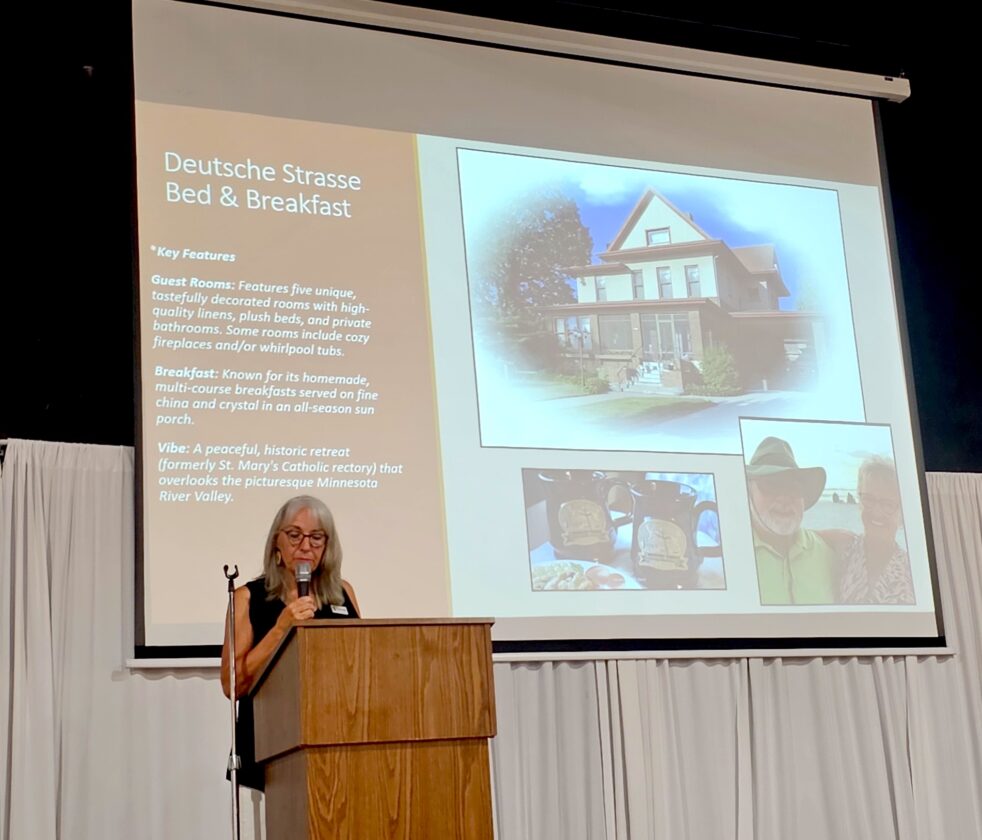
Lisa Besemer discusses the house at 404 South German Street, in New Ulm. It was built in 1894 for George Egert Paul, a teacher, city councilor, and partner in the Empire Mill Company. (Photo by Amy Zents)
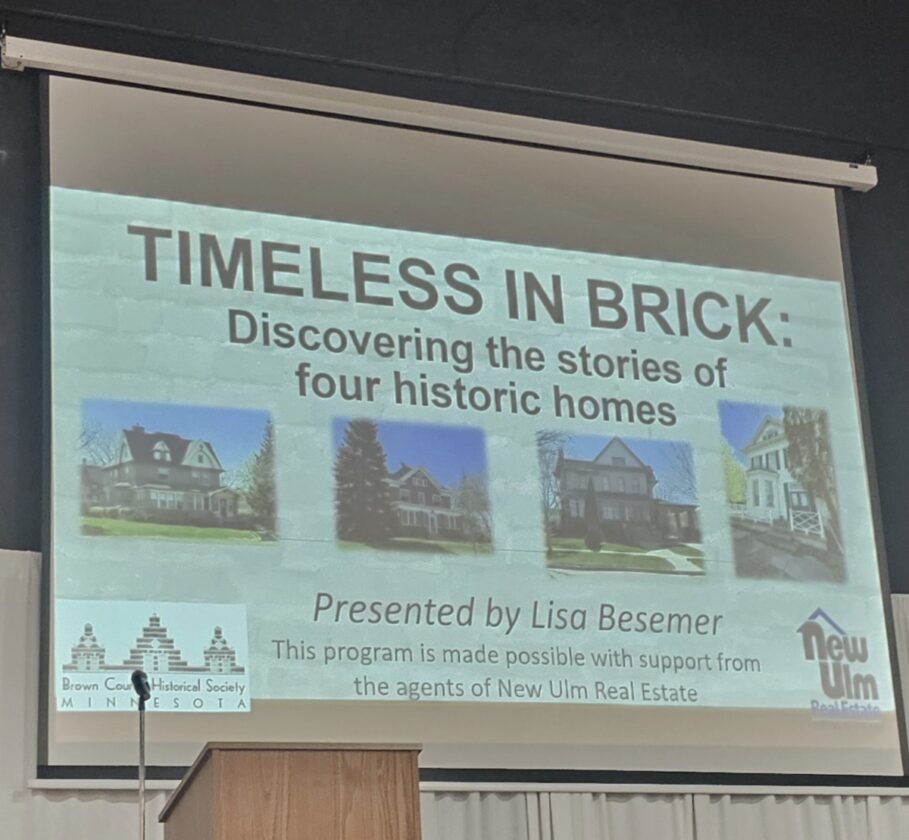
Local historian Lisa Besemer presents "Timeless in Brick: Discovering the Stories of Four Historic Homes" to a capacity crowd at the Brown County Historical Society’s annual event at Turner Hall. (Photo by Amy Zents)
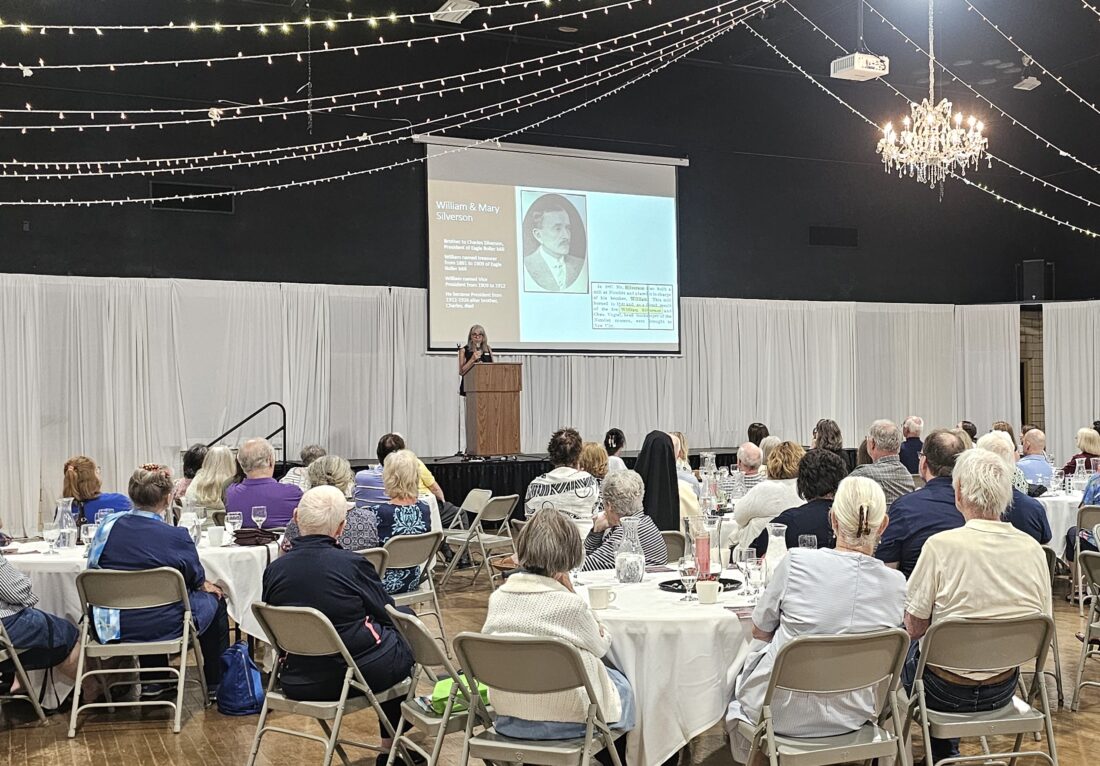
Local historian Lisa Besemer presents the history of William and Mary Silverson and their New Ulm residence to an engaged, capacity crowd at Turner Hall. (Photo by Amy Zents)
Lisa Besemer discusses the house at 404 South German Street, in New Ulm. It was built in 1894 for George Egert Paul, a teacher, city councilor, and partner in the Empire Mill Company. (Photo by Amy Zents)
Local historian Lisa Besemer presents "Timeless in Brick: Discovering the Stories of Four Historic Homes" to a capacity crowd at the Brown County Historical Society’s annual event at Turner Hall. (Photo by Amy Zents)
Local historian Lisa Besemer presents the history of William and Mary Silverson and their New Ulm residence to an engaged, capacity crowd at Turner Hall. (Photo by Amy Zents)
Trending
NEW ULM -- Local historian Lisa Besemer presented "Timeless in Brick: Discovering the Stories of Four Historic Homes" at the Brown County Historical Society's annual event at Turner Hall on Thursday.
Besemer discussed the construction, ownership history and architectural details of four local properties.
Amy Johnson, executive director of the Brown County Historical Society, welcomed the audience.
"What may begin as a simple question about a home, a family, or an architectural detail turns into a deep dive down the rabbit hole of local history," Johnson said.
The first home, at 404 South German Street, was built in 1894 for George Egert Paul, a teacher, city councilor, and partner in the Empire Mill Company.
The property later passed to William Silverson, who held leadership roles at the Eagle Roller Mill. In 1903, Mary Beecher purchased the residence. Her husband, Henry Beecher, served as general manager and president of the mill until his death in 1933.
The home housed numerous domestic workers over the decades, including Lena Baer, Mary Sellinger, Bertha Bathke, Rose Virgil, Frances Stoddard and Elsie Brandes. A groundskeeper and chauffeur lived above the carriage house.
St. Mary's Church acquired the property in 1951 for use as a rectory. Gary and Ramona Sonnenberg operated it as the Deutschstrasse Bed and Breakfast from 1997 to 2017. The home is now a private residence for Larry M. Hahka and Lora L. Hahka.
Besemer said, "While I certainly love remarkable properties, I’ve come to realize that my true passion lies in the stories behind the walls. There is a quiet magic to stepping inside a house and realizing that every room has witnessed daily life, humor, joy and struggle alike."
The second home is the Hauenstein House at 1603 South Payne Street, built in 1898 by John Hauenstein, founder of the Hauenstein Brewing Company.
Hauenstein, a Bavarian immigrant, established the brewery in 1864 after serving in the 1st Minnesota Cavalry during the Dakota Conflict. The brewery operated until December 31, 1969.
The house remained in the Hauenstein family for decades. On April 1, 1947, the estate was sold to Dr. Charles Leland Hintz and his wife, Roberta Beecher.
The third home stands at 210 North Marshall Avenue in Springfield. Constructed in 1911 by George Peter Forster, founder of Forster Furniture, the 3,462-square-foot residence includes original details such as built-in black walnut cabinetry in the formal dining room, wood-beamed ceilings and an oval leaded glass window on the staircase landing.
Forster established his furniture business in 1896. The enterprise expanded with his sons to include stores in Springfield, Tracy, Redwood Falls, St. James and Fairmont. George and his wife Louise had three children: Irene, Vincent and Arion. George retired from daily operations in 1933. Louise died in 1938, and George died on August 26, 1954. He left the house to his daughter-in-law Rowene.
On December 21, 1962, the property was sold to Dr. Francis and Glenna Boyle, who occupied the home for over 50 years. They raised eight children there: Frank Jr., Phil, Pat, Mark (Father Stephen), Anne, Jane, Jean and Mike, a New Ulm lawyer.
During the presentation, Besemer asked Mike to identify one of the bedrooms from an old photograph.
The fourth home, at 122 South Broadway in New Ulm, was built in 1907 by Joseph Anton Ochs. Ochs opened the Beehive Department Store at 6 North Minnesota Street in 1902. His sons, J.A. Ochs and Arthur Ochs, operated the business until it was sold to Pink's Department Store in 1951.
The 2,400-square-foot residence features pocket doors, original hardware, a main staircase, and a narrow servant's staircase leading to a room in the attic. Paper blueprints of the home are preserved with the property.
Subsequent owners included Edgar C. and Cecile Veeck. Besemer shared that while the family lived at their previous home on 100 South German Street, a tragic accident occurred when their 5-year-old son, Charles, accidentally shot and killed his 2-year-old sister, Vivian.
Edgar later served as plant superintendent at the Eagle Roller Mill from 1925 to 1933. The home was sold to the Wisconsin Evangelical Lutheran Synod on September 4, 1962. Professor Waldemar Nolte and Gertrude Vogel Nolte owned it next and sold the property to Randall and Martha Wise on May 1, 1995.
Besemer thanked the Brown County Historical Society, Darla Gebhard, the Elroy Ubl collection and the private families who provided support and documentation.
Christina Miller Koester, program coordinator, highlighted upcoming events.
Koester said, "The Kiesling House is now open on Fridays and Saturdays from 11 AM to 3 PM." Koester added that the Lunch and a Bite of History lecture series continues this summer, with presentations in June, July and September.
Youth options include the One-Room Schoolhouse Day Camp scheduled for June 16 and 18, and a Junior Interpreter program for youth ages 10 to 15. Koester also noted that the historic 1914 popcorn wagon is scheduled to open for its season on June 8.
The historical society plans to make the presentation available on its website and YouTube channel.