
Mural may be ready for Musikantenfest ‘73 in July
Trending
Sponsors hope to have a semi-three-dimensional mural installed or ready for installation on the side wall of Pink's in time for Musikantenfest '73, July 27-29.
Mr. and Mrs. Jack Pink have donated use of their alley wall for the project.
The mural will consist of scenes depicting life led by early German pioneers and by the Sioux Indians around New Ulm in the 1850's, prior to the Indian Uprising of 1862.
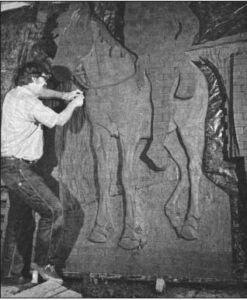
The figures are raised out from the wall the width of the brick from which they are made. They will be placed on a mural, 90 feet long and 12 feet high at the highest point. The mural will have nine human figures, three geese and two horses.
The first scene will be of a pioneer woman feeding three geese.
The second scene will be of a woman making cheese, which is much more traditional than churning butter according to Gordon Dingman, the artist who is creating the mural units.
The third scene will switch to the Indian culture, showing an Indian man on a horse looking past his own woman working by a campfire to a group of whites. The group of whites will make up the fourth scene.
The fourth scene will have two parts: a settler using a drag-line drawn by a horse, a common tool used in excavations of that era; and a woodcutter using a balanced one-man saw.
The mural will depict the settlers and Indians in peaceful co-existence, but the Indian on a horse will be looking beyond his way of life, beyond the settlers starting to change his land, almost as though he envisioned the conflict to come.
Some day that conflict, the Indian Uprising of 1862, will be depicted by a battle display to be erected at the end of the alley.
++
DINGMAN, professor of art at Southwest State College, Marshall, is working several days a week at Ochs Brick and Tile Co. in Springfield, forming unfired brick into the larger-than-life figures. He is assisted by his wife, Jill, the former Jill Marti of New Ulm, and another student.
The project is part of the developing Historic Trail which has been proposed for New Ulm. New Ulm Business Districts arranged the project.
The scenes use carved brick in an ancient art form which was used as long ago as 1590 B.C. by the Babylonians.
The black unfired brick is mounted in a wall and carved to give the figures their depth and dimension. Each brick is then removed and hand coded, then fired for about two weeks in a brickyard kiln; the firing will give the bricks their red color.
The bricks will be assembled in New Ulm and mounted according to the coded number.
About 400 hours of research preceded the actual work with preliminary drawings and carving. Carving began last April 6.
The Ochs Brick and Tile people have gone out of their way to get the right material, according to an NUBD official. New Ulm Public Utilities Commission has cooperated in changing light poles in the area of the alley where the mural is to be installed.
Richard Heymann and Clara Schonlau are co-chairman of the NUBD committee which arranged the project.
The cost of carving the brick, research and so on have been shared by NUBD and Southwest State College. A financing program for installation is still to be worked out. One method suggested would be for people to donate "a buck for a brick" until the installation is complete. Probably about $4,000 could be raised this way, one official said.
New Ulm Daily Journal,
June 10, 1973