
Grand unveils Living Legacy of Lace exhibit
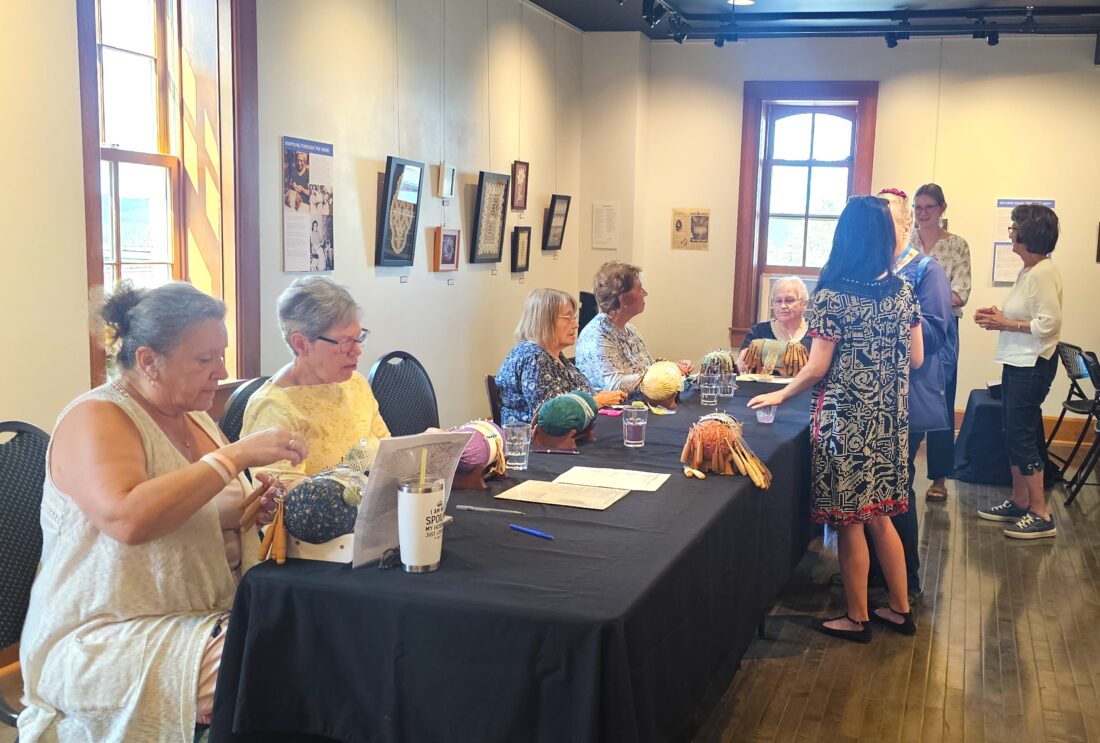
Local artisans and community members gather at the 4 Pillars Gallery to celebrate the opening of the knippling exhibit. (Photo by Amy Zents)
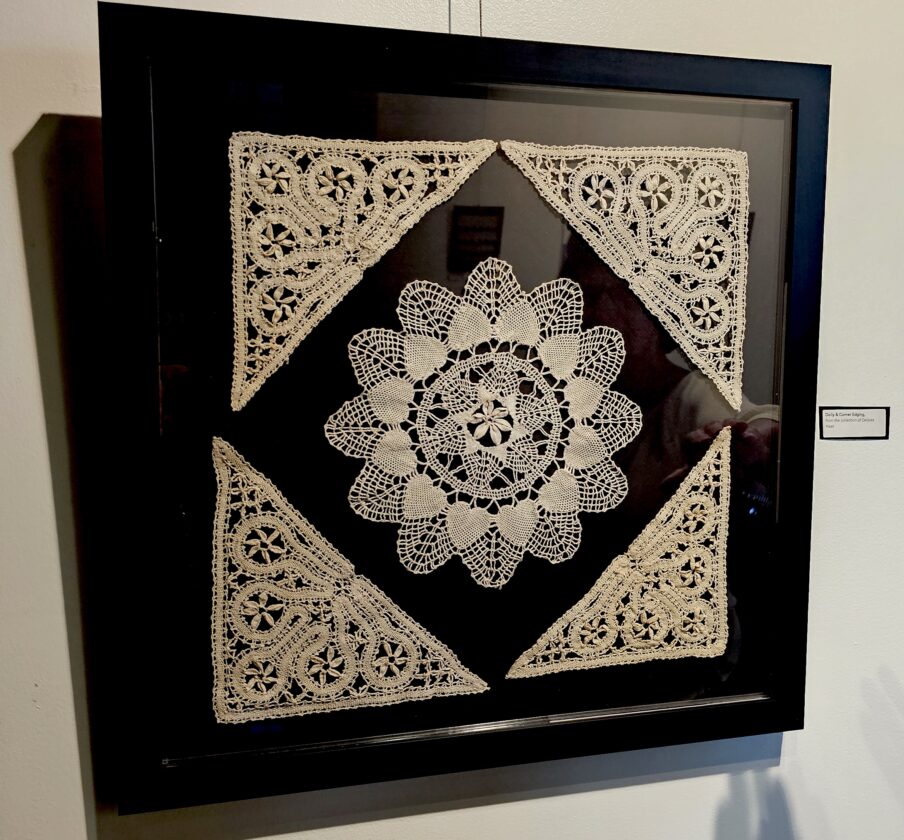
A display of intricate lace work, explaining that foundational patterns are built using four basic moves: the cloth stitch, the half stitch, the whole stitch, and the twist. (Photo by Amy Zents)
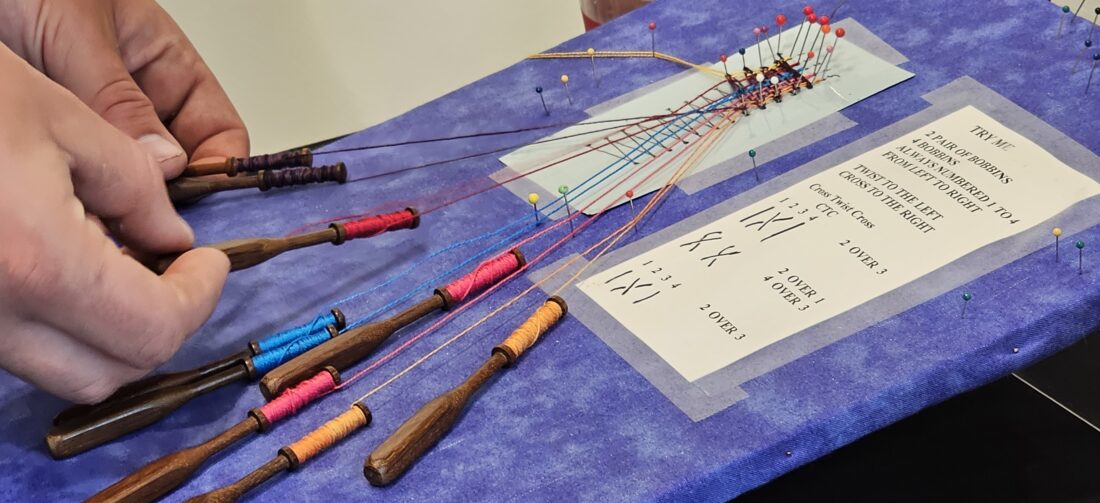
Visitors to the “A Living Legacy of Lace” exhibit have the opportunity to try their hand at bobbin lace-making using a "Try Me" demonstration pillow. (Photo by Amy Zents)
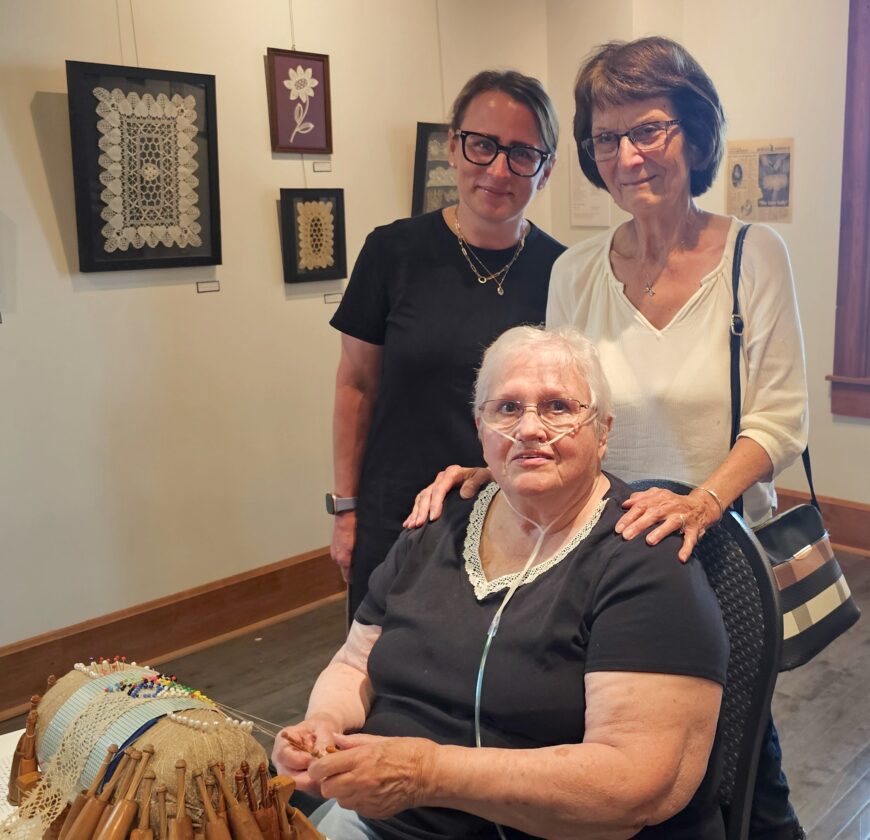
Mary Lou Bonnifield (seated) is pictured with Cathy Guggisberg (standing, left) and Carol Guggisberg (standing, right.) (Photo by Amy Zents)
Local artisans and community members gather at the 4 Pillars Gallery to celebrate the opening of the knippling exhibit. (Photo by Amy Zents)
A display of intricate lace work, explaining that foundational patterns are built using four basic moves: the cloth stitch, the half stitch, the whole stitch, and the twist. (Photo by Amy Zents)
Visitors to the “A Living Legacy of Lace” exhibit have the opportunity to try their hand at bobbin lace-making using a "Try Me" demonstration pillow. (Photo by Amy Zents)
Mary Lou Bonnifield (seated) is pictured with Cathy Guggisberg (standing, left) and Carol Guggisberg (standing, right.) (Photo by Amy Zents)
Trending
NEW ULM -- The 4 Pillars Gallery at The Grand Center for Arts and Culture opened the exhibit "A Living Legacy of Lace...The Tradition Continues" this past Friday.
The exhibit, which focuses on the history and practice of knippling, or bobbin lace-making, will be on display through Aug. 7.
The gallery displays approximately 30 historic and contemporary examples of the craft.
Featured contributors include Mary Lou Bonnifield, Ronda Flor, Carmen Reinhart Calbick, Marilyn Hesse, Karen Sellner, JoAnne Griebel, Maggie Bauer, and exhibit organizer Olivia Norquist.
Knippling was brought to New Ulm by immigrants from Bohemia in the mid-19th century.
Mary Lou Bonnifield, who has practiced the craft for 13 years, said she began after conducting genealogical research.
Bonnifield's ancestry traces back to Rindle, Bohemia, with her ancestors Johann and Barbara Koestner emigrating in 1873. The log house located at the Brown County Fairgrounds was the family’s original home.
Bonnifield is currently working to reproduce patterns from pieces she received from the estate of the late Marilyn Vogel.
"My goal was to reproduce those patterns and write up the directions for them, so that the next group of people could look at the pattern that I graphed out and then print out step-by-step directions for it," Bonnifield said.
Regarding the technical variety of the craft, she said there is specific terminology used to define the lace structures.
"There are four basic moves in knippling: the cloth stitch, the half stitch, the whole stitch, and the twist," Bonnifield said.
She said that these maneuvers are the building blocks for the intricate patterns displayed in the gallery.
The exhibit also features items inherited from the late Delores Haas, who taught the craft to more than 200 people.
The collection also includes several items on loan that were crafted in Germany.
Haas’s daughter Carol Guggisberg attended the opening with her daughter Cathy and her son Loren.
Loren shared memories of his grandmother's ability to perform the work, saying that Haas could handle the complex lace-making process without needing heavy concentration, as the movements were deeply ingrained and repetitive for her.
Carol observed the rarity of the practice during her own travels in Germany.
Opal Dewanz attended the reception and shared a detailed historical account of her neighbor, the historic lacemaker Mary Dauer (Zeug).
Recalling her childhood, Dewanz said, "I remember sitting on her lap; she was a very old lady, but she would let me sit there, and she would tell me how to move things around."
Dewanz said that Zeug suffered from significant shoulder pain, which made the traditional movements of knippling exceptionally difficult. To compensate, Zeug did not just rely on her hands; she had to move her entire body to perform the rhythmic, intricate maneuvers required.
JoAnne Griebel, a member of the local lacemaking group, is currently working on her first handkerchief pattern.
Describing the learning process, Griebel said, "At least I know when I mess up, I back it up and then step forward again, and back down again." For her, mastering the craft is a matter of trial and error.
Exhibit organizer Olivia Norquist said that the "Try Me" demonstration pillows were used by attendees during the reception, providing hands-on opportunities to see how the craft is performed.
Norquist said, "Reactions have been positive, and I’m happy to see people trying the ‘Try Me’ pillow and getting a feel for it."
The exhibit also features a prominent display titled "Knippling Through the Years," which highlights the craft’s local evolution.
This section chronicles the practice following a national surge in interest, showing how New Ulm and surrounding area community members continued to create bobbin lace and teach others.
The display documents how people supported the craft beyond the lace-making itself, including individuals who crafted the necessary bobbins and stands, such as Roman Zangl, Delmar Windhorn, and Walter Haas.
It features historical photographs, including a 1975 image by Flip Schulke of Francis Zeug (Mary Zeug’s daughter,) and records from the Sleepy Eye "Kloppel Sack Club," identifying members of the craft from the early 20th century.
The exhibit chronicles how the practice has transformed from a necessity of survival in 19th-century Bohemia to a hobby for contemporary artisans.
The gallery setup allows visitors to appreciate not just the finished products, but the meticulous preparation, from winding the bobbins to pricking the intricate paper patterns that dictate each weave.
Practitioners must carefully coordinate the movement of "worker" threads and "passenger" threads to maintain constant tension and ensure weave density.
The exhibit shows examples of these technical aspects, including the use of specialized techniques like picots and leaf tallies.
Norquist said, “The Knippling workshop scheduled for Aug. 1 is full with eight participants.”
Norquist is consulting with the instructor about potentially expanding the class to 10.
The local knippling group meets on Tuesdays at 1 p.m. at the New Ulm Public Library.
For those interested in learning the craft, the group encourages new members to attend and experience the process firsthand.
"A Living Legacy of Lace" is on display at the 4 Pillars Gallery, 210 N. Minnesota St. Gallery hours are Tuesday through Friday, 10 a.m. to 4 p.m., and Saturday, 11 a.m. to 4 p.m. For additional information, contact The Grand at 507-359-9222 or visit thegrandnewulm.org.