
‘A heart rooted in the Minneapolis sound’
Prince Legacy Project at MMHOF
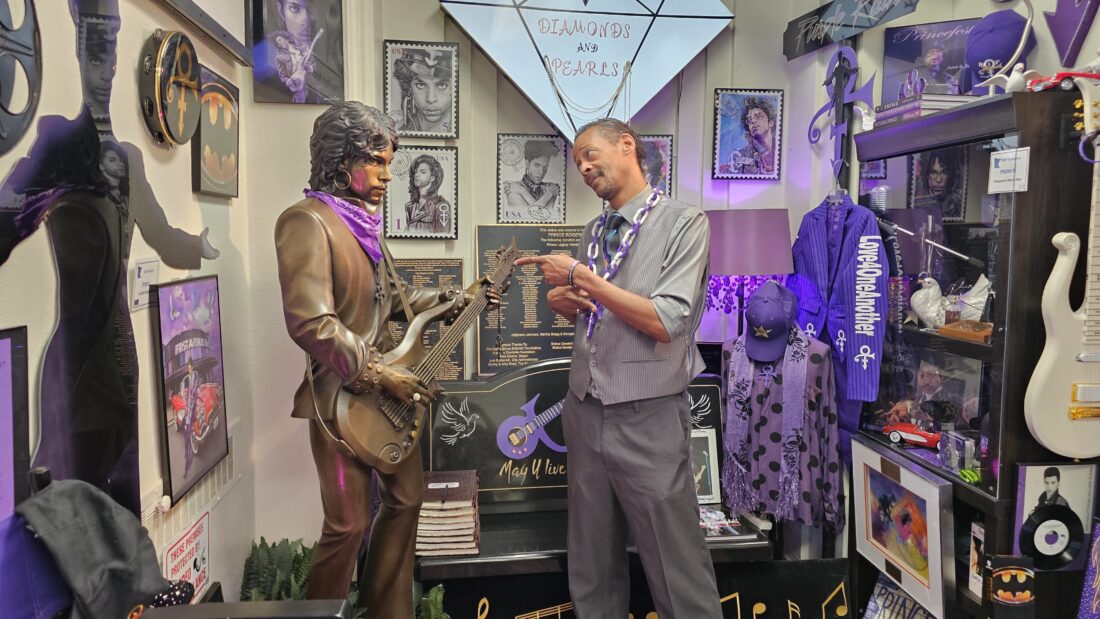
Minneapolis musician Jerome Newsom views an exhibit featuring a statue of Prince and other memorabilia related to his career at the Minnesota Music Hall of Fame. (Photo by Amy Zents)
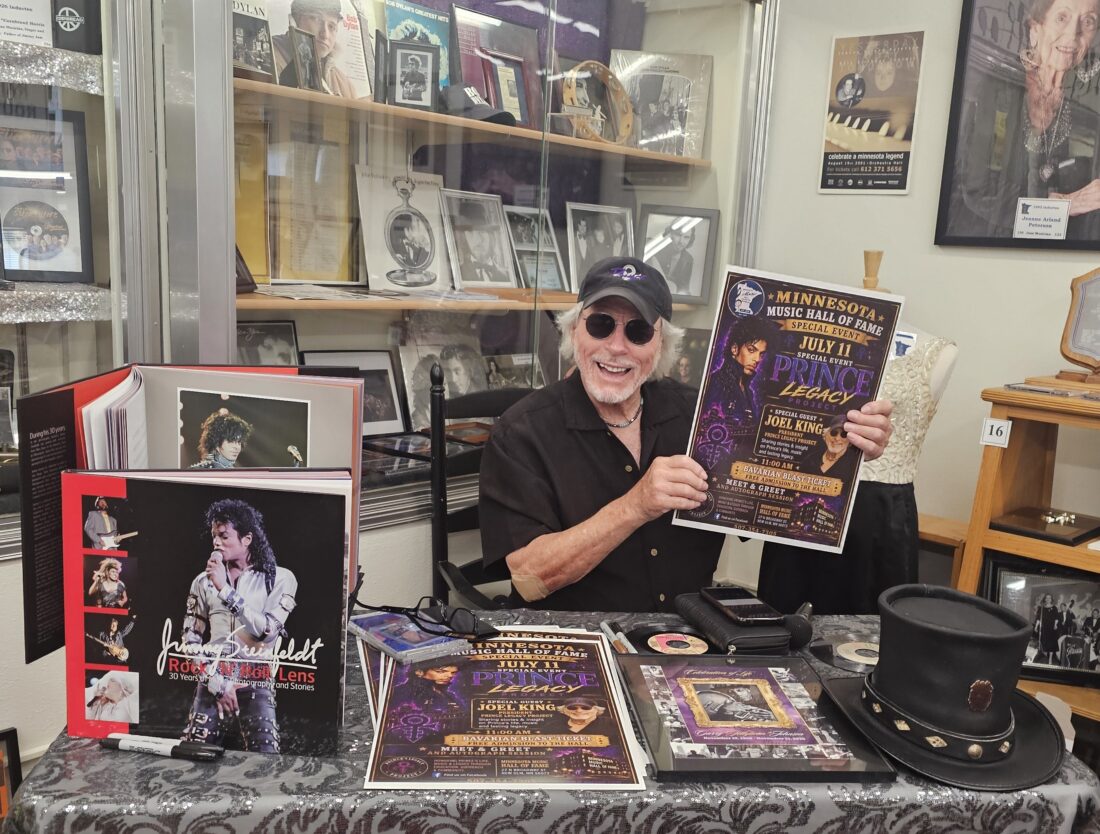
Joel King holds a promotional poster for the Prince Legacy event held at the Minnesota Music Hall of Fame. (Photo by Amy Zents)
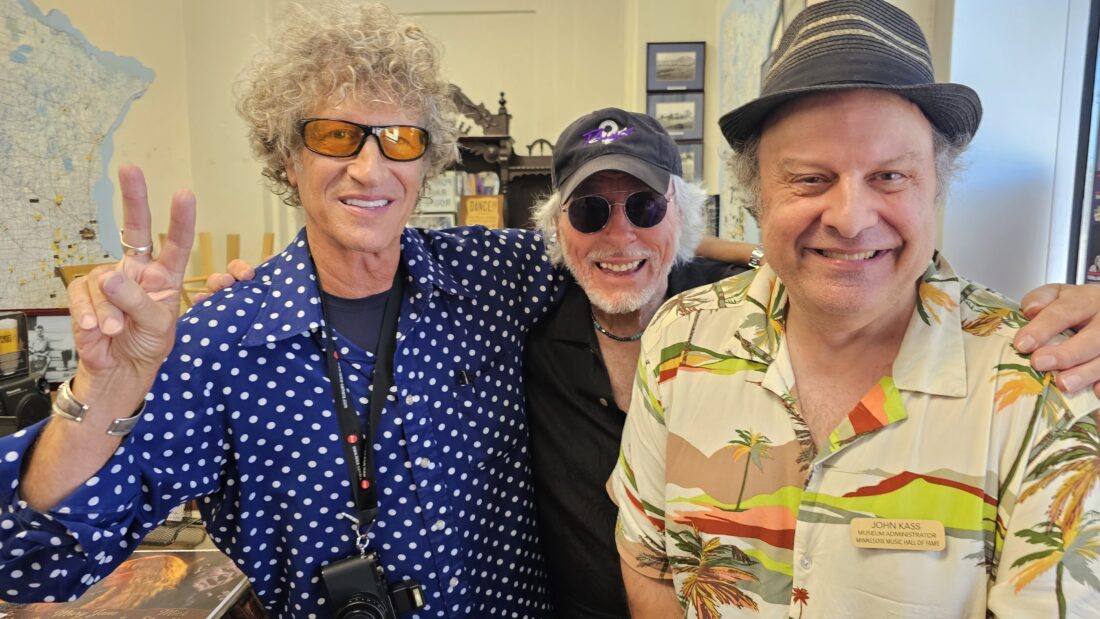
Photographer Jimmy Steinfeldt, cinematographer Joel King, and MMHOF volunteer John Kass pose for a photograph at the Minnesota Music Hall of Fame. (Photo by Amy Zents)
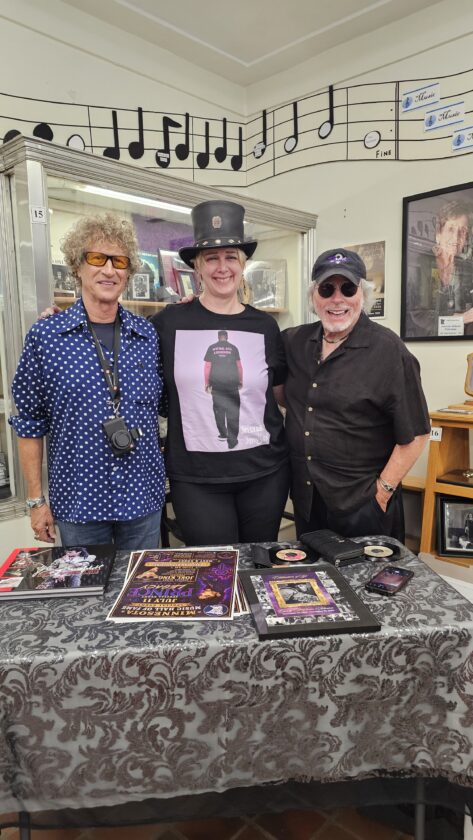
Jimmy Steinfeldt, Marty Bragg, and Joel King stand together at the Minnesota Music Hall of Fame during the Prince legacy event. (Photo by Amy Zents)
Minneapolis musician Jerome Newsom views an exhibit featuring a statue of Prince and other memorabilia related to his career at the Minnesota Music Hall of Fame. (Photo by Amy Zents)
Joel King holds a promotional poster for the Prince Legacy event held at the Minnesota Music Hall of Fame. (Photo by Amy Zents)
Photographer Jimmy Steinfeldt, cinematographer Joel King, and MMHOF volunteer John Kass pose for a photograph at the Minnesota Music Hall of Fame. (Photo by Amy Zents)
Jimmy Steinfeldt, Marty Bragg, and Joel King stand together at the Minnesota Music Hall of Fame during the Prince legacy event. (Photo by Amy Zents)
Trending
NEW ULM -- The Minnesota Music Hall of Fame hosted a program Saturday regarding the history and influence of Prince and the late percussionist and guitarist Jellybean Johnson.
At the center of the event was Joel King, president of the Prince Legacy Project and a veteran Hollywood cameraman.
King, a Lakeville, Minnesota native, now living in Henderson, Minnesota, provided a detailed account of his career, which began at 20th Century Fox.
Joel King's career spanned numerous film and television productions.
As a trainee, he worked on “Planet of the Apes,” “Batman” (starring Adam West,) “Green Hornet,” “Lost in Space,” and “Land of the Giants.”
As an assistant cameraman, his credits include Steven Spielberg's “Duel,” and “Ulzana’s Raid,” starring Burt Lancaster.
He also worked on the television series “McCloud” and “Columbo.”
Later, as a camera operator and cameraman, he worked on “The Family Holvak” (starring Glenn Ford and Julie Harris,) the hit movie “Carrie” (starring Sissy Spacek,), “MacArthur” (starring Gregory Peck,) “The Main Event” (starring Barbra Streisand and Ryan O’Neill,) “The Betsy,” (starring Tommy Lee Jones), and “Stuntman,”(starring Peter O’Toole.)
Additionally, King shot approximately 100 television commercials in the 1980s and worked on Prince's film, “Graffiti Bridge.”
King's primary focus remained on his multi-year professional association with Prince, specifically during the production of the 1990 film, “Graffiti Bridge.”
King detailed the standards Prince required on set.
"Prince was the most disciplined director I ever worked with," King said.
He described Prince as an active manager of his production environments, frequently monitoring the well-being of his crew.
"He knew every light, every shadow, and every person in the room," King said. "His attention to detail was unparalleled."
Regarding Prince's focus on the sobriety of those he employed, King observed that Prince played a significant role in his recovery. King had been struggling with drug and alcohol dependency and had attended treatment, yet Prince hired him after his producer, Peter McDonald, received a recommendation from Barbra Streisand.
When Peter McDonald asked Streisand about King, she confirmed he was clean.
Prince regularly checked on King’s well-being with a simple, grounded inquiry: "Joel, how are doing today?”
King recounted an incident on the set of “Graffiti Bridge,” where he fell from a stage, landing in a shallow trough filled with water and broken mirrors.
"I was lying there, and the first voice I heard was Prince’s," King said.
When King remarked, "Sobriety is hell," Prince paused.
"He told me later, 'I'm using that line,'" King recalled.
King emphasized the collaborative nature of the set, stating, "Every day was a lesson in how to be a professional."
The legacy of percussionist Jellybean Johnson was also a focal point.
Martha “Marty” Bragg, Johnson's longtime partner, presented a leather top hat belonging to Johnson to the museum.
Bragg provided context regarding Johnson's decision to remain in Minnesota despite opportunities to relocate.
"He could have moved anywhere, but he chose to stay," Bragg said. "His heart was rooted in the Minneapolis sound. Gary lived for this community."
Bragg said that Johnson's priority was the cultivation of the local musical ecosystem. "He gave away more music than most people ever sell," Bragg said. "He wanted to see the next generation rise. He was the rhythm behind so many of the songs we love."
Jellybean Johnson’s real name was Gary George Johnson.
Johnson was a musician and producer known for his working extensively with Prince.
As a founding member of The Time, he play drums along with musicians, Morris Day and Jimmy Jam.
Johnson toured with Prince starting in 1981, appeared as a member of a rival band in the “Purple Rain,” movie, and played on various projects, including in the film, “Graffiti Bridge.”
A long-time collaborator in the Minneapolis music scene, he worked closely with Prince-affiliated acts like The Family and provided percussion and guitar support throughout his career.
The local impact was further addressed by Jerome Newsom, a musician with the house band at Bunkers Bar in Minneapolis called, Chase & Ovation.
Newsom provided a perspective on the North Minneapolis music scene, his early exposure to the industry within his father's nightclub.
"I saw the greats come through our doors every night," Newsom said. "They weren’t just icons, they were mentors."
Newsom said that the environment was characterized by constant collaboration.
"You learned by doing, not by watching from afar," Newson said.
He emphasized that artists like Johnson prioritized the transfer of the craft, and musical knowledge.
"Jellybean taught us that music is a gift, not just a career," Newsom said. "He made sure we knew the history we were standing on."
Newsom added, "He was the definition of local loyalty."
Visual documentation of the Prince era was provided by Jimmy Steinfeldt, a successful rock ‘n roll photojournalist from Hopkins, Minnesota.
Steinfeldt, who photographed Prince for fourteen years, discussed the technical requirements of capturing live performances.
"To photograph Prince was to photograph lightning," Steinfeldt said. "You had to be ready for the unexpected."
Steinfeldt recalled his process for becoming Prince’s photographer starting in the early 1980s.
"I called them in the days when you could pick up a phone and call a management company," Steinfeldt said. "A human would answer, and they said, 'Yeah, send some pictures.'"
Steinfeldt referenced his specific contributions to recent collections, including an image taken at Bunkers.
"This is their first picture at Bunkers," Steinfeldt said. "The last time I photographed Prince was at the Hollywood Bowl when I moved to California."
Artist Neal Bond contributed custom-designed posters to the exhibit. King chose to autograph them for attendees at no cost.
King acknowledged the reason he donated so much time, effort and expense into establishing the largest exhibit at the MMHOF featuring Prince.
"I started this Prince memorial to give back to Prince because of what he gave me, you know, sobriety.”
July 16, the Hall of Fame music series continues with a salute to 2024 inductee Pamela McNeill.
Detailed information regarding current collections and upcoming events is available at mmhof.com.