
A ‘Close and Distant Reading’ at The Grand
New art exhibit from artist Luke Johnson
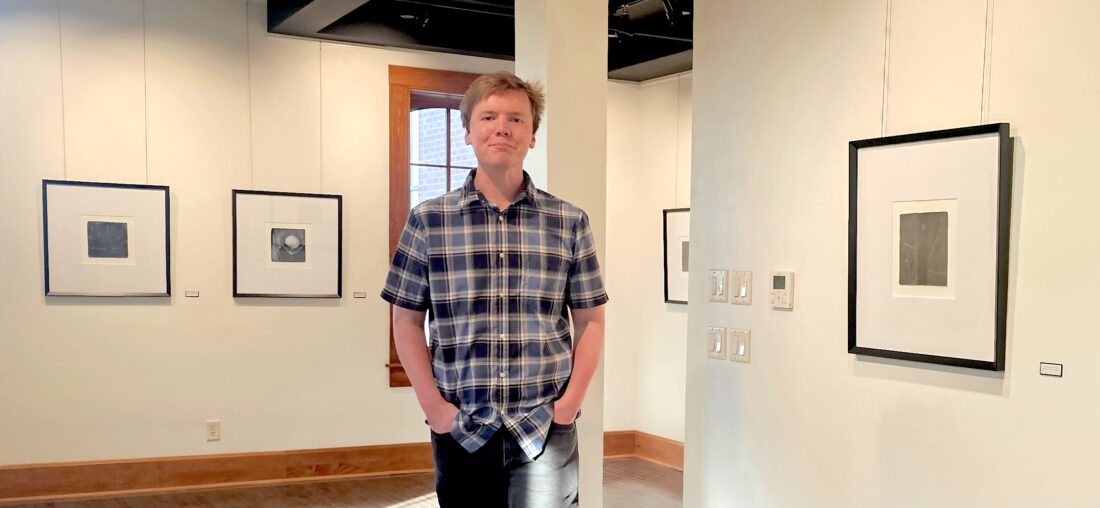
Luke Johnson stands in the 4 Pillars Gallery during the opening of his exhibition “Close and Distant Reading” at The Grand Center for Arts & Culture in New Ulm. (Photo by Amy Zents)
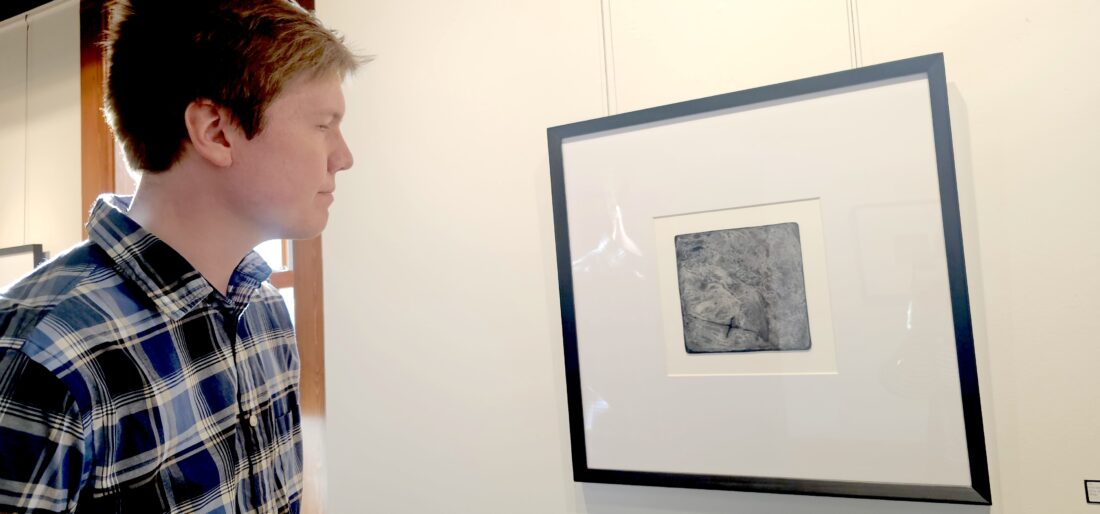
Johnson examines one of his own works, which blend enlarged photographic prints of lead type with hand-drawn elements using crayons, ink, acrylic and floor wax. (Photo by Amy Zents)
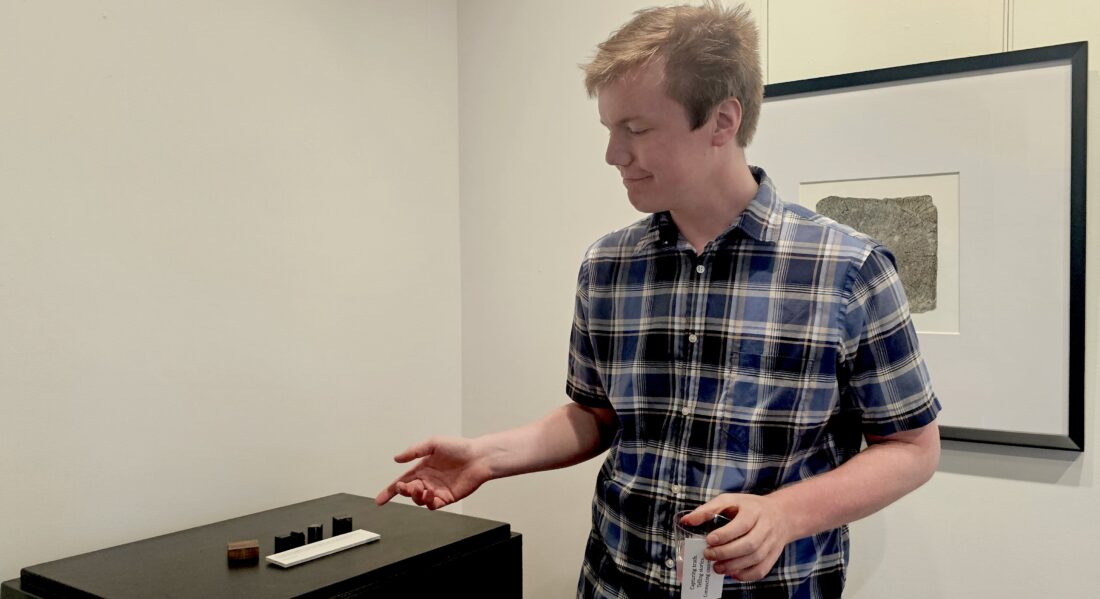
Johnson explains the small lead spacing blocks (em quads) that he photographed and enlarged into the large-scale works featured in “Close and Distant Reading.” (Photo by Amy Zents)
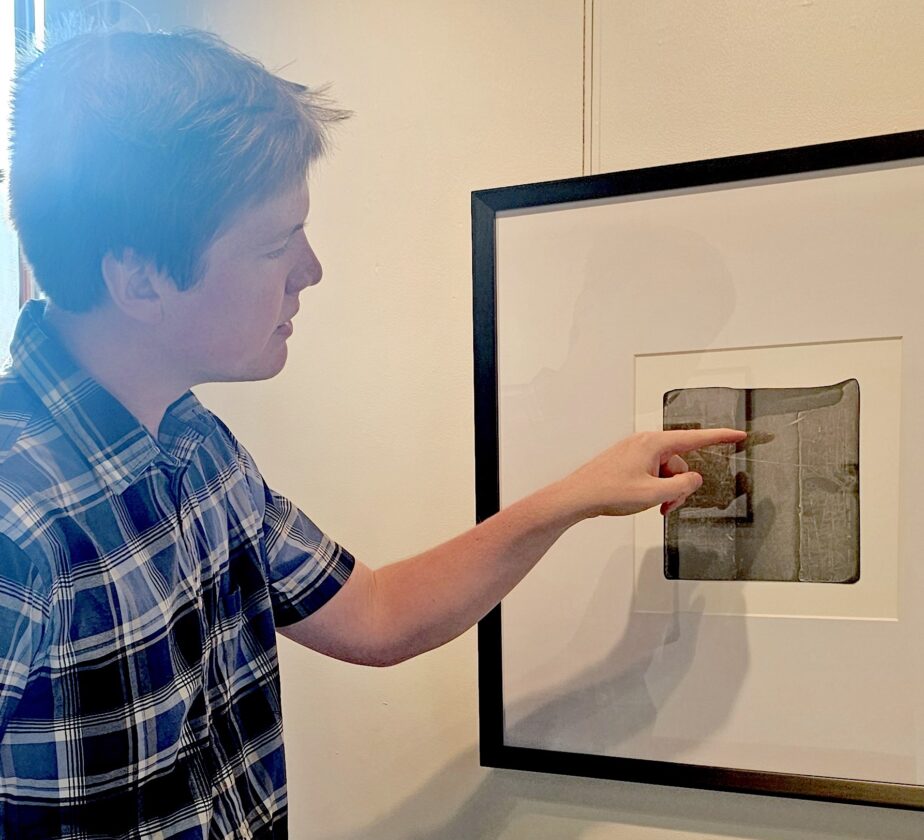
Johnson points out scratches, stains and other marks of decades of use on one of his prints inspired by lead type spacing tools. (Photo by Amy Zents)
Luke Johnson stands in the 4 Pillars Gallery during the opening of his exhibition “Close and Distant Reading” at The Grand Center for Arts & Culture in New Ulm. (Photo by Amy Zents)
Johnson examines one of his own works, which blend enlarged photographic prints of lead type with hand-drawn elements using crayons, ink, acrylic and floor wax. (Photo by Amy Zents)
Johnson explains the small lead spacing blocks (em quads) that he photographed and enlarged into the large-scale works featured in “Close and Distant Reading.” (Photo by Amy Zents)
Johnson points out scratches, stains and other marks of decades of use on one of his prints inspired by lead type spacing tools. (Photo by Amy Zents)
Trending
NEW ULM -- Artist Luke Johnson opened his solo exhibition, "Close and Distant Reading," Friday at the 4 Pillars Gallery in The Grand Center for Arts & Culture.
The show, featuring 15 prints and drawings inspired by lead type spacing tools from the building's Cellar Press, runs through July 3.
Johnson, a St. Paul native, has transformed humble lead spacing tools used in letterpress printing into large-scale works of art. His practice explores how objects embody, or fail to embody, their own history.
Using photographic printmaking, he first captures the marks left by time on these objects. He then layers them with drawing, blurring the boundary between the camera's mechanical record and the artist's hand.
The resulting pieces pose visual questions about the meaning and traceability of marks left behind over decades.
Many works began as photographs of lead spacing blocks, known as "em quads." Johnson enlarged them dramatically, revealing scratches, stains, dents and crushed edges from lifetimes spent between and around words.
"All the work on the show is taking an original photograph of those pieces of lead and enlarging it so you can see all the little marks," Johnson said. "They've been between and around so many words in their lifetimes, so they get scratched, and they get stained. They get dropped on the floor, and the top gets crushed, so they change shapes. Every little lead piece has a story."
He builds on these photographic foundations with hand-drawn elements using crayons, ink, acrylic and even floor wax. From a distance, the works can read as straight photographs; up close, the drawn lines emerge.
The exhibition title references two modes of seeing. "Close reading" echoes the attention required when setting type by hand, where errors must be caught before they go to press, because "once it publishes your errors are out there," Johnson said.
Distant reading, by contrast, offers a broader historical perspective that can shift understanding over time.
This duality reflects Johnson's work as both artist and self-described historian. In what he calls an "inventory of precarity." Johnson said his pieces preserve traces that might otherwise vanish in what he calls a "throwaway society."
He said his interest in tangible objects may stem in part from his mother, a sculptor.
He also cites books such as Edmund de Waal's "The Hare with the Amber Eyes," which traces a collection of figurines through a family's history, including their survival of the Holocaust.
Mistakes are integral to his process. One piece in the "Admission of Structure" series started as a Xerox or silkscreen print he deemed a failure.
"Some of them get away from me and I go, 'Okay. Put it down for tonight,'" he said. The solution? "OK, pour some floor wax on top and see what happens. This cloudy texture never would have existed except for the layer underneath failing."
The exhibition marks a homecoming for Johnson. After earning a BFA from the University of Wisconsin-Madison and an MFA from the University of Alberta, he lived in Alberta for seven years before moving to Waterville, Maine, where he is a visiting assistant professor at Colby College.
"Minnesota's home, and so it's nice to bring [the work here]," he said. "I haven't shown this much work in Minnesota before. It's also really special to be in a building where printmaking is happening. These are real things, and they're in use. You can go downstairs to Cellar Press and do it yourself."
Beyond the studio, Johnson curates exhibitions, writes catalogue essays and leads community workshops. His work has been exhibited across North America and internationally and earned him a nomination for the Queen Sonja Print Award. It is held in public collections, including the DeWitt Wallace Special Collections at Macalester College.
Johnson's art elevates utilitarian objects, highlighting production flaws and signs of wear to spark dialogue between technical precision and lived history.
4 Pillars Gallery is open 10 a.m. to 4 p.m. Tuesday through Friday and 11 a.m. to 4 p.m. Saturday. For more information, call The Grand Center for Arts & Culture at 507-359-9222 or visit thegrandnewulm.org. Johnson's work can also be viewed at lukejohnsonart.com.