
Fun on the farm
Trending
NEW ULM -- Hundreds of people of all ages got a slice of working farm life at the Steve and Kerry Hoffman farm Thursday.
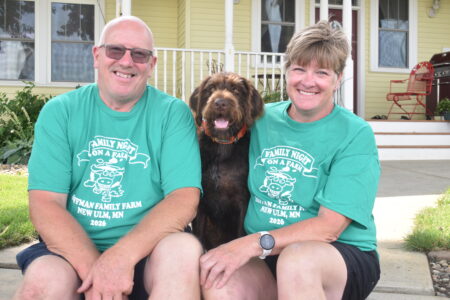
Sponsored by the Farm-City Hub Club, Family Night on a Farm was nothing new to the Hoffmans. They have hosted the event many times since it began in 2007.
The free event includes farm tours, hayrides, milking demonstrations, animal petting and other kid's activities, photos with dairy princesses, educational exhibits and displays, picnic meal, goodie bags, dairy treats including 1919 Root Beer floats, and a chance to meet a veterinarian and other agriculture specialists.
"I think this is our ninth time hosting Family Night on a Farm," said Steve Hoffman. "We host this event to give urban/city people a chance to get out on a farm."
He began milking 40 cows in a stanchion barn in 1986. A compost barn and herd expansion took place in 2004. The farm's original barn was remodeled and a new milking parlor was built in 2005.
The Hoffman's son Joe joined their farm operation in 2019.
Two years ago, he left the dairy business and began raising beef animals including mostly Angus cows instead of Holsteins for milking.
"I still remember when the last truck with our Holsteins pulled out of driveway," said Hoffman. "The farm place seemed strange for a while without the mooing."
They still live on their farm and don't plan to leave any time soon. Last year, he became an independent insurance agent and his wife Kerry began a dog boarding business.
Steve Hoffman compared Holstein and Angus cows.
"Feeding beef breed cows is way different than it is for dairy cows," he said. "Beef cows don't require nearly as many nutritional goodies that dairy cows do. They aren't as domesticated as our dairy cows, which we worked with so closely, milking, feeding and breeding them every day. They were very gentle and calm. Beef cows are not so much. They have more ambition. Dairy cows are a lot of work every day. Beef cows are a little bit of work every day."
Steve Hoffman said he sells cow calves when they are 8 or 9 months old.
The Hoffman's son Russel and his wife Rebekah feed 350-400 steers per year near Elkton, South Dakota, not far from the Minnesota state line. They buy and feed the calves after Steve and Kerry Hoffman raise them. The Hoffman's son Joe operated a 40-head beef cow/calf operation.
Agriculture knowledge nuggets posted at the event read that the average dairy cow gives enough milk in her life to make 9,000 gallons of ice cream. Corn is used to feed cows, pigs, chickens, other animals and is used in many products including soda, candy, baby food, cereal, ice cream, instant coffee and gasoline.
Oats are used in cereal, oatmeal and cattle feed. Oat plant stems are baled into straw and used for animal bedding.
Soybeans are used in animal feed, ink, paint, crayons, pizza crusts and salad dressing.
The University of Minnesota Forever Green Initiative promotes kernza, a perennial grain and distant relative of wheat helps farmers decrease field planting time with roots, stems and leaves that protect soil year around with roots that can grow longer than 10 feet, improve water quality and soil health, reduce erosion, increase soybean yield when it is planted in the same field and keep carbon dioxide out of the atmosphere.
Winter camelina can be planted in the fall after harvesting wheat, oats or soybeans. Winter camelina seed oil is used in cooking oil, sustainable aviation fuel and in feed for livestock and pets.
New Ulm Farm-City Hub Club Family Night on a Farm Committee member Michelle Schroeder said Family Night on a Farm continues to grow every time is occurs.
"We send out event flyers to day care businesses, inviting them to come because this is the perfect place for young children to come," she said. "We also invite group homes and promote it on Facebook, on radio and in newspapers. It's a great, hands-on opportunity to learn about agriculture."