
Spinnin’ wheel, spinnin’ true
Making yarn from wool requires skill, touch of knowledge — and practice
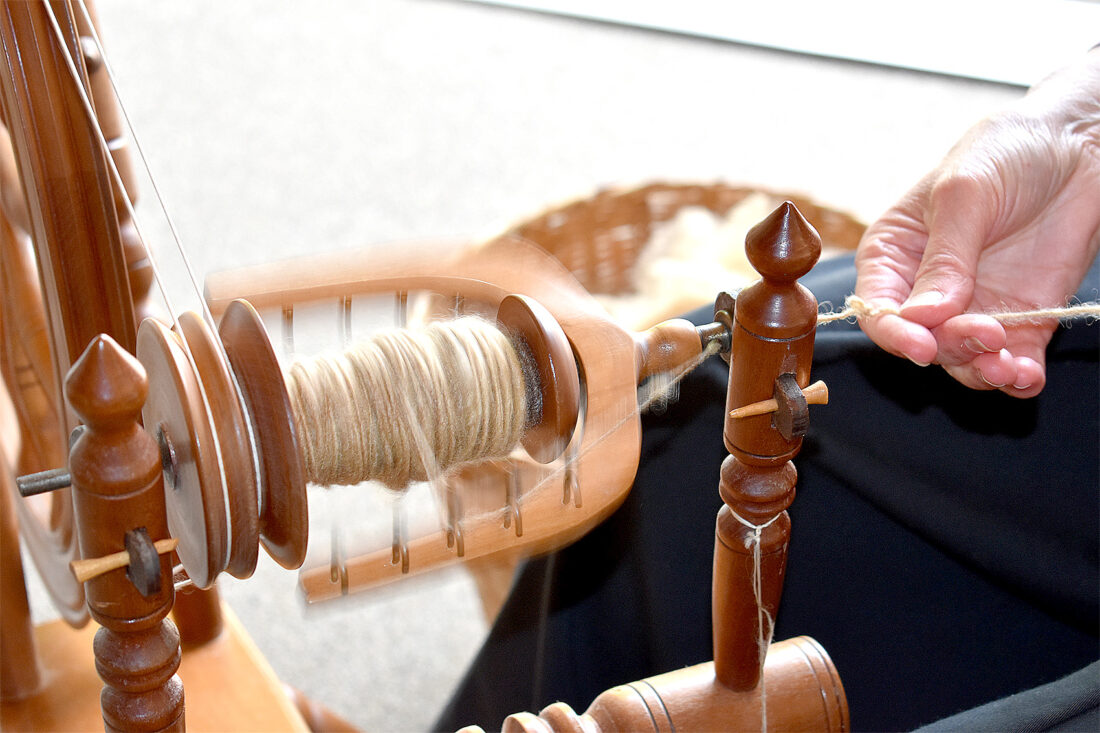
Staff photo by Clay Schult High-speed spinning of raw wool fibers bonds them together into yarn, as JoAnn demonstrated Saturday at the Kiesling House.

Staff photo by Clay Schult JoAnn Huss demonstrates how to use a spinning wheel during a special summer historical programming event at the Kiesling House.
Staff photo by Clay Schult High-speed spinning of raw wool fibers bonds them together into yarn, as JoAnn demonstrated Saturday at the Kiesling House.
Staff photo by Clay Schult JoAnn Huss demonstrates how to use a spinning wheel during a special summer historical programming event at the Kiesling House.
Trending
NEW ULM-- JoAnn Huss returned to the Kiesling House on Saturday to give a spinning wheel demonstration.
Since the Kiesling House began hosting summer historical programming, a visit from Huss and her spinning wheel has been an annual tradition.
The purpose of the spinning wheel was to to create usable yarn from raw sheep wool. Huss took visitors through the steps, starting with raw wool. First she took the wool and combed it with two hand carders. Combed fibers are cleaner and stronger, which is needed for spinning starts.
Once the wool is combed, she rolls the cleaned fiber off the hand card. The direction she rolls the fiber off the hand card will determine if the yard produced is worsted or wollen.
The fibers are than combined into a rope. Wool fibers connect easily. Huss explained that on a microscopic level, wool is made of little barbs that hold it together. By putting the fiber through a spinning wheel the fabric twists together creating a yarn that could be used for knitting, weaving or crocheting.
Huss uses a spinning wheel that was made in 1983 by Tony Steinbach. Huss said she saw Steinbach spinning yarn at Heritagefest and she asked him to make her a wheel and he produced a Saxony Wheel. This style of wheel was created around 1533 in Brunswick, Germany.
The Saxony Wheel is powered by a foot treadle. One of the greatest challenges of spinning wool on wheel is getting the correct rhythm. Huss said in order to keep the wheel going, the user must continue to pump the the treadle for every rotation. If the user pumps too early or too late, the wheel could stop.
At the same time the wool fiber must be guided into the wheel. The user must use their hands and foot at the same time and keep movement synchronized.
Huss said it takes considerable practice. Today, wool spinning has become industrialized. Motorized spinning wheels have made it easier to mass produced spun fibers, but there are many like Huss who do things the old-fashioned way.
The Kiesling House is open noon-4 p.m. Friday and Saturday.