Crisis management
Community, school, business, teamwork needed to address day care shortage
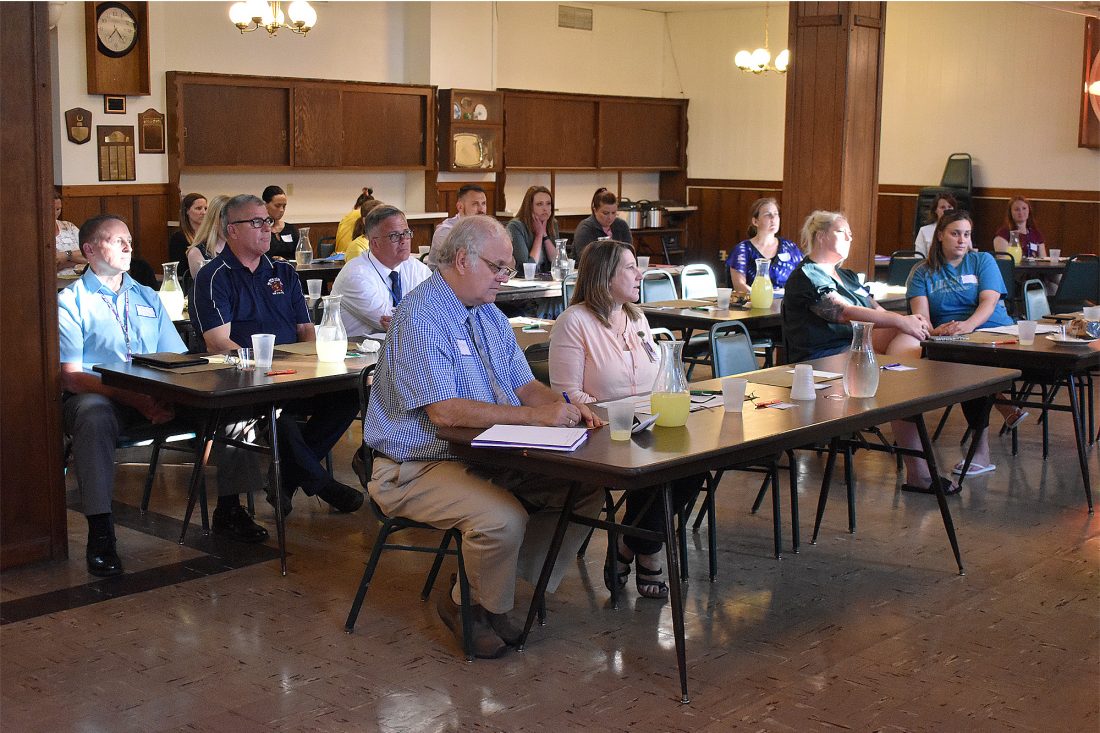
Staff photo by Clay Schuldt Dozens of parents and leaders of the community attended Tuesday's child care town hall, reflecting the gravity of the issue at hand. Seated at the front table are New Ulm Mayor Terry Sveine, and Betty Uehling, director of Early Childhood and Family Education. Seated at the table behind them are from left New Ulm Schools Superintendent Jeff Bertrang, Fire Chief Paul Macho and Police Chief and County Board member David Borchert of New Ulm.
NEW ULM — While critical shortages of child day care threaten rural economies, officials from the local Rural Child Care Innovation program offered goals and strategies to address the issue during a Tuesday town hall meeting.
After members from the First Children’s Finance organization presented current statistics, members of the RCCI teams offered six community goals for alleviating the childcare crisis:
Expand and strengthen current child care centers:
Instead of just looking to recruit new providers, Brown County day care provider Lisa Schmitz said retaining home day care providers should be considered as well. She said the news of a day care center coming to Sleepy Eye caused four of the youngest family providers in the community to quit.
Explore using vacant buildings for the pod model of day care:
The pod model is a new licensing option allowing four family-licensed providers to share the same space.
Heather Bregel, a member of the Rural Child Care Initiative team, said city staff is looking into a building to host a pod model. The building could allow four-family providers to run day care outside of the home. There is also an option of hosting a capital campaign for the community to donate to renovate this building for the pod model.
Offer grants and programming through the New Ulm Economic Development Authority:
The EDA has already started initiatives, including substitution programs and free day care training programs.
The EDA offers small business grants, which child care providers are eligible to receive. One new provider received a $10,000 grant to start the business within the first year. At least one other provider is on the waiting list to receive another $10,000 grant. However, only for businesses within New Ulm city limits are eligible for those grants.
Schmitz supported this goal. She believed $10,000 grants offered to the new child care programs were a great idea for bringing in younger providers.
Schmitz said she hoped other communities would offer this solution and suggested grants for existing providers would be helpful.
Expand the child care workforce:
This could be done by using Martin Luther College students and expanding the room at Early Childhood Learning Center.
Add a toddler program at Washington Learning Center:
District 88 Superintendent Jeff Bertrang said the school is researching the feasibility of the center’s building supporting a toddler program, and what funding would be needed to make that work. He said the greatest challenge will be staffing.
MLC students are already helping staff the Kid Connection program. Another challenge is making it cost-neutral to the district while providing a service to the community.
Explore community partnerships:
Such partnerships with local businesses or churches would provide child care those partners’ locations. The team has already reached out to area business churches. Space is available and businesses are willing to offer it. Although none of those potential partners were able to operate the child care service, they expressed willingness to allow outside providers to run the business on their sites.
Rural Child Care Innovation is an ongoing initiative. First Children’s Finance has a complete summary of New Ulm’s Community Solution Action Plan for Child Care on its website at ruralchildcare.org. The public is encouraged to view and share the action plan.
Local News

Groe brings decades of cartoons, caricatures to 4 Pillars gallery

Oak Hills fundraiser in race for new resident bus

Rock hunter says artifacts are closer than you may think
Brown Co. board balks at allowing public comments
NEW ULM — Brown County Commissioners suspended Roberts Rules of Order during their May 5 meeting to hear ...
Gibbon man faces two felonies
GIBBON — A 42-year-old Gibbon man faces two felonies after authorities found a Schedule IV controlled substance ...