Seminar talks about sifting facts from opinion in the news
Series can be seen on YouTube
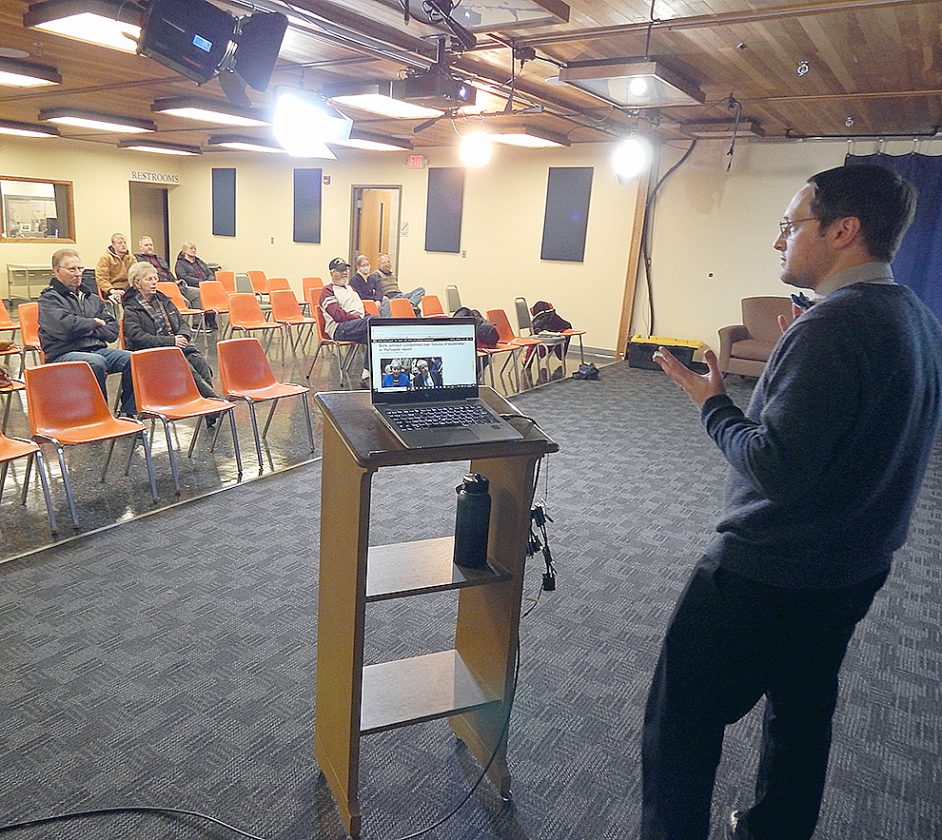
Seminar talks about sifting facts from opinion in the news
NEW ULM — New Ulm Public Library Programming & Technology Service Librarian LeRoy Harris presented his fifth and final seminar on evaluating the news in the library meeting room Thursday.
Harris talked about how to sift out facts to make informed decisions, how to recognize bias and opinion, and how to determine the motives of a story or publication.
In addition, he presented an in-depth analysis of news media companies, fact checking, click bait, fake news, misinformation and bias.
Harris said news literacy includes the knowledge and skills to identify, analyze, evaluate, and decide for yourself the nature, intent, and consequences of news.
He talked about the need to examine your own emotional responses, recognizing evaluating thoughts, confirmation bias, assumptions and perspective blinders, prejudices and opinions.
In separating fact from opinion, Harris talked about remembering that facts have context.
Harris said readers should question intent.
He presented stories geared to inform and others intended to entertain or persuade by using sensationalism.
“Verify information,” Harris said. “Look for other articles by the same author and how they compare in subject matter, style, tone and intent.”
He told attendees to look for other perspectives on the same topic, how they differ and why.
Harris talked about looking for what is missing, if something is taken out of context or omitting a key piece of information.
He talked about deepfakes — artificial intelligence-based human image synthesis techniques in which a person in an existing image or video is replaced with someone else’s likeness. Techniques include manipulating or generating visual and audio content with great potential to deceive.
“This is the scariest thing. It can made you question reality. Made by a computer, it can make it look like a person like a celebrity or politician said or did something when in fact they didn’t,” said Harris.
“Splicing is a technique in which parts of two different videos are put together to look like they are one,” Harris said. “It can look like one, continuous scene when they are really two scenes put together.”
Harris said there are places you can go to learn skills to combat “deepfakes,” he said. “The Washington Post has some pretty good tools that allow you to practice spotting them.”
In addition, he presented a variety of news stories on a variety of subjects. He praised some news stories for being straightforward, telling what happened.
Harris said to watch for “charged language” in stories and social media that may present biased, emotional phrases and words.
Library seminars can be viewed on YouTube. Visit https://www.youtube.com/watch?v=6tuQv5Rw6Nw. Visit the library Facebook page at https://www.facebook.com/newulmlibrary/
Local News
Teamwork makes the dream work

Fun on the farm
Wage settlements, health costs rise for Greater MN cities
Nilson files for District 88 school board
NEW ULM – A third candidate has filed for New Ulm School Board, Tara Nilson officially filed her affidavit of ...

The Crazier, the better