
The real McCoy on display
Smallest Museum exhibits opens season with McCoy planter collection
Trending
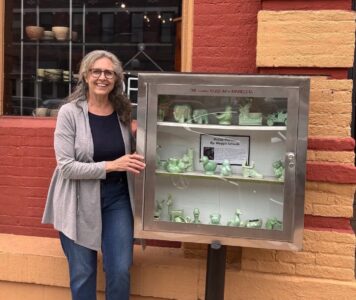
NEW ULM -- The Smallest Museum in Minnesota, a compact glass display case on the sidewalk outside The Grand Center for Arts & Culture at 210 North Minnesota Street, is open for the season.
It now features vintage McCoy planters from a collection owned by local artist Maggie Schwab.
The call went out at a recent board meeting seeking collections for the museum to restart the outdoor season after its winter pause and to build community interest. Schwab, a longtime board member, volunteered immediately.
"They asked, 'Who's got a collection?' and I said, 'Well, I got planters,'" she said.
The display case includes two McCoy elephants, a bird, a vintage car, several ducks, a deer, and other small animal figures.
Schwab's full collection numbers three or four dozen pieces, gathered over 45 years.
"Forty-five years ago I started going to antique stores and rummage sales, and I just took a liking to them," she says.
She also owns larger pieces not on display this time, including a clown and two other favorites.
"I have two where there's a donkey pulling a cart, and one's a goose pulling a cart," Schwab said.
At home, she uses the smaller planters for baby plants.
"I have little plants until they get too big," she explains."They just remind me of simple beauty."
The planters are authentic Nelson McCoy Pottery from Roseville, Ohio.
The Nelson McCoy Sanitary and Stoneware Company was founded in 1910. It began with practical stoneware crocks and jars made from local clay.
By the 1930s, the company had shifted to decorative art pottery: vases, jardinieres, cookie jars, and novelty animal planters.
Schwab's pieces feature the company's signature glossy green glaze (yellow, pink, and turquoise versions were also produced).
The fine network of cracks in the glaze, called crazing, and the orange color sometimes visible on the base are typical of authentic older McCoy pieces and are prized by collectors.
Schwab is a self-taught watercolor artist who also does caning and seat weaving on antique furniture. She paints everyday subjects from her backyard or around town.
The Smallest Museum rotates exhibits every month or two throughout the summer. Previous displays have included art glass, beer steins, rocks, tiny oil paintings, feathers, and political buttons.
Submissions for consideration should be resistant to heat and strong sunlight, as the late afternoon summer sun can heat up the mobile museum.
"It was just to get it kicked off for the season again," she says, "and now other people's minds [are] going, 'Oh yeah, I've got something I could put in there.'"
Schwab believes her collection will get people tot think about their family collections.
"I think when people look in there, they'll think, 'yeah. My grandma had something on the windowsill.'"
This is the first time Schwab has shown her collection publicly.
"People should come and enjoy it," she says. "Come and see what's going on inside the Grand. There are a lot of activities. Check our website.”
The display is open 24/7 and free to the public. If you have a unique collection and would like to be considered for a future display, contact Olivia Norquist at The Grand.