
‘With malice toward none’
Historian David Jones breaks down the Lincoln assasination
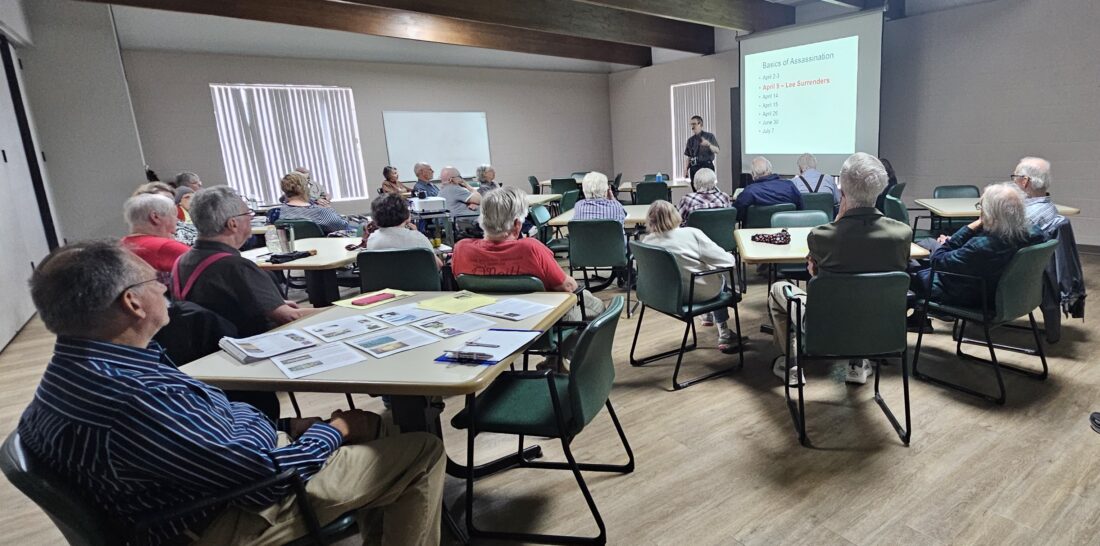
A full house listens as David Jones presents "The Lincoln Assassination: A Fragile Time" on Thursday at the CAST Senior Center in New Ulm. Photo by Amy Zents
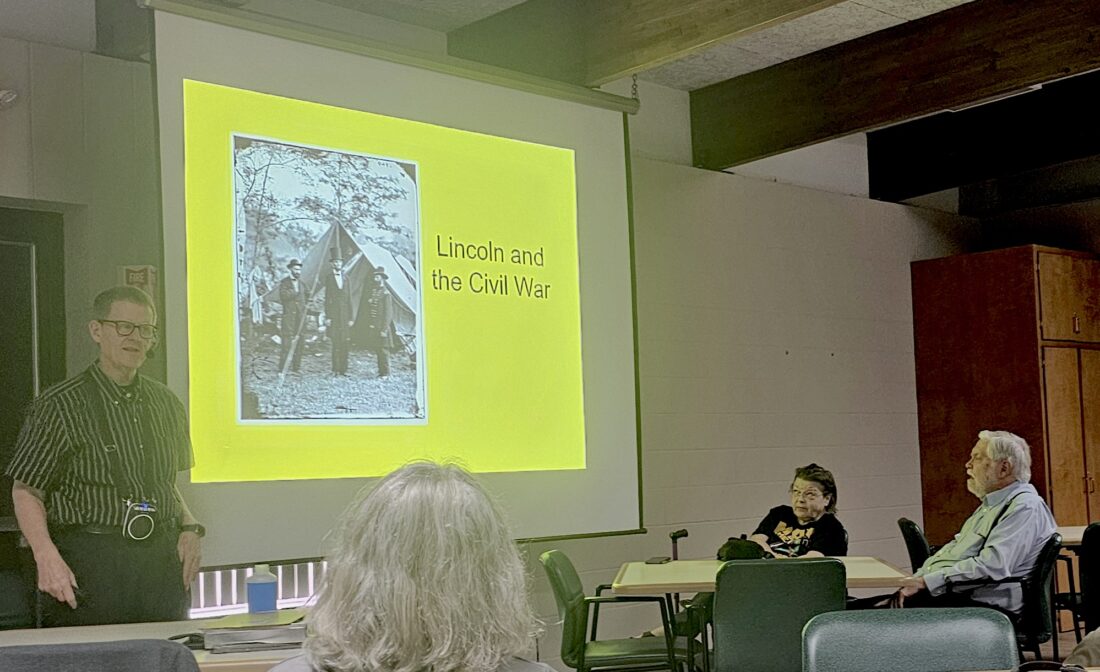
Lincoln and the Civil War — forever linked. David Jones explores that connection last Thursday at the CAST Senior Center in New Ulm.
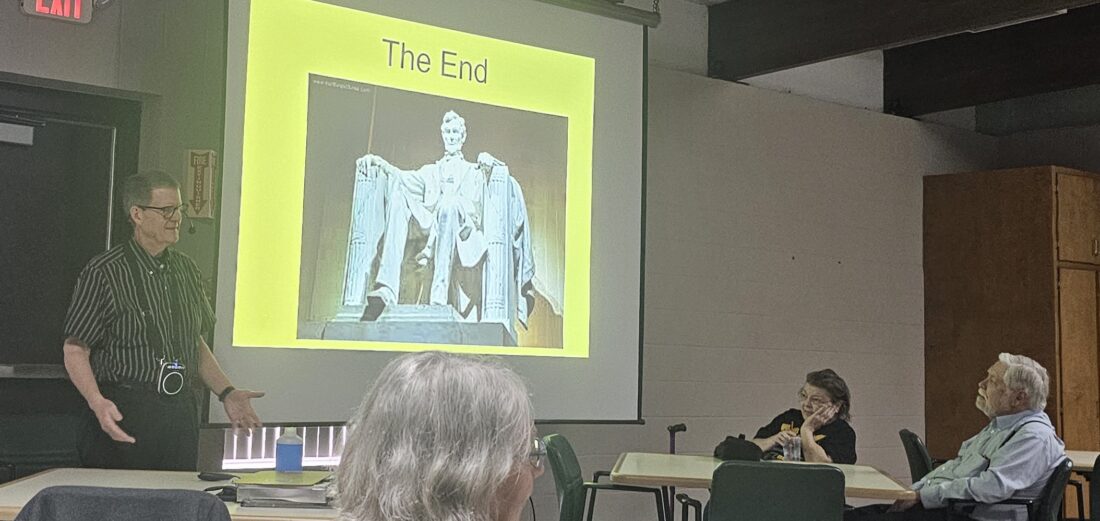
David Jones wraps up his presentation with an image of the Lincoln Memorial — a fitting tribute to a president many historians consider the most revered in American history, a legacy shaped in part by his assassination. Photo by Amy Zents
A full house listens as David Jones presents "The Lincoln Assassination: A Fragile Time" on Thursday at the CAST Senior Center in New Ulm. Photo by Amy Zents
Lincoln and the Civil War — forever linked. David Jones explores that connection last Thursday at the CAST Senior Center in New Ulm.
David Jones wraps up his presentation with an image of the Lincoln Memorial — a fitting tribute to a president many historians consider the most revered in American history, a legacy shaped in part by his assassination. Photo by Amy Zents
Trending
NEW ULM - Last week, guests of the CAST Senior center were treated to a history lesson on one of American's most infamous crimes.
Historian David Jones gave a presentation on the murder of President Abraham Lincoln, titled "A Fragile Time."
Jones set the stage for the Lincoln assassination, saying that in two weeks before the murder it looked like the Civil War was coming to an end with the Union prevailing. Union troops captured Richmond, Virginia, the Confederate capital, on April 2-3.
A week later, on April 9, Confederate Gen. Robert E. Lee surrendered to Union Gen. Ulysses S. Grant. “The war might be over,” Jones said.
A few days later, on April 14, President Abraham Lincoln attended the play "Our American Cousin" at Ford’s Theatre in Washington, D.C. The play was a comedy, one actor John Wilkes Booth was very familiar with. He knew Ford's theater well, he waited for a big laugh line in the third act.
Booth slipped through two unguarded doors into the presidential box, where Lincoln sat with his wife Mary Todd Lincoln, Clara Harris and her fiancé Major Henry Rathbone.
Booth shot Lincoln in the head. Rathbone tried to stop him and received a serious knife wound to his arm. Booth leaped 11 feet to the stage, breaking his leg. Still holding the knife, he turned to the audience and shouted.
Jones said some accounts say Booth said "Sic semper tyrannis" and some say he yelled “The South is avenged.”
After the attack, Booth hobbled out the back door, mounted a waiting horse and fled.
The manhunt lasted 12 days. Booth and a co-conspirator covered only about 70 miles before Union troops cornered them early on April 26 in a barn on Garrett’s farm in Virginia. Booth refused to surrender. Soldiers set the barn on fire. As Booth raised his rifle, a soldier shot him through a crack in the boards. Booth died hours later.
The broader plot called for the simultaneous killing of Lincoln, Vice President Andrew Johnson and Secretary of State William Seward on the same night. Only Lincoln was killed. Seward survived savage knife wounds. The attempt on Johnson failed.
Eight people were charged with conspiracy. They went to trial together starting in May. All were convicted by June 30. Four were executed on July 7.
“Let that sink in a little bit,” Jones said. “Twelve weeks between the crime and the execution. That’s unheard of. That doesn’t happen in our country.”
After his death, Lincoln's body lay in state in Washington. A special funeral train left April 21 and stopped in Philadelphia, New York City, Buffalo, Cleveland, Columbus, Indianapolis and Chicago before reaching Springfield, Illinois, on May 3. At each big city, thousands filed past the open casket. Embalmers traveled on the train and re-embalmed the body six or seven times. Between cities, the train moved slowly so people in rural areas could line the tracks.
“It becomes this national event of mourning,” Jones said.
Jones placed the assassination in the context of the Civil War, the deadliest in U.S. history. More than 620,000 U.S. soldiers died, he said, roughly the total from all other American wars combined up to that point. Nearly 80 percent of the battles were fought in the South.
“One in four white males of military age from the South died,” Jones said. The Confederate economy lay in ruins after it financed the war by printing money.
He quoted historian James McPherson: “The South seceded in order to protect the institution of slavery. But by seceding, they ensured its abolition.”
The war began to preserve the Union after Southern states seceded following Lincoln’s 1860 election. Democrats split between Peace Democrats, who wanted to let the South go, and War Democrats, who fought to keep the Union but cared little about slavery. Radical Republicans in Lincoln’s own party said he was too soft on the Confederacy.
Lincoln’s April 11 speech from the White House, in which he suggested voting rights for some freed Black Americans, helped shift Booth’s earlier kidnapping plot into an assassination plot. Booth reportedly said, “That’s the last speech Lincoln will ever make.”
Lincoln’s death elevated Andrew Johnson, a Southern Democrat and War Democrat from Tennessee, to the presidency. “The man who was the best president we’ve ever had [was] assassinated, replaced by Andrew Johnson [who] is the worst,” Jones said.
Attendees asked questions afterward about conspiracy theories surrounding Booth’s death, the fate of Major Rathbone and details of Booth’s escape route.
Jones closed by reading the final paragraph of Lincoln’s Second Inaugural Address, delivered six weeks before the assassination:
"With malice toward none, with charity for all, with firmness in the right as God gives us to see the right, let us strive on to finish the work we are in, to bind up the nation's wounds, to care for him who shall have borne the battle and for his widow and his orphan, to do all which may achieve and cherish a just and lasting peace among ourselves and with all nations."