
Sleepy Eye farmer finds better way to farm
Plants cereal rye, lets cattle graze on it for better soil
Trending
SLEEPY EYE -- About 11 years ago, Mark Portner said he got tired of seeing his farmland flooding and washing away so he decided to begin the transition from conventional farming to using sustainable techniques for improved soil health.
"I gained a better understanding of soil, how it works and how I could make it work better for me and my farming operation," he said. "It helped me understand how I could make farming work better especially in tough economic times and for future generations."
Portner attended a soil health improvement seminar and asked lots of questions about how to improve his farm opeation.
"I was directed to talk to Redwood County farmer Grant Breitkreutz, a mentor for the Minnesota Soil Health Coalition (MSHC)," said Portner. "He guided me and was a great help."
Breitkreutz and his wife Dawn received the $10,000 Leopold Conservation Award in 2024 from MSHC and Soil Regen. Given in honor of conservationist Aldo Leopold, the award recognizes landowners who inspire others to consider land conservation opportunities.
The Breitzkreutzes manage 1,759 acres in Redwood and Renville counties with diverse crop rotations of corn, soybeans, oats, cereal rye and alfalfa grown with a cover crop and no-till system. About 100 head of Red Angus cow-calf pairs rotationally graze on 675 acres of pasture and cover crop fields each year. About half the pasture was converted from cropland. The rest was remnant prairie.
Portner said he also learned a lot about sustainable farming from Youtube University.
"I found that being inquisitive about sustainable farming was a good way to begin doing it. I just want to keep learning more about it," he said. "I now plant rye grass as a cover crop to increase soil aggregate (structural building blocks of soil formed by the binding of soil particles like sand, silt, clay and organic matter into stable clusters). My cattle eat the rye grass and make manure all over the field."
Portner said the easiest way to begin no-till farming was to plant grain with soybeans.
"About four years ago, I got brave enough to do corn and grain," he said.
Livestock and grazing specialist Kent Solberg of Verndale compared what Portner does with his rye cover crop to slurry manure, which he called "a soil disruptor."
"Farmers that put more than 8,000 gallons of slurry manure on an acre create a major soil disruption," Solberg said. "I've seen fields where it caused all the earthworms to come to the surface and die."
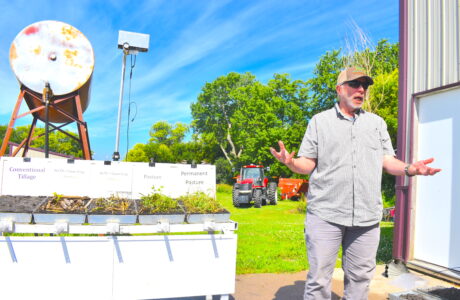
Solberg displayed a rainfall simulator that poured about two inches of water on soil samples with conventional tillage, no-till, cover crops and soybeans and corn, pasture land and permanent pasture.
The water poured on conventional tillage land ran off the soil. Water poured on the other four land samples did not wash away.
"The crop residue slows down the water and buffers it, (natural processes by which soil and vegetation absorb and neutralized rainwater, particularly during heavy rain events," said Solberg.
He said it's in a farmers best interest to understand the way conventional farming is and what could be done to make farming more sustainable, especially in challenging economic times, which he predicts in the near future.
"We don't know how much nitrogen will cost next year," said Solberg. "There are lots of geopolitical decisions going on now to challenge how farmers farm now."
He said farmers need to have a dynamic view.
"We've got to see beyond yield. Most farms have a dysfunctional soil ecosystem. The big question is, are farmers going to do anything about it? This seminar is about soil health, soil function, the ability to capture and store water and cycle nutrients and gases. To respirate, like humans do," said Solberg.
He said only 40% of the nitrogen farmers put on fields actually goes into the soil.
"We need to keep the soil covered with cover crops. We need to keep living roots in the soil," said Solberg. "Remember the Dust Bowl? This spring, I saw lots of soil blowing around. That needs to stop. Without a cover crop, the soil is twenty degrees warmer in the summer. At seventh degrees Fahrenheit, one-hundred percent of soil moisture is used for plant growth. At One-hundred degrees, eighty-five percent of soil moisture is lost. Microbes break down at one-hundred-fifteen degrees. They die at one-hundred forty degrees."
The seminar was sponsored by the Brown Soil and Water Conservation District and USDA Natural Resources Conservation Service. For more information, viisit www.brownswcdmn.org.