
Bogen descendants attend New Ulm premiere of ‘A Life for the Revolution’
Trending
NEW ULM -- Direct descendants of Ludwig Bogen attended the North American premiere of "A Life for the Revolution" Sunday matinee at State Street Theater in New Ulm.
The performance featured German playwright Erich Becker's work about Ludwig Bogen (1809-1886). Bogen took part in Germany's 1848 revolutions, later immigrated to the United States, edited the New Ulm Post and advocated for democratic reforms.
Among those present were Steven Baun of New York City, Michael Baun of Pittsburgh, Pennsylvania, Lisa Hansen of Colorado, Matthew Baun of Colorado and Laura Ankeny of Arizona. Baun, 26, is Bogen's great-great-great-grandson and was visiting New Ulm for the first time. Hansen's middle name, Marie, honors Ludwig Bogen's youngest daughter.
Matthew Baun said the experience felt surreal. "I had heard bits and pieces of my great-great-great-grandfather's story growing up, but seeing it on stage was something else," he said. "Visiting his grave in the Pioneer section of the New Ulm cemetery just hours earlier made the death scene especially moving."
Laura Ankeny, Matthew Baun's mother, said the play was transformative for the family.
"To see how everybody in the family always had those same sort of philosophical underpinnings. And so to see where it originated and then his life story. It was surreal to watch that and to watch on stage his great-great-great-grandfather's death scene," she said.
"And then at the cemetery that we had just been to hours earlier. So it was really profound actually for me."
State Street Theater Executive Director Lorie Jewell made her directorial debut with the production.
"We run almost entirely by volunteers, so truly every ticket, every visit, every cheer makes a difference," Jewell said.
The two-act play follows Bogen's life over more than five decades. Harpist Valerie Cribbs, Becker's wife, performed live music between scenes. Her selections included "Muss i denn," excerpts from classical pieces and "The Star Spangled Banner" as Bogen arrives in America.
Becker attended from Germany with his wife Valerie Cribbs and two friends, Heidrun Dammel and Wolfgang Häeder. Dammel and Häeder also appeared in the original 2018 German premiere in Michelstadt and took small roles in this production.
Larry Mack, a New Ulm city council member, said he was pleased to see the project come together.
"When Erich Becker first reached out, I knew this story needed to be told here in New Ulm," Mack said. "Guiding him to the historical society and Bogen's grave helped bring authenticity to the play."
The family has worked to preserve Bogen's legacy. Steven and Michael Baun traveled to Michelstadt, Germany, and returned a mayoral ring that belonged to Bogen's father, who served as mayor there. The brothers later donated additional family heirlooms to the Brown County Historical Society.
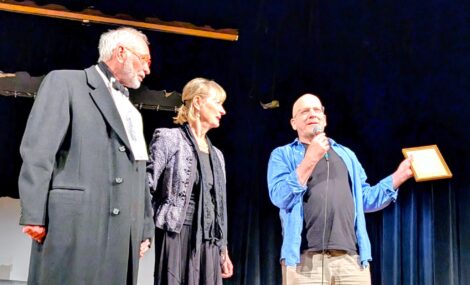
During the talk-back session, Michael Baun presented Becker with a historic postcard. The postcard, dated July 7, 1903, shows the famed German dramatist Goethe as a university student. It was originally purchased by Ludwig Bogen's youngest daughter, Marie Bogen, during a visit to her homeland and given as a symbolic gift from one dramatist to another.
Audience members asked about Bogen's writings on Indigenous issues and the Dakota War. Becker explained that Bogen died at his desk on April 6, 1886, while in the process of writing an article on the topic. Because of his sudden death, no such letter or article was ever published in the New Ulm Post. Becker confirmed he plans further research in St. Paul, where many of Bogen's German-language journals are held.
Valerie Cribbs, who translated the play from German to English, said the process was challenging.
"I'm a musician, not a word person, so it was quite a challenge," she said. "I had to go through the German play word by word to get his meanings. We had some long conversations about it."
Becker, a former history teacher and city guide in Germany, said he chose the story because of its themes.
"Ludwig Bogen fought for democracy and freedom, free speech, free press, and tolerance," Becker said. "These are my favorite things. They are very important."
Becker added that seeing the descendants in the audience made the premiere meaningful. "It shows how one person's fight for democracy can still inspire across oceans and generations."
Bogen's body lies in the Pioneer section of the New Ulm cemetery. He arrived in New Ulm after the U.S.-Dakota War of 1862 and helped rebuild the city. As editor of the German-language New Ulm Post, he produced hundreds of articles on free expression, social progress and local issues.