
‘Net Zero Carbon’ bill impacts municipal utilities
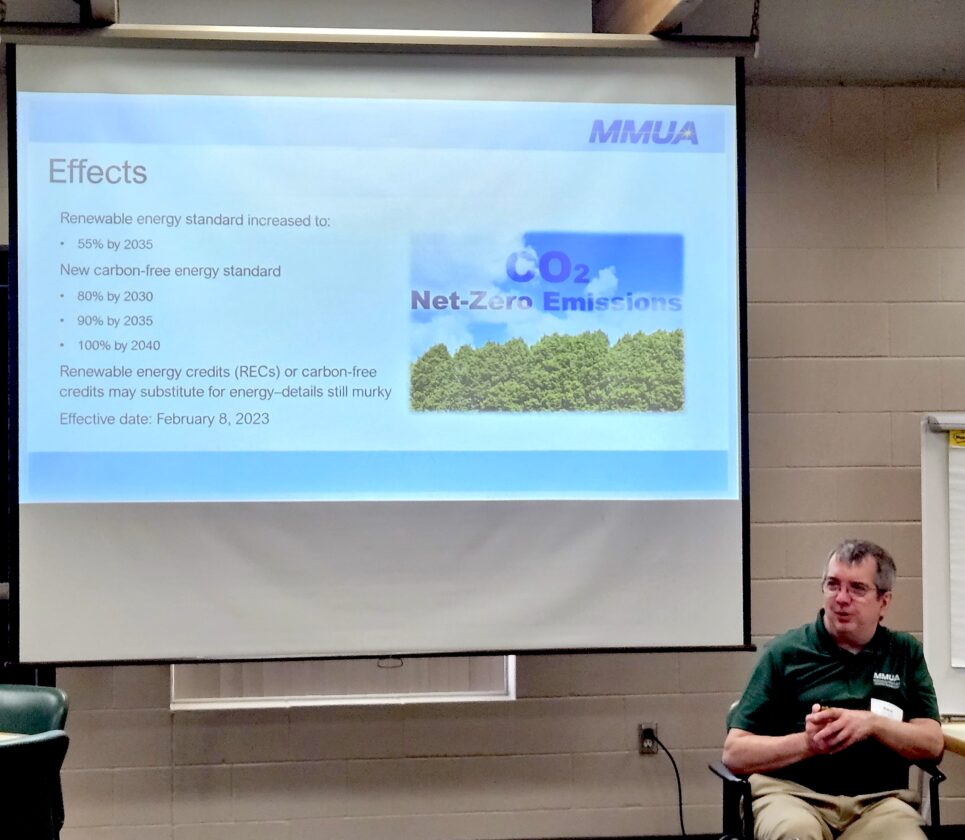
MMUA Director of Government Relations, Ken Sulem gave a rundown of new legislation passed in Minnesota this last session and how it could impact municipal utilities.
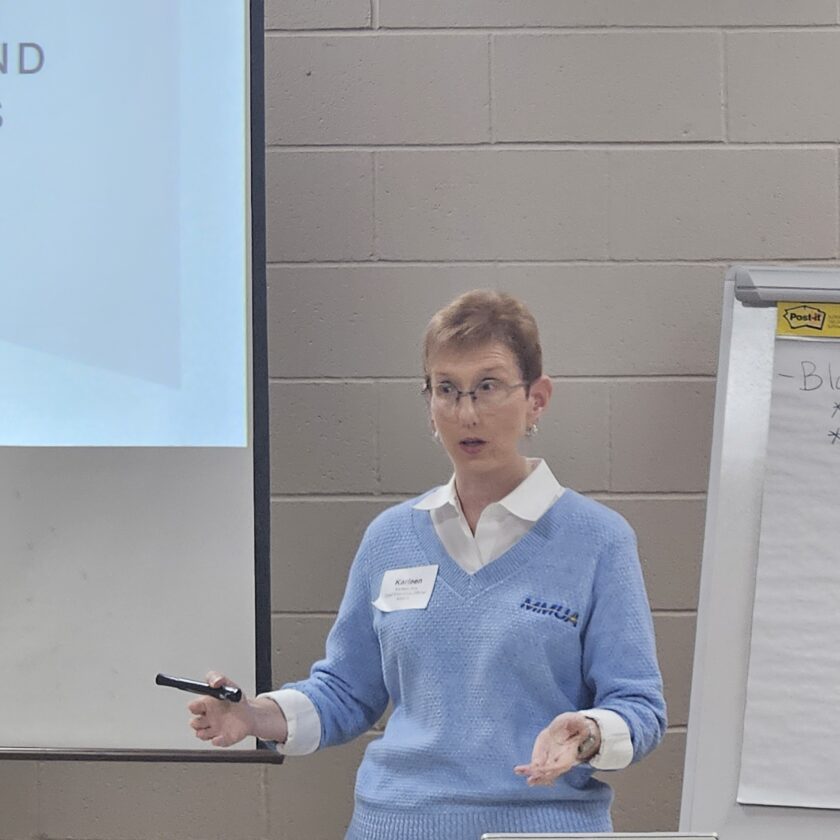
MMUA CEO Karleen Kos encourages municipal utilities to share their stories about how recent legislation will impact them on human terms. “Going in with a list of pros and cons doesn’t make nearly the same impact as telling them a real story about what is happening on the ground.”
MMUA Director of Government Relations, Ken Sulem gave a rundown of new legislation passed in Minnesota this last session and how it could impact municipal utilities.
MMUA CEO Karleen Kos encourages municipal utilities to share their stories about how recent legislation will impact them on human terms. “Going in with a list of pros and cons doesn’t make nearly the same impact as telling them a real story about what is happening on the ground.”
Trending
NEW ULM -- The 2023 session of the Minnesota Legislature saw the passage of hundreds of new laws and regulations that impact many sectors of the state, including municipal utilities.
In order to communicate the changes coming to municipal utilities the Minnesota Municipal Utilities Association (MMUA) has been holding workshops in communities across the state. Monday, MMUA came to New Ulm to discuss the changes with local utility stakeholders.
MMUA Director of Government Relations, Ken Sulem, gave a rundown of the various bills.
He said the recent Minnesota Legislative Session moved at a pace never seen before.
"They started off running and didn't stop until the end of May," he said.
The change having the greatest impact on municipal utilities was the "Net Zero Carbon by 2040" bill. This requires the state's electric utilities to get all electricity from carbon-free sources by 2040. The bill had benchmark dates requiring 80% of electrical generation to be carbon-free by 2030; 90% by 2035 and 100% carbon-free by 2040. The law also included a modification to the renewable energy standard. Minnesota must be using 55% renewables by 2035.
"It is going to be a lot of work for utilities to figure things out," Sulem said but believed many utilities could get by working through their power agency. The municipals who provide their own generation or part of generations could struggle to meet the standard by the deadline.
Renewable energy credits (RECs) can be substituted to reach the goal, but Sulem said it is unclear how the trading will be approved.
New Ulm Public Utilities Commissioner Sean Fingland asked how other states passing similar laws are handling carbon-free standards.
Sulem said about 20 states have enacted a carbon-free standard. Some have different effective dates, but 2040 is one of the more aggressive dates.
MMUA CEO Karleen Kos said this legislation is an example of how MMUA must work at the legislature.
"We are for anything that is good for municipal utilities, we try to build bridges and understanding for things that are bad for municipal utilities," she said.
MMUA fought this session to have the major power agency take responsibility for the carbon deadline. Kos said it would help take the pressure off the small municipal utilities.
Sulem said the larger providers have more resources to reach the benchmark goals. Excel Energy was fine with this legislation on the condition their two nuclear power plants were authorized because those plants represent 20% of the carbon-free goal.
New Ulm Public Utility Director Kris Manderfeld was concerned NUPU would not be covered by one of the large power agencies because only a block of energy came from a large supplier, the rest came from the Midcontinent Independent System Operator (MISO).
"We fall in between, being a full member of a power district and not covered by anyone," she said.
Sulem said as long as a municipal is a member of an agency, even if it does not provide 100% of power, that would be the cut-off point of having an individual requirement. However, he was unsure if that would hold true long-term.
New regulations and funding for monitoring Perfluoralky and Polyfluoroalky substances (PFAS) were approved. Sulem said in a normal year, MMUA would spend more time on this issue. PFAS are sometimes called forever chemicals and are hazardous if they get into groundwater and drinking water.
Sulem said their goal is to make sure the state understands utilities are not the source of PFAS. MMUA is willing to work on this if there is funding, but they should be combated at the source.
"We're not the source, we're not the problem, we may be part of the solution but only if there is help," he said.
Not every bill passed in the last session affected municipal utilities directly, but could be an issue later on.
Minnesota significantly expanded paid employee leave time. An employee could have up to 12 weeks of family leave and 12 weeks of sick leave. Leave maxes out at 20 weeks of leave. This means if a person takes 12 weeks of family leave, they can only take 8 weeks of sick leave. The law would allow a person to take leave to help with a family member who is sick.
Sulem said 20 weeks of leave is shy of half a year. If multiple employees are using this, it could create a hardship. The real impact on utility is the need to expand staff to help fill in when a person is on leave.
Kos said the new leave policy would get complicated, but her advice was to default to allowing employee leave for anything done with health and safety.
"Error on caution, figure it out later," she said. "For better or worse, the legislators thinks we will have a better workforce if people don't have to worry about losing their job," she said.
At the close of the workshop, Kos asked those in attendance to contact MMUA about what needed to be advocated for in the next legislative session.
"MMUA wants to know what they need to advocate for in the next session," she said. "What should be fixed and what stories should be told to help?"
Kos said believed many legislatures forget how messy it can be to transition from one infrastructure change to another. As an example, she said society transitioned from horses to cars, but there was a time when the horse was more reliable than the car.
"Legislators need to know about the steps in between to make it to the next step," she said. "Think of how we tell this story in a human way…going in with a list of pros and cons doesn't make nearly the same impact as telling them a real story about what is happening on the ground."