Snow it begins…
Three-day snow event starts on cue
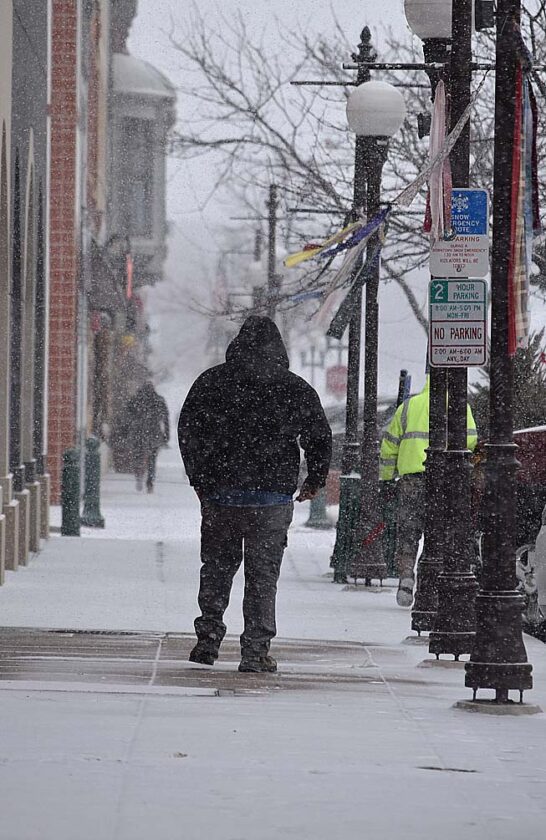
Photo by Clay Schuldt People navigated downtown New Ulm through the snow that began falling around noon Tuesday. Predictions from the National Weather Service indicate that 14 to 24 inches of snow could fall before the storm ends late Thursday.
NEW ULM — The first day of a three-day snow storm began promptly at noon Tuesday and is expected to continue through Thursday.
In the days leading up to the storm, weather models projected two low-pressure waves from the Rocky Mountains would hit southern Minnesota back to back.
These back-to-back fronts could result in 48 hours of continuous snowfall across southern Minnesota. The first was forecasted to hit Tuesday afternoon, but arrived in New Ulm a little before noon with roughly half an inch falling each hour. Between 4 to 8 inches of snow are expected in the first wave of snow.
A second, larger wave of snow is forecast arrive Wednesday with a blizzard warning in effect between 9 a.m. Wednesday and noon Thursday. Heavy snow combined with a wind gusts of 35 mph to 45 mph will create blowing and drifting snow with whiteout conditions.
This is expected to be the worst part of the storm. Between 8 to 18 inches are predicted. The total snow accumulation could reach between 14 to 24 inches. The blowing snow could create drifts several feet deep, making travel impossible in many areas.
The New Ulm City Street Department announced it will begin plowing streets curb-to-curb starting at 4 a.m. Wednesday. They ask that people move their cars off the street to allow for better results.
The City of St. James has declared a snow emergency starting at 1 a.m. Wednesday and continuing through 12 p.m. Friday. All vehicles need to be removed from city streets until streets are plowed curb to curb. Cars that are not moved can be ticketed, and could be towed at the owners’s expense.
Closings
Due to winter weather conditions, Minnesota State University, Mankato will shift to remote learning for Wednesday, Feb. 22 on campus in Mankato and at its Edina location.
Faculty are encouraged to provide reasonable accommodation for students not able to participate in remote delivery due to the shift to e-learning. Classes that cannot be delivered remotely will be cancelled.
The Brown Soil and Water Conservation District Highway 14 Crops, Livestock and Soil Innovation Conference scheduled for Wednesday, at the Sleepy Eye Event Center has been postponed to a later date.
For more information, visit the Brown SWCD website at Brown Soil & Water Conservation District – Brown County, Minnesota or call the office at 507-794-2553.
During the blizzard warnings, people are encouraged to stay home and not travel unless absolutely necessary. Check with the Minnesota Department of Transportation (511mn.org) for information about road conditions and closings.
The AAA advises following the advice of local authorities and staying home when possible. If you should travel and become stranded, the AAA recommends:
• Stay in the vehicle. Your car can provide shelter, allowing emergency responders to best locate you, and prevent you from being struck by an approaching vehicle. If you must get out of the car, ensure the surroundings are safe.
• To make the gas last longer, don’t leave the car running. If there is an extended traffic jam, turn off the engine for a period, then back on to reheat the inside, when it has gotten too cold again. Make sure the exhaust pipe is snow-free.
• Avoid driving on the shoulders or medians of highways to get around the traffic jam. These need to be kept clear for first responders, tow trucks, and emergency vehicles to get to the cause of the stoppage.
• Cold weather can shorten the range of electric vehicles. EV drivers should plan for more frequent stops for charging and identify the location of charging stations before you hit the road. AAA recommends “pre-heating” the inside of your electric vehicle to a comfortable temperature while still connected to the charger. This will reduce the vehicle’s battery demand to regulate cabin temperature at the onset of driving.
If you must be on the road, check the weather before setting out and change plans accordingly.
• Pack a well-stocked emergency kit with a cell phone car charger, first-aid kit; extra blankets, hats, gloves and coats; plenty of drinking water and non-perishable snacks for passengers, including pets; flashlight and extra batteries; reflective warning triangles; and an ice scraper or snow brush.
• Always drive at a safe speed that matches the prevailing visibility, traffic and road conditions – even if that means driving below the posted speed limit.
• Compensate for reduced traction by increasing your following distances (normally three to four seconds) to eight to ten seconds.
• Never crowd a plow. Allow sufficient room for maintenance vehicles and plows, stay at least 200 feet back and, if you need to pass, go to the other vehicle’s left. Be sure to watch for vehicles hidden by the snow cloud and the blades that extend out from the plow’s front and sides.
• Watch for icy surfaces on bridges and intersections, even if the rest of the road seems to be in good condition.
• Avoid braking on ice. If you’re approaching a patch of ice, brake during your approach. Control the skid. Applying pressure to your brakes while on ice will throw your car into a skid
• If you get stuck in snow or ice, straighten the wheel and accelerate slowly. Add sand or cat litter under the drive wheels to help avoid spinning the tires.
• Slow Down, Move Over. Avoid driving on shoulders or medians so first responders, tow truck operators and emergency vehicles can get to stranded motorists who are in dangerous roadside conditions.
Local News
Crosswind runaway prepares to take off

Eighty years of music from New Ulm’s Municipal Band
Vancura finds new expression in retirement
Classic rock cover band coming to NU
NEW ULM — A north Iowa-based, classic rock cover band will perform Thursday, June 11 in the German Park Summer ...
NU City Council approves residential rezone for N. Highland property