
Forensic psychologist’s work led him to writing about crime
Trending
NEW ULM -- It was a night of crimes, lies and literature at the New Ulm Public Library.
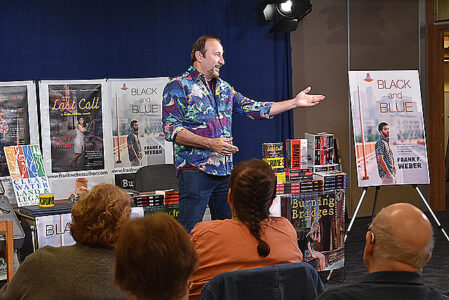
Forensic Psychologist and true crime writer Frank F. Weber gave a presentation on his work to library patrons.
Weber is a forensic psychologist specializing in homicide, sexual assault and domestic abuse cases. In his career, he interviews victims and offenders. His interviews help him profile criminal cases.
Weber got into writing as a way to cope with what he did for a living. He said it was difficult to come home and tell his family about his day when that involved interviewing a serial rapist. Instead, he started writing murder mysteries based on real Minnesota cases. For 24 years he collected these stories in ringed binders. In 2016, Weber sent his first book to a publisher and it was picked up by a national publisher.
He has since published six books, one each year starting in 2017. His books include "Murder Book,” "I-94 Murders,” "Last Call,” "Lying Close,” "Burning Bridges" and "Black and Blue."
"Black and Blue" is his most recent book, released this year. The mystery is based on the murder of a police officer's 19-year-old fiancée in Minneapolis. Weber gave the back story on the real mystery that inspired the case.
Initially, the main suspect in the murder was an African American man who was convicted of the murder based on DNA evidence. This man is also suspected in other assault cases.
However, the case was re-opened after the victim's police officer fiancé was arrested for violent rape. While in prison, the ex-cop attempted to join a white militia by admitting to killing his fiancée because was cheating on him with the black man who was convicted. Outside of prison, he recanted the statement, saying he only said that to be accepted into the gang, but it caused the case to be reopened by the Bureau of Criminal Apprehension.
Webers said both suspects had done horrible things, making it possible either one was the murderer.
Weber said one of the reasons he writes about these cases is to raise awareness about problems in the system that allow offenders like this to get away with crimes. In "Black and Blue," one of the suspects can avoid being charged through technicalities in state law. Weber hopes that by writing about the issues the state will fix laws to avoid other miscarriages of justice.
Weber spoke about some of his work as a forensic psychologist. In his line of work Weber sometimes asks, "Why do people kill?"
He said the best answer is murderers and other offenders have a narcissistic nature. They are incredibly self-centered.
Weber said he once diagnosed a level-three sex offender as having a narcissistic personality disorder. The offender did not like this diagnosis and told Weber he only seemed that way because he "was never in a room where he wasn't the smartest and best-looking person."
Weber said in solving crimes, cell phones are some of the best evidence. The camera also helps catch criminals, but many cell phones are equipped with GPS systems. The new cell phones can help track the movements of suspects. Some of the new phones can pinpoint a person at an exact location.
As an example, Weber said a phone can be used to prove a suspect was at the location of the body drop at the time it was dropped.
An interesting Minnesota forensic tip, how do you take a mold of a footprint in the snow? You use beeswax to create a mold without melting the print.
Weber showed the audience how a lie-detector machine worked with a demonstration. Donna Sluiter volunteered to be hooked up to a lie detector machine.
She was asked a series of questions. A third party gave her a number between one and five. Sluiter was asked which number she saw. No matter which number she was asked about, she denied it was that number.
Weber admitted after the test he was not able to determine which number she lied about seeing. The readout was inconclusive.
He acknowledged there was a margin of error with the machine, but anxiety level is a factor. In this case, Sluiter was asked to lie about a number, but lying about murder is harder to do. In general, the more anxious a person is, the easier the charts are to read.
Weber said during his interviews he does get suspects to confess to the crime. He said the method of getting into a person’s face and yelling does not help because many offenders have had someone screaming at them their whole lives.
His method is to have a simple conversation with the person about their childhood and relationships. Often he can understand the reason for the offense once he knows the person's past.
Weber's visit to the New Ulm library was made possible by a grant provided by the Traverse des Sioux Library Cooperative and funded with money from Minnesota’s Arts and Cultural Heritage Fund.