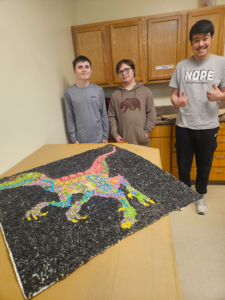
Rotary Ethics Workshop poses difficult situations for teens
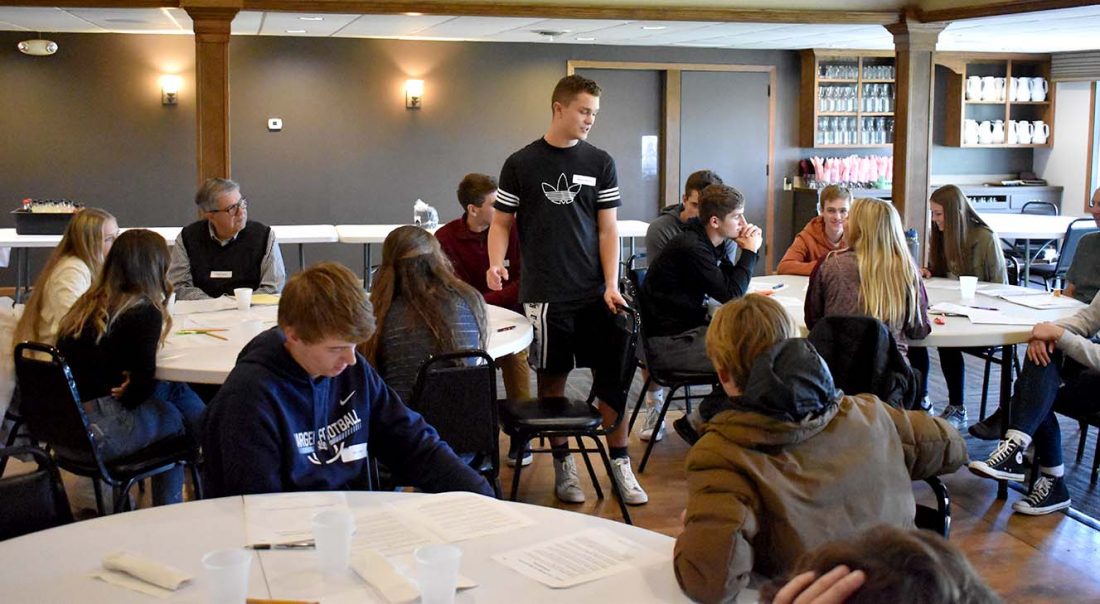
Dawson Schaefer speaks on behalf of his team at the Rotary Ethics Program Tuesday at the New Ulm Country Club. His company’s solution to the Business Ethics exercise involved increasing product cost to counteract human rights issues overseas.
NEW ULM — Area high school students were presented with a series of ethical quandaries, Tuesday at the New Ulm Country Club.
Students from New Ulm Public High School, New Ulm Area Catholic Schools, Minnesota Valley Lutheran and Riverbend took part in the New Ulm Rotary Club’s Ethics Workshop, an annual event put on by Rotary Club members to help train student leaders in ethical thinking.
Coordinator Harold Remme said in terms of ethics, the students learn a little bit about everything.
The key part of the workshop was Business Ethics simulations. Students organized in groups of six. Each member of the group is given an administrative position in a fictional company facing a series of ethical dilemmas. Each group had to decide together how best to address the ethical concerns in the company.
David Rodburne of St. Thomas University helped the students run through the ethics exercise. Rodburne said the scenario was loosely based on real-world events that had impacted clothing and apparel companies with overseas supply chains.
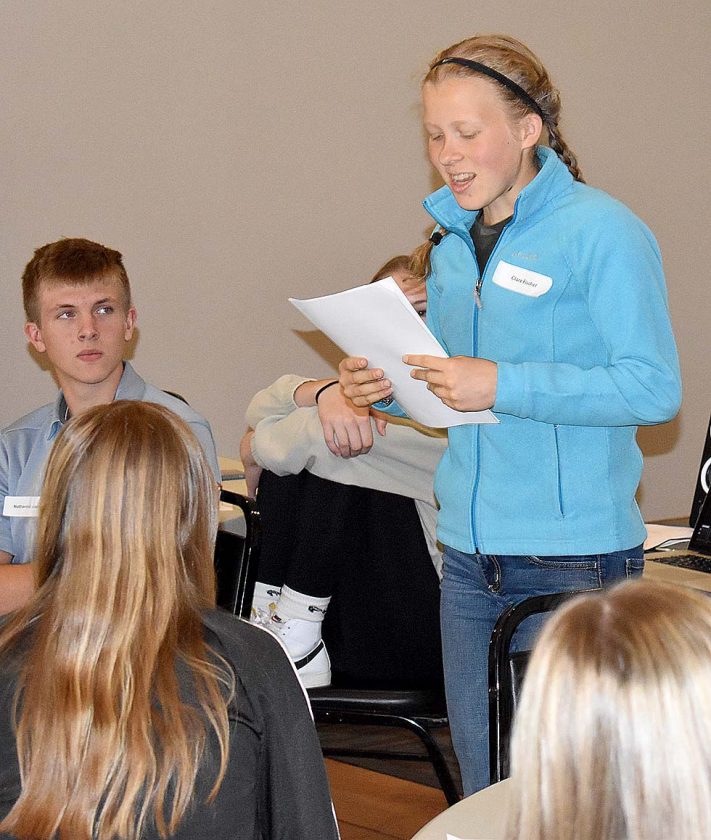
Forty-two students from area high schools broke into teams of six to take part in a business ethics exercise. Claire Fischer was spokesperson for team two. After the exercise, Fischer said their team worked well together, but acknowledged there were several diverse problems to solve and no single way to address the issues
In the scenario, the students learned of potential human rights violations at overseas factories producing their products and rumors of a company vice-president taking bribes from corrupt governments. The students also had to contend with domestic workers concerned with losing their jobs to cheaper international labor.
Rodburne described the scenario as a jigsaw puzzle without a picture to show what the final result should look like. There were multiple methods to fix the problem and not necessarily a single correct answer.
After working on the problem in teams, each group had a spokesperson present their solution to the companies problem. The other teams took turns acting as employees, stockholders and reporters asking questions about how this would impact the company.
“This is pretty reflective of real life,” Rodburne said. ” Many companies deal with these issues, though not all on the same day.”
The seven teams all developed unique ways of dealing with controversy. Many of the groups tried to maintain domestic jobs while restructuring foreign supply lines. Several teams chose to raise the cost of products to cover additional expenses and create more sustainable products.
MVL student Josh Giefer was the team four spokesperson. After the presentation, he admitted the exercise was difficult.
“Coming up with a solution was a challenge,” he said. Many of the choices available negatively impact somebody. For this reason, his group decided to fire its vice-president because it limited the impact on the company.
Team two spokesperson Claire Fischer of Cathedral said her team had a lot of good conversations about the best course of action, but said there were so many problems to solve and many diverse issues.
Brianna Beranek commented that in her group it was a challenge to focus on one ethics problem without forgetting another problem.
Rodburne acknowledged that this scenario was a mess to deal with, but reminded the students these were issues people sometimes needed to consider. The hope was the students could see how ethics tied back to different situations.
Rotary member Duane Lambrecht spoke to the students on the history of the Rotary Four-Way test of ethics in business. The test was invented by Herbert Taylor in the 1930s after his aluminum company faced significant challenges. The four questions a person must ask: Is it the truth? Is it fair to all concerned? Will it build goodwill and better friendships? Will it be beneficial to all concerned?
Lambrecht said he was impressed with the students handling of the exercise. He said this year’s group of students was one of the best in terms of participation.
-
- Dawson Schaefer speaks on behalf of his team at the Rotary Ethics Program Tuesday at the New Ulm Country Club. His company’s solution to the Business Ethics exercise involved increasing product cost to counteract human rights issues overseas.
-
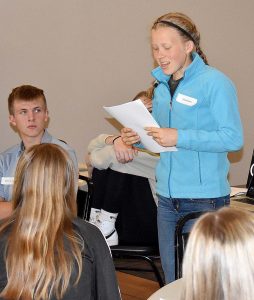
- Forty-two students from area high schools broke into teams of six to take part in a business ethics exercise. Claire Fischer was spokesperson for team two. After the exercise, Fischer said their team worked well together, but acknowledged there were several diverse problems to solve and no single way to address the issues
Local News

‘Don’t be afraid to go for it’
Timeless in Brick

A ‘beautiful and vibrant’ downtown
NU school board cuts nine staff
New Ulm - Thursday’s school board meeting confirmed the termination of nine New Ulm Public Schools’ staff ...
ISD 88 Foundation launches community endowment drive
NEW ULM - Independent School District (ISD) 88 Foundation is calling on the New Ulm community to invest in the ...