
State Society will purchase Harkin store in Nicollet County
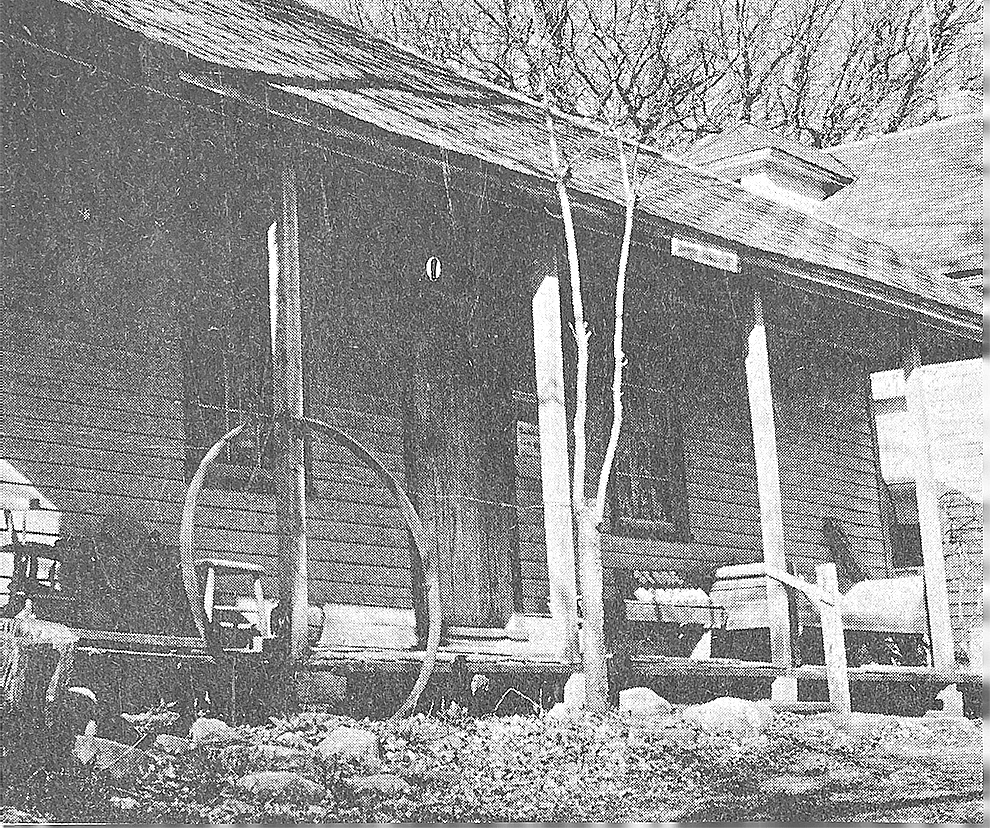
Old store had porch for loafers.
ST. PAUL — Agreement has been reached by the State Historical Society to purchase the Harkin Store 9 miles west of New Ulm in Nicollet County’s West Newton Township.
Owners of the historic country store on the Minnesota River are Dick and Janet Massopust. The store is more commonly known as the Massopust Store and was built by the brother and sister’s grandfather, Alexander Harkin, in the 1860’s.
An option to purchase the store, ice house and a residence on the site has been secured by the historical society for $40,000.
Money would have to be appropriated by the Legislature this session for the option to be executed. Rep. Carl Johnson, DFL-St.Peter, and Rep. A.J. Eckstein, DFL-New Ulm, authored such a bill and introduced it Thursday.
The bill appropriates $55,000 to purchase the property and do some repairs. More money would be needed in the next session of the legislature to finish restoration of the store.
Russell Fridley, director of the state historical society, said Thursday it would probably be five years before the store is open to the public again.
The store is badly deteriorated and is in need of repairs to make it available as an historic site.
The society has been interested in the store for a long time, Fridley explained. The state made an offer 10 years ago whereby the Massopusts would give the store to the state in exchange for lifetime use of the adjacent home. It was refused and the society lost interest because they did not see any feasible way to finance the purchase and restoration.
“It’s really been Reps. Johnson and Eckstein that have regenerated an interest again,” Fridley said.
Eckstein said former Nicollet County Agent Fred Wetherill and Nicollet County farmer Henry Lippmann have been very instrumental in convincing the Massopust’s to sell the store.
The option was secured on Monday, Eckstein said.
The store will be in exclusive company in the state historical system, joining only 22 other historical sites operated by the society.
Fridley said it was on “the premium list of historic sites in the state. We know of only one other country store in the state.”
That store is in Forestville State Park in Fillmore County in southeastern Minnesota. That store is not as old.
Fridley said the long range plans for the store would be to restore it and have it open to the public but first the society will have to inventory the items and become familiar with the history of the store.
The administration of the store will be tied in with Fort Ridgley State Park which is also administered by the society.
++
THE OLD store in summer is almost hidden by trees, vines, and underbrush on the north bank of the Minnesota River. It is made of native black walnut and pine.
The store had been the hobby of Janet Massopust for many years and was open to visitors until ill health forced her into a nursing home in Fairfax. The store contains relics of the old settlement days along the Minnesota River. There are still old post-office files and old account books used by the earlier generations.
The trading post was used as an Army base to preserve peace among the Sioux Indians.
Wetherill wrote about the history of the store in a farm magazine:
Today, everything in the store is dusty and dingy with age, but it reveals life as it was lived beyond the memory of most of us. The old, rusty, low, rectangular stove seems to be just waiting for that hand of the past to build a cheerful fire around which the brave pioneers would gather to pass the time of day and discuss the state of the nation.
Grandfather Harkin was postmaster from 1862 until 1893, and first sorted the mail in Diepolder’s Hotel, about three-fourths of a mile up the road. When the store was built, he moved his postal duties to the store; the open letter boxes will stand in one corner. Bunting of Civil War vintage is tacked up all around the store, a symbol of Mr. Harkin’s patriotic love of his new country. The flags have only 39 stars each.
ON THE walls are advertisements of the leading drug products of the day, such as “Hostetter’s Stomach Bitters” and “Dr. Jaynes’ cure-all medicine.” On a shelf one finds an old, wooden butter mold, iron candle molds, and an old lantern designed to burn a candle inside a frame of glass. A case of white (then called “enameled”) thread, knitting needles, old dishes, pots and pans, other souvenirs of the past remain in place. A powder barrel stands on the counter.
Ammunition boxes draw one’s attention behind the counter. On one box is lettered: “Captain F. W. Downie, Acting Officer, Department of Northwest, St. Paul, Minnesota, New York Arsenal, 100 Car-ridges, Rifle Musket, calibre 577 (1863).” Here, also, is an Irish pewter teapot, and a pipe lighter which is a figure of an Englishman smoking a cigar.
A long piece of metal is described by Miss Massopust as a butter tester; in those days, too, butter was bought and sold according to quality. Since Nicollet County is an outstanding Minnesota dairy county, this is one of the forerunners of the now thriving agricultural enterprise. Along the counters and in drawers one also finds boots, with copper tips and red tops, the soles of which are attached with wooden pegs, which would attract any modern-day child. Some of these shoes, left from the original store’s stock, are fastened with two rows of buttons, made to fit either foot.
BOXES of coffee essence — something people today hear little about — rest in the original box from the Kelley Wholesale House, St. Paul. In the hardware department one finds a queer-looking knife which was used to make shingles. Hundreds of pounds of old-fashioned, square-tipped nails still are in the nail kegs in which they were shipped,
One of the prized treasures of the store is a framed copy of the London Sun of 1838, an issue printed in gold ink to commemorate the coronation of Queen Victoria. Mr. Harkin brought it to this country when he emigrated from Scotland. All perishable foods are gone, but the cracker barrel still stands in one corner. The big snuff jar — it came in the bulk in those days — is on the shelf. Flour, sugar and coffee bins still are plainly labeled.
In the post-office corner, by an antique safe, is a Civil War musket and a breech-loading rifle. Grandfather Harkin brought the rifle from Scotland in 1856.
Back in 1893, Janet’s father, Rudolph Massopust, married Catherine Harkin, the daughter of the founder of the trading post. The Massopusts carried on with the store and mail service after Mr. Harkin’s death, and until the R. F. D. service originated. The post stands today exactly as on the day the doors were locked against the buying public in 1901.
During the latter years of Rudolph Massopust’s life, he opened the store for the visiting public, charging a small fee for entrance. Since his death in 1941, Janet is more than ever determined to make a hobby of preserving a landmark that holds so many memories and so much historic lore for her community.
++
ECKSTEIN expects the bill will pass. However, even local reaction is not entirely in favor of preserving the store.
Mrs.Leota Kellett, director of the Brown County Historical Society, said in a letter to Eckstein she is “very strongly opposed to such action.”
Mrs. Kellet writes about her attempts to acquire the store by the local society and of their personal time and expense she put into trying to get the store 10 years ago.
“The intervening years change has no longer made this site sufficiently important to justify the cost… I hope, therefore, that you will realize that supporters of such state funding by legislature do so against the belief of many who feel there are more significant projects in Brown County. In comparison the store is not important,” Mrs. Kellet said.
Eckstein, who has been at the store many times, said the items inside deserve to be preserved. He noted the store could be part of an historic trail from New Ulm to Fort Ridgley along the river road.
The environmental preservation natural resources committee of the House will discuss the bill at a Tuesday evening meeting.
New Ulm Daily Journal,
April 15, 1973