50 Years Ago: Senior transportation program
‘It’s been a Godsend to me’
By JOHN LAMPINEN
Staff writer
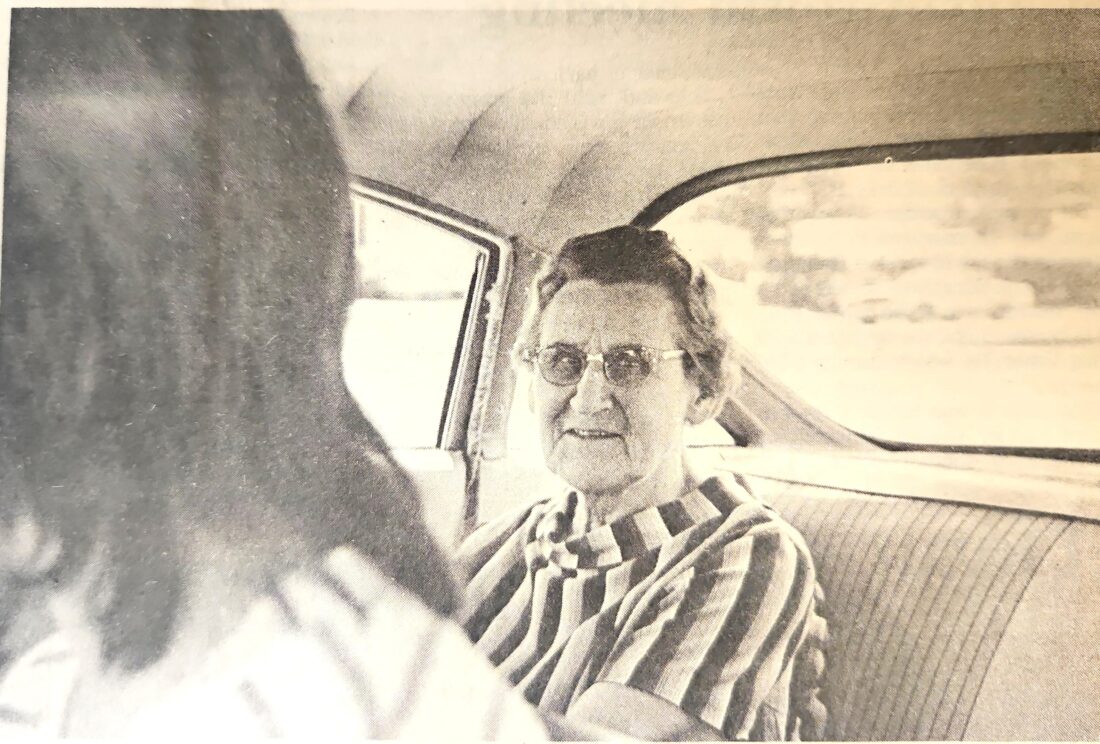
At 84, Mrs. Leah Ryan’s sight isn’t what it used to be.
Because of that, she says, she doesn’t “dare” go anywhere by herself any more. That includes making the trip from Traulich Estates to Loretto Hospital, where her sister is a patient.
For the last five or six years, she says, her only means of visiting her sister has been by taxi, and she figures she’s spent more than $800 in cab fares that she’s “had to” rather than “can”afford.
SINCE last month, however, she’s been able to get to the hospital by using the new Brown County Senior Citizens Transportation Program.
“I think it’s a wonderful thing,”Mrs. Ryan says of the program,”because there are probably many senior citizens who are shut-ins like me.
“It’s been a Godsend to me.”
Mrs. Ryan is one of about 65people in the county who have used the program since it began June 1, according to Jeannie Wroblewski, who is in charge of the program.
The senior citizens use the transportation for a variety of reasons, according to Margaret Boelter, who takes calls for rides in New Ulm. They have used it to go shopping, visit friends, make doctor appointments, see attorneys, get to the bank and visit friends and relatives in the hospital.
“I WOULD say 85 per cent of them that have used it so far really need it,” Mrs. Boelter says.
‘I think it’s a wonderful thing because there are probably many senior citizens who are shut-ins like me.’
Of course, one person’s definition of necessary may differ from another person’s. Mrs. Boelter points out that trips that may not seem all that important can mean a lot.
“Sometimes I think for some of these people, it’s just as good for them as going to the doctor to see a friend at the hospital and have someone to talk to,” she says. “It’s probably just as important to them as going to the doctor.”
Ms. Wroblewski points out that the family service center has been concerned that perhaps the program would be used for minor trips.
“We were afraid of being flooded with calls that weren’t essential and that we’d be tied up with these trips,” she says.
Because of that, in some cases the family services center makes special arrangements with the senior citizens being driven. As an example, she points out, one woman in Lafayette wanted to make regular hospital visits three days a week.
THE PROGRAM directors offered to take her twice a week and let her find her own means of transportation is she wanted to go a third time.
“We’re not leaving them high and dry, but we’re trying to work it out so they’re not an expense for the program,” Ms. Wroblewski says.
A minimum donation of 25 cents for each 10 miles is requested of the senior citizens, according to the guidelines of the program, but Ms. Wroblewski emphasizes that riders can pay more.
“We try to help the people realize that the 25 cents doesn’t cover the cost of the program, that we pay the drivers 15 cents a mile,” she says.
The program is open to all senior citizens in the county, but, according to the first month’s statistics, ridership is much higher in New Ulm than in other parts of the county. Comfrey, for example, has had only one rider; Hanska has had none.
IT IS also open to the handicapped, but according to Ms. Wroblewski, only two handicapped people have taken advantage of it.
“Handicapped persons have had I would say 85 per cent of them that have used it so far really need it.’ Generally somebody they can depend on. The need is more identifiable by friends and neighbors,”she says. “Senior citizens are more shut off.”
Mrs. Boelter, who says she took the coordinator job in New Ulm because she enjoys older people, adds that she has found that to be the case.
“I have found — I can tell by the cards where it tells you who to contact in an emergency — that a lot of these women don’t even have relatives in town,” she says.
“I never realized how many older people we have in New Ulm-I never knew it -that are all alone too.”
New Ulm Daily Journal
July 1, 1975