
‘Beyond the Call of Duty’
New exhibit at BCHS honors Capt. Bianchi
Trending
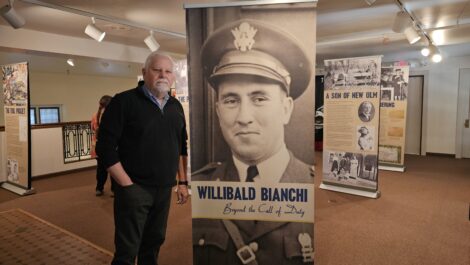
At the Brown County Historical Society, curator Dan Hoisington provided tours of the new exhibit, "Beyond the Call of Duty."
The display features artifacts, letters, and photographs that document Willibald Charles Bianchi's life from a poultry farm in New Ulm to the battlefields of the Pacific and his actions that went beyond the call of duty.
The exhibit opened Friday, the same weekend the community gathered to inter the remains of its only World War II Medal of Honor recipient.
On Saturday, May 2, 2026, Gov. Tim Walz proclaimed Willabald C. Bianchi Day in Minnesota. Flags flew at half-staff statewide.
Pointing to a Life magazine photo from a Bataan field hospital, Hoisington said, "That's him right there. His mother recognized him in the middle with his arm extended. It's not labeled, but she said, 'That's my son.'"
The image was captured by reporters Melvin and Annalee Jacoby, a newlywed couple who had just married in November 1941. Two weeks later Pearl Harbor happened, and they were stuck in Manila but still went out to cover stories. They traveled to Bataan in February 1942, took the photo spread showing wounded soldiers and nurses, and then smuggled their film out by boat to Australia over three weeks.
Hoisington spent several months assembling the display.
"It's been really enjoyable to have the opportunity to study the history of this time," he said. "Every day I would find something new."
Born March 12, 1915, in New Ulm, Willibald Charles Bianchi was the only son of Joseph and Caroline "Carrie" Bianchi. He had four sisters, including Jermayn, who later became a nurse and was assigned to the Pacific theater. She repeatedly told others she was going to find her brother Bill and arrived in the Philippines too late, he had already died.
Before deploying, Willibald Charles Bianchi wrote home about enjoying "regal luxury,” fishing and buying a 35mm camera he had long wanted.
"I've always wanted a camera," Hoisington quoted from one letter. Later, after being wounded during the action that earned him the Medal of Honor, Bianchi turned to a fellow soldier and said, "Take care of my camera."
Serving with the 45th Infantry Regiment, Philippine Scouts, Willibald Charles Bianchi fought on the Bataan Peninsula. On Feb. 3, 1942, near Bagac, he earned the Medal of Honor. Wounded three times, he kept fighting. The Life magazine photo in the exhibit shows the injury.
"He was tough as nails," Hoisington said.
Captured after Bataan fell, Willibald Charles Bianchi survived the Death March and was held at Cabanatuan.
A sketch by fellow prisoner Eugene Jacobs shows him fairly distributing food to 1,500 prisoners.
"Getting in his line was a lucky break," Hoisington said. "Because he was always fair."
Willibald Charles Bianchi endured the hell ship transports. He survived the bombing of the Oryoku Maru but was killed Jan. 9, 1945, at age 29, when a U.S. plane bombed the Enoura Maru at Takao, Formosa (Taiwan).
Tom Bodie, sitting next to him, took his vest and credited it with helping him survive the cold journey to Japan.
The Rev. William Cummings, who coined the phrase "There are no atheists in foxholes," was also among the prisoners on the hell ships.
Thomas Smothers Sr., father of the Smothers Brothers comedy duo, survived one hell ship but died on a different transport later in the journey.
Willibald Charles Bianchi's mother, Carrie, received the Medal of Honor on his behalf in June 1945 at Fort Snelling.
Saturday's graveside service at New Ulm City Cemetery brought closure. "It's a little bit of closure after all of that," Hoisington said.
The exhibit remains on display at the Brown County Historical Society during regular hours.