
Laid to rest in hometown 85 years after serving with valor
Bianchi lived to help others
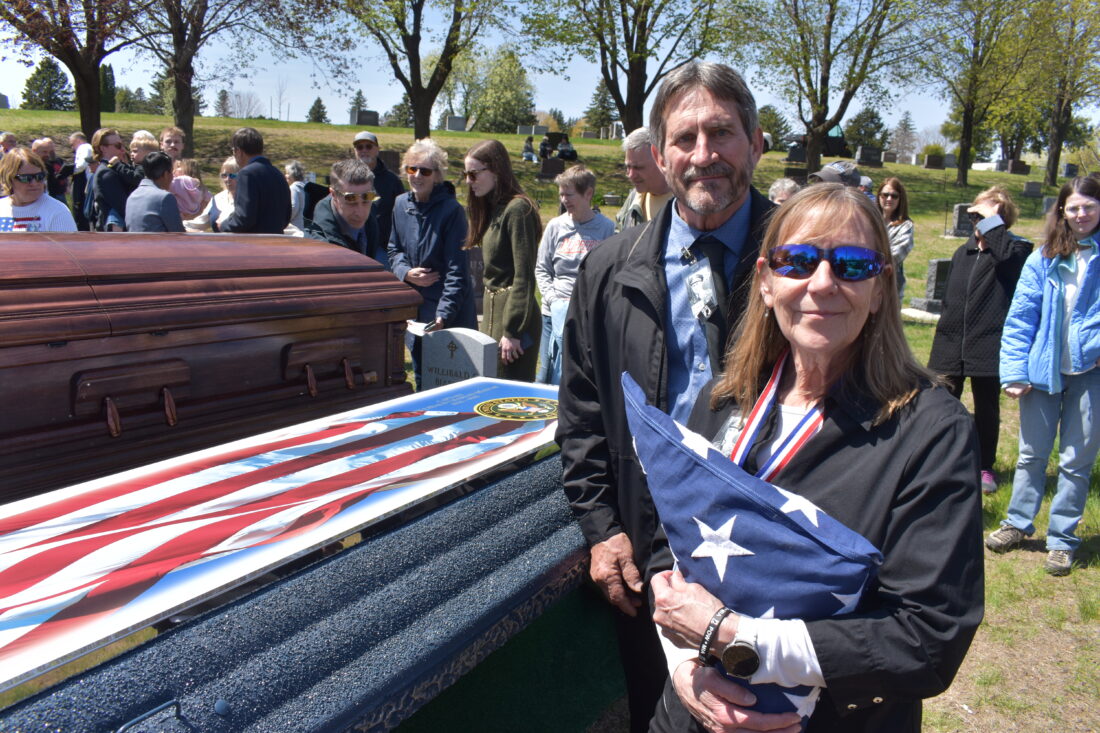
Staff photo by Fritz Busch Sue Marti of New Ulm, right, the niece of WWII hero Capt. Willibald Bianchi, and Mike Marti of North Mankato, Bianchi's nephew are pictured next to Bianchi's casket following his graveside services with full military honors at the New Ulm City Cemetery Graveside Ceremony Saturday. Bianchi's remains were positively identified with the help of advanced DNA testing last August.
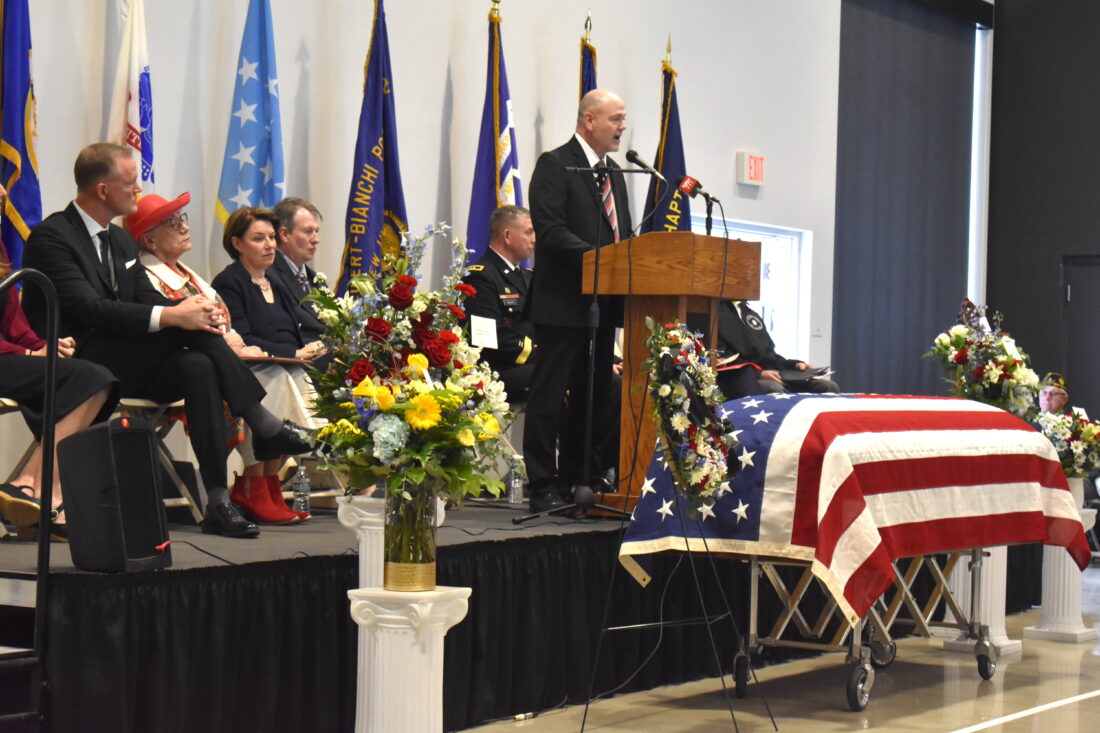
Commissioner for the Minnesota Department of Veterans Affairs (MDVA) Brad Lindsay speaks during the visitation for Capt. Willbald Bianchi Photo by Clay Schuldt
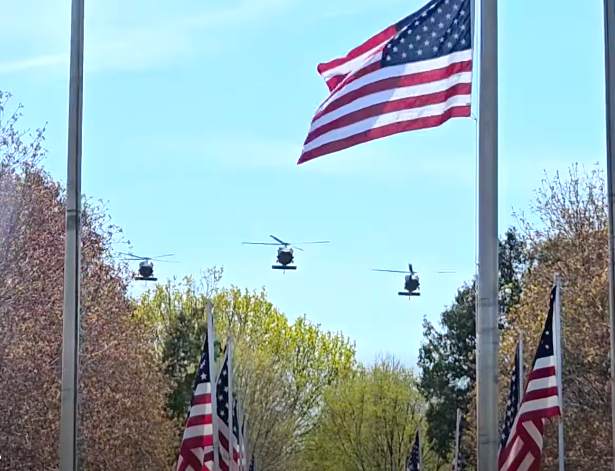
Three Black Hawk helicopters fly over New Ulm City Cemetery to honor Capt. Willibald Bianchi who was buried in his hometown Saturday with full military honors over 80 years after his death. Photo by Clay Schuldt
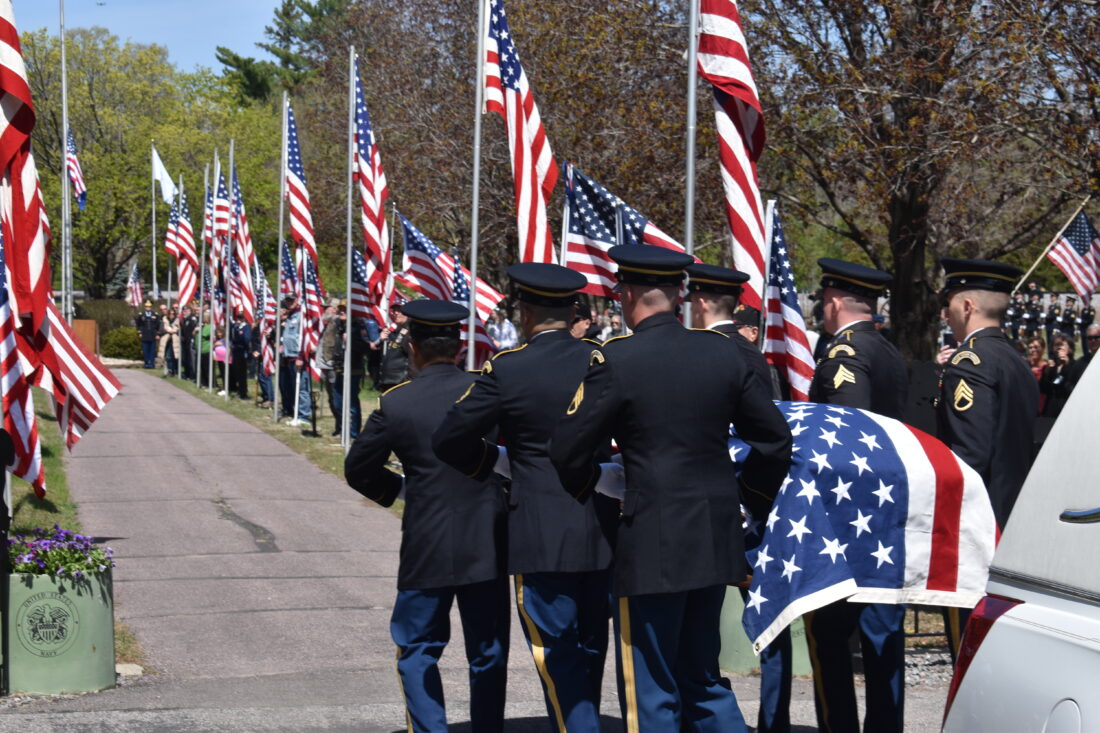
Staff photo by Fritz Busch The Minnesota Military Funeral Honors Team carries the casket of Capt. Willibald Bianchi at the New Ulm City Cemetery Saturday.
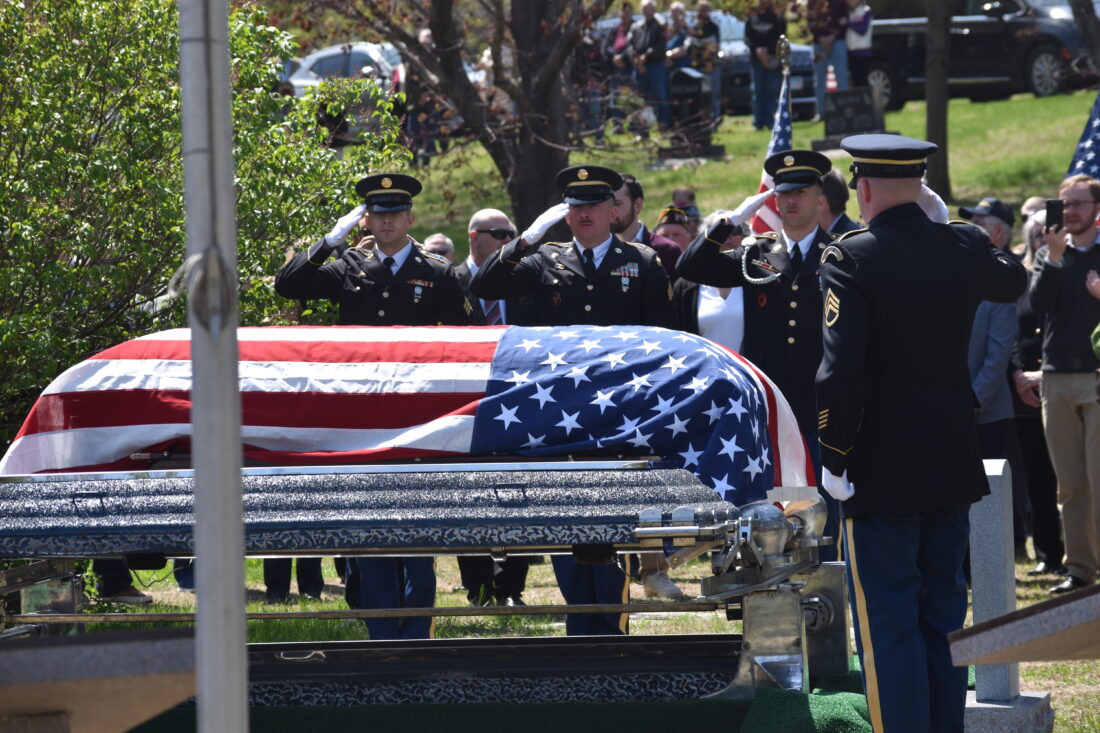
Staff photo by Fritz Busch The Minnesota Military Funeral Honors Team salutes Capt. Willibald Bianchi's casket at graveside services at New Ulm City Cemetery Saturday.
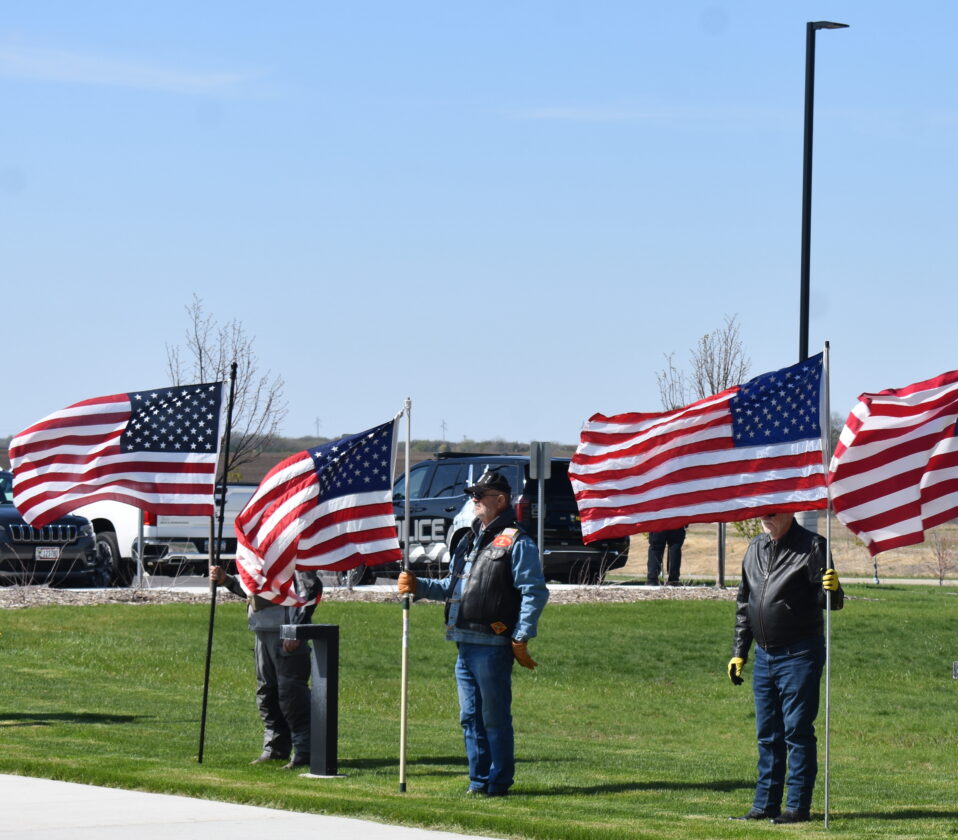
American Legion Riders Members of the American Legion Riders stand at attention outside the National Guard Readiness Center Saturday during the visitation of Captain Willbald Bianchi. Photo by Clay Schuldt
Staff photo by Fritz Busch Sue Marti of New Ulm, right, the niece of WWII hero Capt. Willibald Bianchi, and Mike Marti of North Mankato, Bianchi's nephew are pictured next to Bianchi's casket following his graveside services with full military honors at the New Ulm City Cemetery Graveside Ceremony Saturday. Bianchi's remains were positively identified with the help of advanced DNA testing last August.
Commissioner for the Minnesota Department of Veterans Affairs (MDVA) Brad Lindsay speaks during the visitation for Capt. Willbald Bianchi Photo by Clay Schuldt
Three Black Hawk helicopters fly over New Ulm City Cemetery to honor Capt. Willibald Bianchi who was buried in his hometown Saturday with full military honors over 80 years after his death. Photo by Clay Schuldt
Staff photo by Fritz Busch The Minnesota Military Funeral Honors Team carries the casket of Capt. Willibald Bianchi at the New Ulm City Cemetery Saturday.
Staff photo by Fritz Busch The Minnesota Military Funeral Honors Team salutes Capt. Willibald Bianchi's casket at graveside services at New Ulm City Cemetery Saturday.
American Legion Riders Members of the American Legion Riders stand at attention outside the National Guard Readiness Center Saturday during the visitation of Captain Willbald Bianchi. Photo by Clay Schuldt
Trending
NEW ULM -- A high-pitched turbine whine from six jet engines and the loud, "whomp-whomp" sound of four rotor blades on each of three Black Hawk helicopters filled the air above New Ulm City Cemetery Soldiers Rest Section Saturday.
Sue Marti of New Ulm hugged a tightly-folded American flag she received after her uncle, Capt. Willibald "Bill" Bianchi, a World War II Medal of Honor recipient, was buried with full military honors and graveside ceremonies.
"This was an amazing journey with everyone," she said. "We couldn't be more blessed and proud. It's an honor to be here and see everybody supporting us."
New Ulm Mayor Kathleen Backer smiled widely as bright sunshine warmed the cemetery crowd after the Minnesota Military Funeral Honors Team and other organizations took part in the event.
"What a wonderful day. The sun is shining. Captain Bianchi came home to rest. We're grateful for his contributions to his country and this city," she said. "I'm happy for the Marti family. They always talked of this day. It finally came to fruition."
Minnesota National Guard State Chaplain Timothy Usset described Bianchi at the graveside service.
"Captain Bianchi lived a life of service, to his family, friends as evidenced by many of us here today to bid farewell to him 85 years after he left New Ulm when he deployed to serve our country in the Philippines in World War II," he said. "He was a war hero showing valor in combat, selflessness service, surviving the Bataan Death March, caring for others including fellow service members until the end. In life, he honored the flag. In death, we and the flag shall honor him."
Usset said it is the hope of many faith traditions that death is not the end, but the beginning of a new life in God.
"In the Christian tradition, we often sing 'because he lived, I can face tomorrow.’ Because he lives, all fear is gone," he said. "Because I know he holds the future, life is worth living, because he lives. We can continue to face the trials of life, our own faith strengthened and inspired by Bill's service and the life he lived."
Usset led the service in reciting the 23rd Psalm and the Lord's Prayer.
Bianchi's surviving relatives observed the dignified transfer of his remains at the Minneapolis-St. Paul International Airport April 24. His remains were identified on Aug. 11, 2025.
The commander of Company D, 1st Battalion, 45th Infantry Regiment, Philippine Scouts on the Bataan Peninsula in the Philippines. He volunteered his company to clear Japanese machine gun nests on Feb. 3, 1942. Shot and wounded multiple times, he continued to lead the attack.
Bianchi was awarded the Medal of Honor, the highest U.S. military award for valor. Many of his fellow prisoners later wrote his mother, crediting him with saving their lives by providing them food he was able to receive from enemy soldiers at times, helping the POWs survive hunger, dehydration, high heat and disease.
Captured by the Japanese on April 4, 1942, he survived the brutality of the Bataan Death March and was a prisoner of war (POW) in the Philippines until 1944.
The Japanese military attempted to move prisoners to Manila for transport to Japan on the Orkyoku Maru, a Japanese passenger and cargo ship that became a troop transport and prisoner of war transport ship during World War II.
Unaware of prisoners on the ship, U.S. carrier aircraft attacked the ship that sank in Subic Bay in the Philippines. Hundreds of American POWs died, but Bianchi survived.
The Japanese transported him to Formosa, know known as Taiwan. While anchored, the Japanese ship was attacked by U.S. warplanes and sank. According to Japanese records, Bianchi died at age 29 in the attack with more than 300 other U.S. Pows on Jan. 9, 1945.
After the war, the American Graves Registration Command investigated and recovered American personnel killed in WWII. More than 311 bodies were recovered in a mass grave that were believed to be those who died in the bombing attack on the ship. The remains were declared unidentifiable and described as unknowns at the National Cemetery of the Pacific, known as the Punchbowl, in Honolulu, Hawaii.
Several years ago, Bianchi's remains were sent to the Defense Department POW/MIA Accounting Agency (DPAA) lab for analysis with modern forensic techniques. Bianchi was positively identified last August after advanced DNA testing.
On May 1, the Brown County Historical Society opened a new exhibit, "Willibald Bianchi: Beyond the Call of Duty" that honors his life.