
Collectors gather for breweriana
Border Batch show returns to New Ulm
Trending
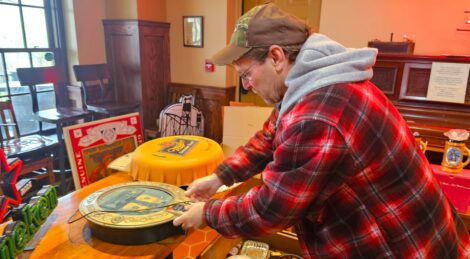
NEW ULM -- The 47th annual Shell's Border Batch Show convened on Sunday in New Ulm, serving as a concentrated gathering for Midwest collectors dedicated to the preservation of breweriana (collectible brewery memorabilia) and regional industrial history.
The show drew vendors and historians specializing in the physical artifacts of the American brewing industry, ranging from pre-Prohibition lithographs to mid-century mechanical signage and rare aluminum containers.
For members of the Border Batch Club, the gathering represents a specialized market where the value of an object is determined by its rarity, physical condition, and connection to regional brewing identity.
Tom Terwilliger, who has managed the club's operations since 1991, said the scarcity of regional items is what drives the current market. He explained that because regional breweries like Schell's operated on a smaller scale than national giants, they produced significantly fewer advertising materials.
"That's what makes Schell's stuff so scarce and sought after," Terwilliger said. "When you find something from a smaller regional brewery like this, you aren't just finding a piece of metal; you're finding a piece of the town's history that survived the decades."
The social nature of the hobby was highlighted by Terwilliger and his wife, Judy, who marked their 25th wedding anniversary during this year's show. The couple was married during the 1999 event in the former Schell's taproom, with a wedding party composed entirely of fellow collectors.
"We got married 25 years ago at this show in the old tap room," Terwilliger said. "The best man and maid of honor were here today, too. It's a hobby, but it's also where our life happened. The items brought us together, but the people are why we stay."
Despite the deep roots of veteran collectors, the hobby is experiencing a demographic shift as a younger generation enters the market.
Josh Ramaker, a collector from Mankato known as the "Beer Sign Guy," noted that the profile of the average attendee is beginning to change.
"I love history," Ramaker said. "I started looking for old Mankato beer stuff for myself, and it just grew from there. Now I see more young people, 21- and 22-year-olds, getting interested in the mechanical side of things."
Ramaker said modern collectors often focus on "man cave" décor and mechanical items rather than the wall-to-wall can collections that defined the hobby in the 1970s. He specifically targets motion signs and neon displays, noting that prices for these high-end items have risen sharply since 2020.
"I see the interest in neon and motion signs especially," Ramaker said. "I found a spinning neon sign from Warroad that I rescued from a liquor store in Faribault. Those are the pieces that younger guys want now because they tell a story and they look great on a wall."
The technical side of the hobby remains rigorous, with collectors using a standardized grading system to assess the value of their finds. Cans and signs are ranked on a scale from 1 to 5, with grade 1 representing a near-perfect specimen and grade 5 indicating significant damage. Physical shows remain vital because serious collectors still prefer to inspect items in person.
"It's really about coming together," said longtime attendee Cheryl Casella. "It's like a family reunion every time we set up. You might come looking for a rare Hamms sign, but you leave with stories from people you've known for thirty years."
The show also featured those who bridge collecting and artisanship. Dave Bullock, a carpenter from Winnebago, displayed how salvaged brewery components can be transformed into furniture and art. Bullock's involvement in the scene led him to establish the Bago Beer Bash, an annual gathering each September at his private residence, where he converted a barn into a tavern-style space.
"If you build it, they will come," Bullock said. "We expect around 250 people this year. It's about creating a place where people can share a beer, look at some steel, and talk about the history of these old labels."
As the industry evolved from "cone top" cans in the 1930s to "flat top" cans opened with a church key, and eventually to modern pull-tab designs, the advertising materials changed as well. The Sunday show provided a visual timeline of these technological shifts, featuring "scenoramas" and "ripple" signs from companies like Hamm's, which used rotating internal cylinders to create the illusion of moving water.
"You see everything from the old porcelain signs to the neon of the eighties," said vendor Jay Martin. "Every decade has a different feel, and every collector is looking for that one specific piece that fits their niche. For some it's the rare Schell's cans, and for others it's the big mechanical signs that still light up."
For those involved, the objects are more than just old advertising; they are a physical record of distribution routes, graphic design trends, and social habits of past generations.
The next major milestone for the regional community will be the autumn swap meet in Winnebago, as the circuit continues to document the history of the American pint.
"Just come try it once," said Terwilliger. "You think you're just coming to look at old signs, but then you meet the people and see the passion they have for the history of this area. It gets under your skin."
The Border Batch Club, established in 1979, plans to continue reaching out to younger collectors to ensure the show remains as active in the coming decades as it has been since its inception.