
House candidates talk priorities
Forum brings together Republican candidates in District 15A
Trending
MARSHALL -- This week, Republican candidates for state Legislature spoke out on topics ranging from fraud in Minnesota, to how they planned to represent rural residents.
A forum event held Tuesday night in Marshall brought together a total of four candidates running in Minnesota House District 15A. District 15A is currently represented by Chris Swedzinski, who has announced he will not seek re-election.
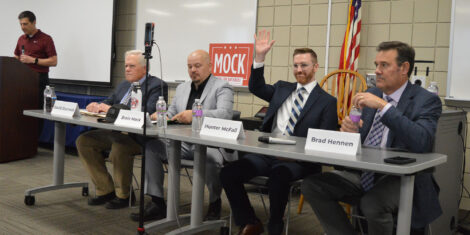
Speakers included candidates David Sturrock, Hunter McFall, Brad Hennen, and Brian Mock. Mock, a Lynd resident, previously running for Minnesota state Senate in District 15, but did not receive the Republican party endorsement. He is now running for state House.
Hennen is a Ghent resident, with a background in agriculture and agricultural sales. McFall is from Granite Falls, and is a paramedic and EMS educator. Sturrock is a Marshall resident and former Marshall City Council member. He is a political science professor at Southwest Minnesota State University.
Over the course of Tuesday's forum, participants were given a chance to say what made them stand out as candidates. McFall said he had a unique perspective as an emergency services worker and a younger resident of greater Minnesota.
"We need to be able to bring our youth out here," McFall said. "We need to think about, how are we going to draw in new businesses? How are we going to keep businesses here, and afloat? Are we going to bring in individuals to fill in our growing job shortages out here?"
McFall said education was one way to help draw people to greater Minnesota.
When asked what his top priorities would be if elected, McFall said he couldn't narrow it down to one issue. "Our district is very diverse in the issues we have going on, that are facing our constituency," he said. "If our farmers are struggling, everybody else is struggling. If our health care workers are struggling, everybody else is struggling. We can't just narrow in on one individual thing."
Mock said there was a lot that set him apart as a candidate. During the forum, Mock discussed his experiences being charged and imprisoned for being part of the Jan. 6, 2021, riots in Washington, D.C. He also said he supported smaller government.
"We're going into a deficit now, and we have to start removing certain things. We have to get that budget in line, and the only way to do that is start cutting a whole bunch of programs," Mock said. "I'm making a stand, and nobody else is doing it."
Mock said his top priority if elected would be not working within the system.
"We've all figured out the system is broken," Mock said. Mock added that there was a "Marxist takeover" going on in Minnesota. "The first priority is, we start fighting. I'm going to show people the way."
Sturrock talked about his record as a community activist in southwest Minnesota, and being active with the Republican Party.
"I have gone to St. Paul many times to advocate for the things that make a difference to the future of our region, chiefly on highways, bridges, water systems," Sturrock said. He said he also wrote the grant for the bypass lanes built on Minnesota Highway 23 in southwest Minnesota.
Sturrock said some of his key priorities if elected would be to "do his homework" as a legislator, as well as to establish "a serious whistleblower protection law" in Minnesota.
"Where I have the greatest strength, probably, is in the wide variety of experiences that I have been able to partake," including as a business owner, salesman and more, Hennen said. "I've been able to lobby in St. Paul and D.C. on behalf of other people, and I think, being able to articulate our values and our principles in a way that resonates with other people."
Hennen said area residents had told him that fraud in Minnesota was a key thing that needed to be addressed.
"Clearly in my talks with you to this point, fraud has been the number one issue," he said.
Hennen said other priority concerns included taxes and regulations, supporting basic freedoms, health care and child care.
Forum moderators said they received a number of questions from audience members asking what candidates would do to fight fraud in Minnesota.
Hennen said the process of stopping fraud was one that would take time.
"I hope that independents and even Democrats recognize how serious the problem is, and that'll help us have more leverage to do things next year," Hennen said.
Prosecuting fraud would be important, but so was preventing fraud in the future, he said.
"Nobody should be receiving money from our state unless they have proven that they are fiscally responsible with their own finances, as well as any organization that they've worked with," he said.
McFall said a bill to create an independent Office of Inspector General needed to make more headway.
"This is our government's way of holding these people accountable and having a separate power from the executive branch," McFall said.
He said accountability was needed on both sides of the aisle in state government.
"Working forward, how do we prevent this from happening again? The OIG bill, we go through full prosecutions, we investigate every last bit of fraud to figure out how this happened," he said.
"First we deal with the evils that have happened. That means prosecutions for the folks who have broken the law," Sturrock said.
He said so far that has been difficult with Democratic public officials like Gov. Tim Walz and Attorney General Keith Ellison, but a bill to create an OIG was moving forward. Sturrock said Minnesota also needed site visits for service providers, and protections for people reporting fraud.
"We need a strong, serious whistleblower law in this state, which we do not have," Sturrock said.
Mock's answer diverged from the rest of the panel. He criticized the proposal of an OIG.
"It's going to be a good politician answer, and that's all it's ever going to be. The way that we fight back is we say, absolutely no," Mock said.
Mock's proposal was to target unconstitutional laws in Minnesota.
"We're going to go after very specific laws, because there's a whole bunch of them that are overreach, and we know for a fact that specific ones, the Supreme Court is going to fast-track."
Another question from the audience was how candidates would change Minnesota's paid family and medical leave program.
"I can understand parts of the concept of it, but this was rushed," McFall said of the program. "They rushed into it, the Democrats wanted to win, and it has been a complete debacle."
McFall said Minnesota needed to go back and re-work the plan.
"It needs to be repealed, and go through the process more thoughtfully, and we need to work through a comprehensive plan on how we're going to implement something like this," he said.
Sturrock said Minnesota "at the very least" needed to tighten up some of the requirements in paid family and medical leave, including documenting what the family or medical need for leave was. "We have to review them," he said.
Hennen said the state needed to change its approach to implementing new programs, especially if they carried large costs. For example, he said, "If you indeed do have a new program that you want to implement at the state level, it should be done on a micro level. Try it on a small scale, first of all," Hennen said.
Mock's response to the question clashed with other candidates again, and he said Minnesotans needed to fight back against the creation of a welfare state.
"We're at crisis level. There isn't a tomorrow. You cannot elect a nice guy again. You cannot elect someone who's going to reach across the aisle. There is no aisle to reach across," Mock said.