
Springfield Public School’s music program receives national recognition
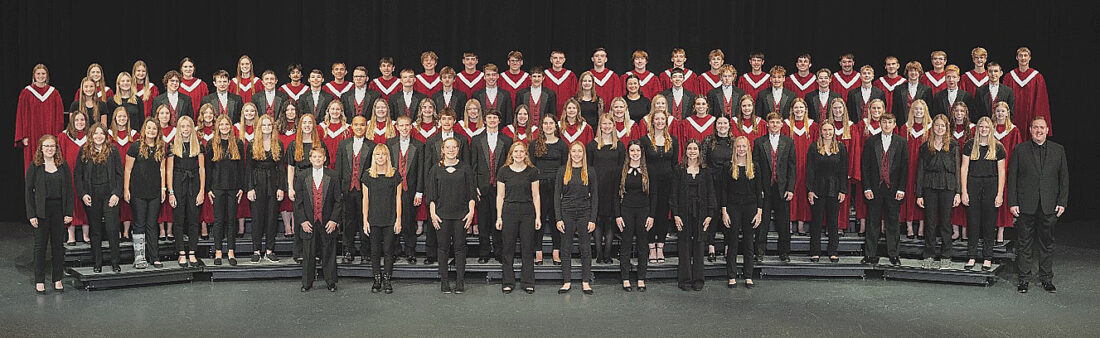
Submitted photoThe current Springfield High School Concert Choir and Concert Band members are pictured with directors Erin Oberle (front row, left) and Bailey Cords (front row, right).
SPRINGFIELD — Springfield Public School has been honored with the Best Communities for Music Education designation from The NAMM Foundation for its outstanding commitment to music education. Now in its 24th year, the Best Communities for Music Education designation is awarded to districts that demonstrate outstanding achievement in efforts to provide music access and education to all students.
To qualify for the Best Communities designation, the music education staff answered detailed questions about funding, graduation requirements, music class participation, instruction time, facilities, support for the music program and community music-making programs. Responses were verified by school officials and reviewed by The Music Research Institute at the University of Kansas.
“I am very proud of the Springfield community being recognized for the second year in a row as a Best Community for Music Education. The Springfield School District tradition of excellence in music and fine arts program is alive and well. This is directly related to the dedicated and passionate work of Mr. Bailey Cords, vocal music instructor; Ms. Erin Oberle, instrumental music instructor; and Ms. Andrea Berends, elementary music instructor. I am grateful for this team,” said Keith Kottke, Superintendent of Springfield Public School.
“Being selected as a Best Community for Music Education is truly indicative of our school community’s realization of and commitment to the academic, social, emotional, and personal benefits children attain by making music together,” said Kottke.
Research into music education continues to demonstrate educational/cognitive and social skill benefits for children who make music: After two years of music education, researchers found that participants showed more substantial improvements in how the brain processes speech and reading scores than their less-involved peers and that students who are involved in music are not only more likely to graduate high school but also to attend college as well.
In addition, everyday listening skills are stronger in musically trained children than in those without music training. Significantly, listening skills are closely tied to the ability to: perceive speech in a noisy background, pay attention, and keep sounds in memory. Later in life, individuals who took music lessons as children show stronger neural processing of sound: young adults and even older adults who have not played an instrument for up to 50 years show enhanced neural processing compared to their peers.
Local News
Graze Food Co-op reports strong year

Sleepy Eye Board OKs elementary principal posting

Searching for a cure for Type 2 diabetes

Captain Bianchi returns to NU Friday
Airport engineering services for crosswind project approved
NEW ULM - The New Ulm City Council approved $245,448 task order to the city’s professional service contract with ...
209 Pub & Grill secures noise variance for fundraiser
NEW ULM - The New Ulm City Council approved a noise variance on Tuesday for a fundraising event hosted by 209 Pub ...