LaFramboise descendent details U.S.-Dakota War outside of NU
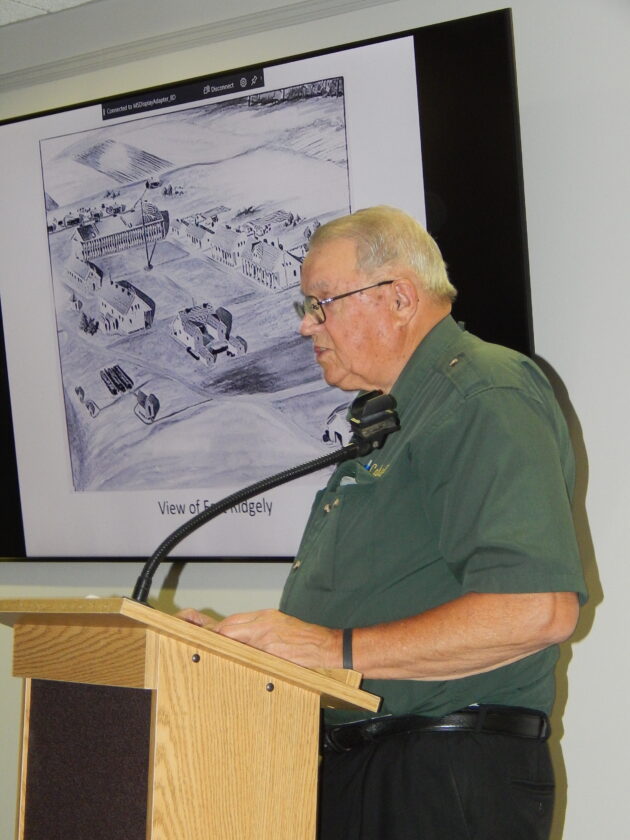
Staff photo by Fritz Busch In front of an artist’s view of Fort Ridgely more than a century and a half ago, Jerry Weldy of Franklin details the U.S.-Dakota War of 1862 outside of New Ulm at the Brown County Museum Annex Thursday.
NEW ULM — A descendent of fur trader and Sioux interpreter Joseph LaFramboise spoke about the U.S.-Dakota War of 1862 at Fort Ridgely and Birch Coulee battlefields in great detail at the Brown County Museum Annex Thursday.
“My roots run deep. I was born two miles west of Fort Ridgely,” said Franklin historian and volunteer Jerry Weldy. “I expect to do a presentation on the LaFramboise family in the future.”
“The Acton murders were the spark that lit the fire. After the four young braves returned to Rice Creek Camp, (Chief) Little Crow was asked to lead the war party,” said Weldy. “He was against the fight and against killing settlers. He signed on to be the leader after being called a coward. But, for the most part, the younger (native) men didn’t listen to him.”
Weldy said all Fort Ridgely buildings were originally intended to be made of granite (stones), but in the end only two were, a bunkhouse and the commissary. Some of the other buildings had granite basements and/or granite footings but were made mostly of wood either built in the area or brought upriver on steamboats.
“There was no fortification, no fence, no stockade,” said Weldy. “There was open prairie to the northwest, a small creek to the northeast and a river valley to the south. There was no well on the site. Water was gathered from the creek or from springs to the south and northeast.”
Weldy said settlers and Indians could walk into the fort and trade in the early years.
He said the Washington DC Treaty of 1858 was done by tribal elders without any consultation with tribal members back home, leading to problems with younger male tribal members.
“Annuity payments came and Indian agents stressed Dakota farming with mixed results. Those who chose to farm were harassed by non-farmers,” said Weldy.
Weldy said Little Crow wanted to attack Fort Ridgley Aug. 19, 1862 but some of his troops decided to go on the south side of the Minnesota River and attack Milford and the western parts of New Ulm.
Weldy said the first attack on Fort Ridgely was thwarted by the use of a Howitzer cannon that fired 18-pound cannon balls up to three-quarters of a mile.
“Most of Little Crow’s warriors wanted him to lead them but they were very poorly organized. Two of the sub-chiefs refused to bring their men into the battle,” Weldy said. “About 400 Indians fired on the east side of the fort.”
Civilians were quickly trained to fire cannons. About 50 Renville Rangers and Civil War troops from as far away as Fillmore County arrived but very few had battle experience. But one of them was a gunsmith, who repaired weapons.
Weldy said a stagecoach arrived with $71,000 in gold and silver annuity payments that were stored in a lower part of the large stone barracks.
“The Dakota would yell to each other their attack plans, but the Renville Rangers (many of them 17-18-year-old half-Dakota) often understand what the Dakota were saying,” said Weldy. “The Dakota burned some buildings but damp roofs prevented more fire damage.”
Dakota charges on the fort were met by cannon fire, before they retreated.
Weldy said there were more Dakota at the Fort Ridgely attack but they were unorganized and threatened by rain. Dakota attacks did not get close to the fort due to cannon fire.
The battle of Fort Ridgely is considered the first successful use of artillery against native forces and showed the desperation of forcing civilians, including women and children to help fight off the Dakota.
Weldy said bullets were in so much demand, women spent hours picking up spent ammunition.
The Siege of Fort Ridgely and battles for New Ulm were considered the turning point of the U.S.-Dakota War. After those battles, the Dakota suffered defeat after defeat until they were either killed or captured.
The Battle of Birch Coulee, north of Morton, was considered one of the hardest-fought battles of the U.S.-Dakota War. It lasted 36 hours.
On Sept. 1, 1862, about 160 soldiers and civilians under the command of Maj. Joseph R. Brown, were sent from Fort Ridgely to bury the remains of settlers who died in the early weeks of the war.
That night, about 200 Dakota surrounded their camp and began firing just before sunrise.
Weldy said Brown was hit in the side of the neck by gunfire and was treated by a doctor at Birch Coulee.
“The heavy fighting lasted an hour or two. After that, it was a 36 hour seige (encirclement),” said Weldy. “The troops were soon out of food and water while the Dakota were comfortable. They had cover and the women came up to feed them.”
Weldy said the half-Dakota Renville Rangers were told by the Dakota through an interpreter they could leave if they wanted to but none of them left the battle.
Fighting lasted until the morning of Sept. 3 when Henry Sibley arrived with reinforcements and artillery from Fort Ridgely, which convinced the Dakota to leave.
Communities
For the love of trout
Sleepy Eye school board OKs Class of 2027 trip
SLEEPY EYE — After hearing about the recent Class of 2026 trip to Florida, the Sleepy Eye School Board ...

BCHS exhibit on Wanda Gág opens Saturday
Panel challenges traditional stigmas surrounding Autism
Fraud messaging in Brown Co. ‘frightening’
NEW ULM — Law enforcement is urging Brown County residents to remain vigilant as a wave of sophisticated scams ...