Why are dragonflies swarming in NU area?
DNR biologist says no cause for alarm; flying insect beneficial for pest control
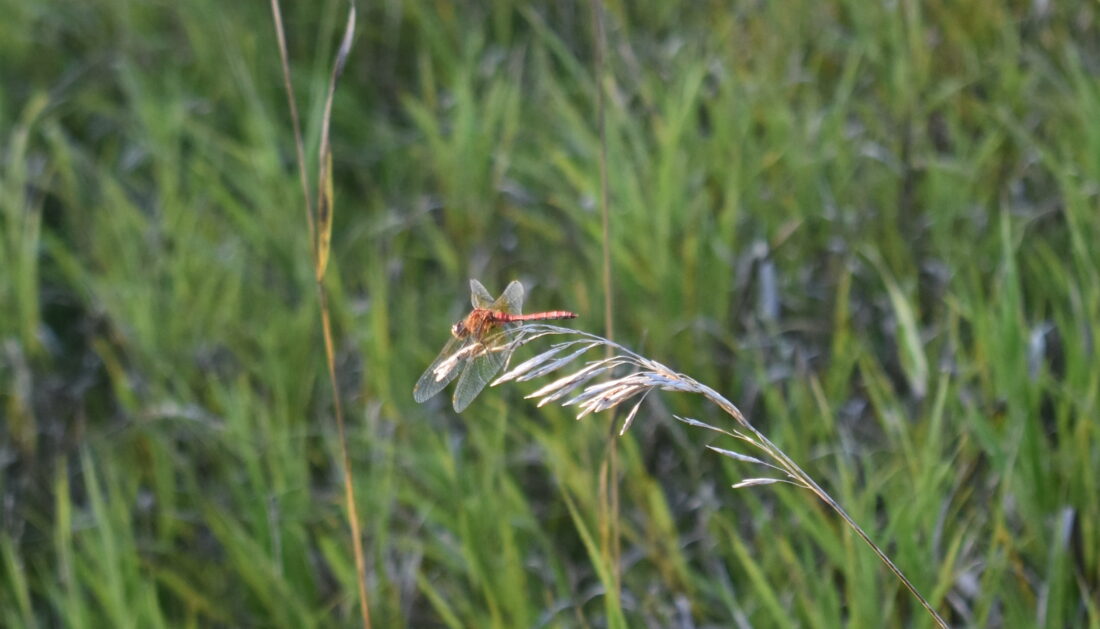
Staff photo by Clay Schuldt A dragonfly is pictured near the North Broadway Pollinator Park early Wednesday evening. A number of people have reported dragonfly swarms lately. Swarms typically occur at dawn or dusk and may be due to recent rainfall.
NEW ULM — Recent reports of dragonfly swarms in and around New Ulm in recent days may not be unusual or cause for alarm.
“It may be that additional rain and available habitat has created more places for dragonflies to develop,” said DNR Aquatic Invertebrate Biologist Don Eaton.
Mother Nature may have a hand in for it too.
“The males of a number of dragonfly species form large mating swarms that they use to attract females. The females fly through the swarm, mate, and lay eggs on nearby ponds and wetlands,” Eaton said.
“Damselflies (similar to dragonflies) tend to pair up, male-female, sometimes in large numbers, then walk as a pair backwards into the water along an aquatic plant stem to lay eggs,” he said.
Dragonflies can be considered beneficial insects, a form of natural pest control. Their primary prey is some of the most troublesome pests you may find: mosquitoes, gnats, termites, gnats, flies and wasps.
“Dragonfly adults and larvae are extremely beneficial as predators of mosquitoes in the air and the larvae in the water. So, having more is a good thing,” he said.
There are an estimated 5,500 to 6,500 dragonflies and damselflies in the world and about 140 total species in Minnesota, about the same number as there are butterflies, according to the DNR.
“Dragonflies are an aeronautical marvel. They can hover, glide and pursue prey like mosquitoes at speeds up to 29 inches per second. They are an aggressive and voracious predator that eat small flies, mosquitoes, butterflies, moths, smaller dragonflies and fish,” reports the DNR.
Dragonflies and damselflies are not known to bite humans.
The DNR Non-game Wildlife Program initiated an annual volunteer dragonfly survey so citizens can help collect information on the distribution of Minnesota dragonflies. For more information, visit www.mndragonfly.org.
Local News

Springfield girls lead Leg 1 of Tomahawk-Valley tourney

SEU freshmen strong in Tomahawk-Valley boys opener
Don’t get ‘ticked’ off this summer
NEW ULM — Don’t let ticks get the best of you this year. That was the advice of Brown County Public Health ...

GFW board OKs FY 27 budget reductions

Looking on the bright side