Take it or leaf it???
City ponders leaf vacuum acquisition
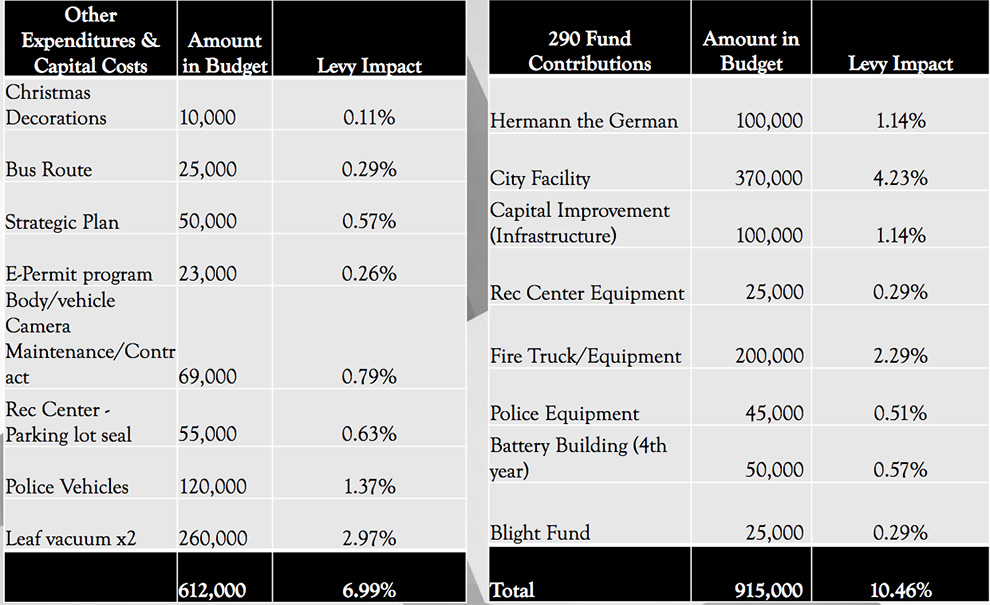
This graphic from the City of New Ulm shows the various proposed items in the city's budget for next year and their impact on the property tax levy.
-
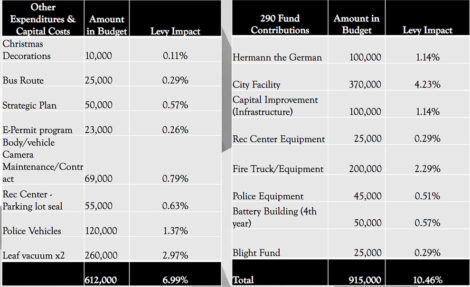
- This graphic from the City of New Ulm shows the various proposed items in the city’s budget for next year and their impact on the property tax levy.
-
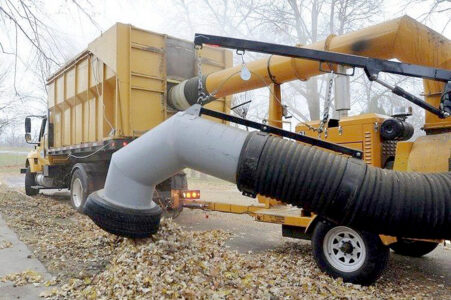
- A North Mankato crew uses a leaf vacuum in fall 2014 to suck up leaves placed curbside during the annual service provided to residents. (File photo courtesy of The Free Press, Mankato)
Every autumn when the leaves start to fall, New Ulm property owners rake up leaves into piles and bag them for transport to a compost site. This could all change in 2023 as the city debates whether to purchase two new leaf vacuums.
Leaf vacuums come in a variety of sizes, including industrial pull-behind vacuums. The pull-behind vacuums are attached to a tractor and pulled along a city street. A special neck attachment sucks up leaves left along the boulevard. The leaves are cut up into mulch and deposited into a collector bag.
In cities like North Mankato and Hutchinson, a leaf vacuum program is an annual part of maintenance. In the fall, instead of raking and bagging leaves, property owners rake to the curb and a city-owned leaf vacuum comes by and collects the leaves for them.
The program reduces lawn maintenance for the community and keeps the city looking clean. Vacuuming up the leaves prevents them from getting into the storm sewers and reduces stress on the regular street sweeper. Fewer plastic bags need to be used to collect leaves.
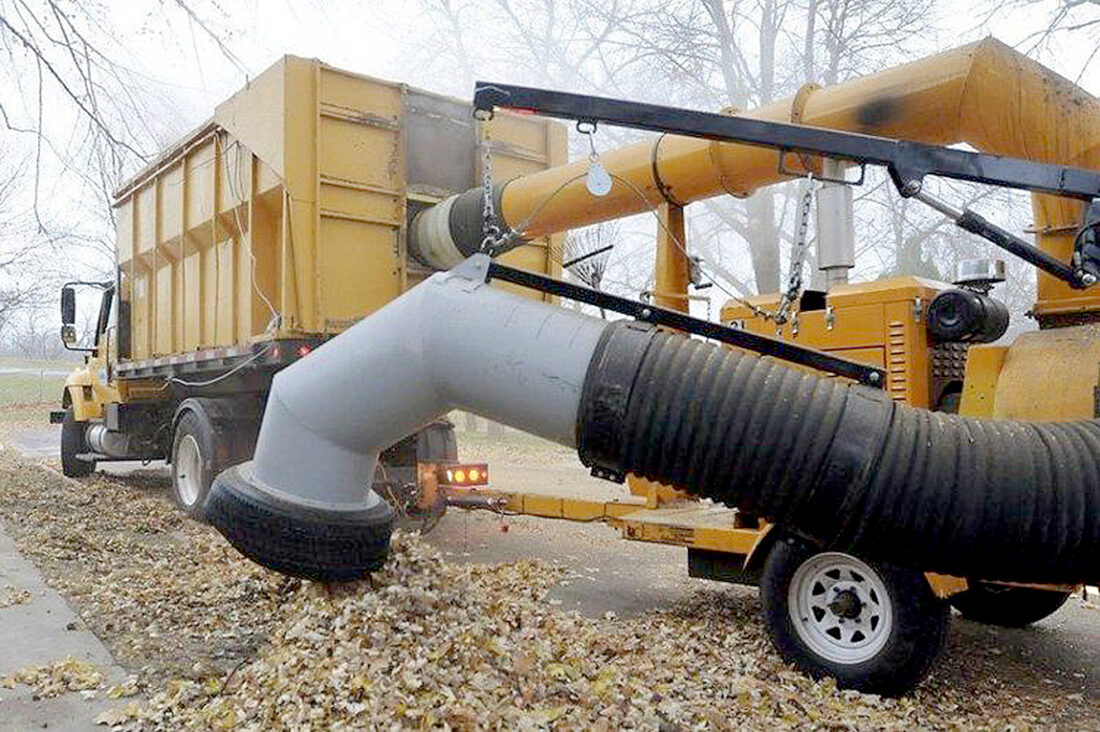
A North Mankato crew uses a leaf vacuum in fall 2014 to suck up leaves placed curbside during the annual service provided to residents. (File photo courtesy of The Free Press, Mankato)
As it currently stands, New Ulm’s 2023 budget includes the purchase of two new leaf vacuums. The leaf vacuums are estimated to cost $130,000 each for a total of $260,000. The two leaf vacuums represent some of the largest increases to New Ulm’s property tax levy, a nearly 3% impact. The question is whether New Ulm residents feel a leaf vacuum program is worth the additional cost.
Based on comments from the City Council during the Dec. 6 Truth in Taxation meeting, the public is supporting the leaf vacuum program.
Councilors David Christian and Eric Warmka both said the majority of people they spoke to favor having a leaf clean-up system.
Councilor Les Schultz has been the most outspoken in favor of the leaf vacuum program. Schultz said he first proposed the idea ten years ago, but the economy was in rougher shape and the city was looking to cut from the budget rather than add. A decade later, Schultz feels the time is right for the program.
“We have a beautiful city with lots of trees and lots of leaves,” Schultz said during the tax hearing. “I would like to see our city provide this service to our citizens.”
Schultz argued many cities in Minnesota already have a leaf vacuum program and New Ulm is one of the few cities of its size without a program. Though the program does come without a start-up cost, he believes residents will support it once it is in place.
Support for the leaf vacuum program among the city council is not universal. Councilor Larry Mack stated he does not support the purchase of a leaf vacuum system at this time. He considered the vacuums a want and not a need.
During the tax hearing, Mack said he would rather use the money for other maintenance needs, such as the Hermann Monument restoration. He was also concerned with the many unknowns connected to the leaf vacuum program.
Mack said he would need to see a working budget for the program before he could support a purchase.
Some of the unknowns include additional costs and staffing for the program. Mack also question the life expectancy of the leaf vacuum equipment and whether now was the correct time for purchase. There is also a concern about storage for the vacuums.
Public Works Superintendent Jeff Hoffmann said the city does not currently have indoor space available for the vacuums. There is concern that leaving the vacuums outdoors could create further maintenance issues.
Hoffmann recommended the city purchase new leaf vacuums instead of used ones. The life expectancy of a leaf vacuum is between eight and ten years. Buying a used vacuum would be cheaper, but would likely come with additional maintenance issues.
If New Ulm moves forward with purchasing the leaf vacuum program, the city will need to develop a new system for using the equipment.
Hoffmann was confident the city could run a leaf vacuum program without hiring additional staff but was uncertain how much staff time was needed to run it.
New Ulm has 99 miles of streets, most of which are lined with trees. Until the program is running, it is the best guest and how long it will take to run a leaf vacuum through all the streets. In addition, leaves do not fall all at once. It is anticipated the leaf vacuums will need to make multiple passes through the city.
Hoffmann said the city of Hutchinson typically needs to run its leaf vacuum through their city four times. New Ulm would likely have a similar schedule.
The city would need to lease a tractor to pull the leaf vacuum. It is unknown how many hours the city would need to budget to lease a tractor, but at $75 an hour, it would cost $7,500 for 100 of use.
In addition to operational costs, property owners would need to be notified in advance when the vacuum was coming and how to prepare.
This is one of the reasons most cities with a leaf vacuum program have two or more vacuums. Multiple vacuums allow staff to cover more of the city. There is also an extra vacuum available in case of a breakdown.
Hoffmann said in conversations with other communities with a leaf vacuum program, it can take between three to five years for the public to get comfortable with the schedule and understand the collection procedures.
It is important residents understand that a leaf vacuum is only able to collect leaves.
Sticks, pumpkins, or other large debris can damage the vacuum. It is also important that residents rake leaves to the boulevard edge and not push the leaves into the street.
In addition to violating the city ordinance, a pile-up of leaves on the city street could create greater problems if a rain or snow event occurs before collection. One of the benefits of a leaf vacuum is it can keep leaves out of storm sewers, but if citizens are incorrectly raking leaves into the street, this would defeat the entire purpose of the program.
Despite these unknowns, Schultz favors the leaf vacuum program. He acknowledge there were still questions about how the program could run, but the city had time to find answers to the question before next fall.
Schultz’s greatest concern was the leaf vacuum program would continually be delayed because of unknowns. During the tax hearing, he said there would always be a reason not to move forward.
“I hope we don’t dog it down and come up with reasons why we can’t and instead look for ways we can make this work,” Schultz said.
The city council is scheduled to approve the final 2023 budget on Tuesday, Dec. 20.
Local News

Springfield girls lead Leg 1 of Tomahawk-Valley tourney

SEU freshmen strong in Tomahawk-Valley boys opener
Don’t get ‘ticked’ off this summer
NEW ULM — Don’t let ticks get the best of you this year. That was the advice of Brown County Public Health ...
GFW board OKs FY 27 budget reductions
Looking on the bright side