COVID concerns continue to top list of local stories in 2021
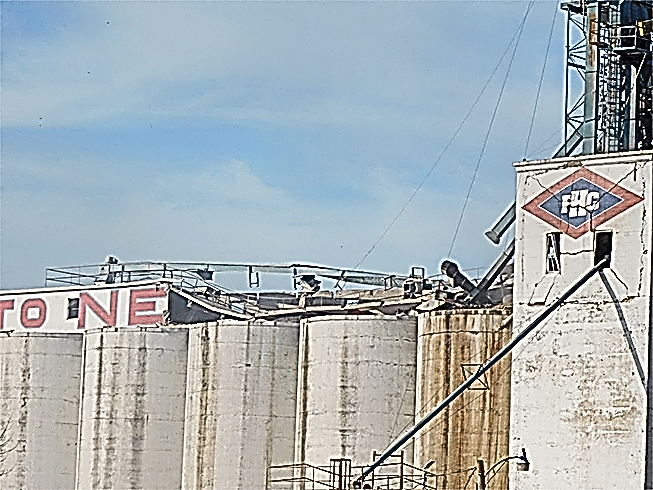
Journal File Photo The “Welcome to New Ulm” sign atop the Farmers Co-op of Hanska elevator in New Ulm was demolished by an evening explosion on June 1. It was the second grain elevator explosion of the day after the Christensen Farmer elevator in Sleepy Eye had a fire and explosion early in the morning.
NEW ULM — In choosing the top ten local stories of 2021 in The Journal area, the one that people hoped would be fading in the distance by now continued to affect lives across the board. The COVID-19 pandemic continues to affect many aspects of people’s lives, from their health to their jobs, from schools to hospitals. It is the top news story of the year, as selected by Journal news staff.
Also on the list are:
2. Two grain elevators exploding in New Ulm and Sleepy Eye on the same day in June.
3. Mayor Robert Beussman resigns at the suggestion of the city council and is replaced by Terry Sveine.
4. The completion of the Reinvest in New Ulm projects
5. District 88’s new CTE center opens to students
6. Masking policy and the possibility of CRT being taught in schools bring audiences with questions and comments to the District 88 school board meetings.
7. The City of New Ulm gets out of the economic development business after assistant city manager/ED coordinator Audra Shaneman resigns, and the money for that position is shifted to other needs.
8. Plans for Vietnam Veterans memorial in German Park stirs passions for and against.
9. George’s Ballroom seems to be once again heading for demolition.
10. New Ulm is the city of festivals once more as crowds return for Bavarian Blast, Hermann Fest and Oktoberfest.
1.) COVID-19 continues to have a major impact on stories big and small
For the second year in a row, the COVID-19 pandemic dominated nearly every news story. The pandemic has been a global problem for over a year and continues to impact nearly every aspect of daily life. Even local news stories not directly about the virus still fell in the shadow of the pandemic.
In January 2021, Brown County was recovering after experiencing the two worst months of the pandemic. November 2020 saw over 1,000 cases hit the county and December saw over 500 more.
The new year started with students going back to in-person learning after many schools were forced into distance learning in November 2020.
The return to in-person learning was made possible by new COVID-19 vaccines created by Pfizer and Moderna. By the start of 2021, the vaccine was being administered to frontline healthcare workers, teachers and senior citizens.
The vaccine was administered free of charge, but in the early months, only certain people were eligible. By spring, nearly all adults were eligible for the vaccine.
COVID restrictions were dialed back as case numbers dropped and vaccination climbed. COVID deaths in Brown County stopped.
Some precautions remained in place. Schell’s annual Bockfest was canceled in early March, but by summer the state and county were pushing for a return to normalcy.
In June, most businesses were reopening without restrictions. Gov. Tim Walz ended the statewide emergency on July 1. Masking mandates were relaxed. New Ulm saw a return of festivals, first with Bavarian Blast in late July.
COVID numbers were extremely low during the early summer. Brown County Public Health recorded only five COVID cases in June and less than 20 in July. However, the pandemic was not over.
The county’s monthly case counts return to the hundreds in August as more people began holding large gatherings without masks and a new strain of COVID called Delta was proving to be more aggressive.
The demand for the COVID vaccine had also dropped. Nationwide, many were resistant to getting the vaccine and most school-age students were still not eligible.
As the new school year was preparing to start, there were difficult questions about whether masking should be necessary. The masking question resulted in one of the most controversial and most well attended New Ulm School school board meetings. This marked the beginning of heightened community interest in school board activities that continued through the rest of the year.
COVID cases continued to rise in Brown County through the fall despite over half the county being vaccinated. The majority of cases were among the unvaccinated. The fall surge peaked in October 2021 with 557 new cases. This was the worst month for COVID cases in 2021 and the third-highest case count since the start of the pandemic.
The rise in case numbers also brought COVID deaths. The county had avoided COVID-related deaths in the summer, but numbers spiked with the surge.
Vaccination rates increase in Brown County, but at the same time vaccine, mandate protests started. Concerned about the federal mandate requiring businesses with 100 or more employees to require vaccination led to nationwide protests. Multiple anti-vaccine mandate protests were held in New Ulm.
In early November the COVID vaccine was approved for children 5-11 years. This led to a spike in Brown County’s vaccine rate. Those already vaccinated were able to get a third booster shot.
Statewide, hospitals began to struggle with capacity. The surge of COVID cases has left a limited number of ICU beds. Some hospitals have been forced to postpone elective surgeries.
In late November, Minnesota became the second state in the U.S. to identify the Omicron variant of COVID. The Omicron variant has started to spread throughout all of the United States.
As 2021 comes to a close, 64.6% of Brown County’s 5 years and older population is fully vaccinated.
One year ago, Brown County COVID statistics were 1,999 cases and 32 deaths. As of Dec. 30, 2021, the numbers are 5014 cases and 66 deaths.
2.) Two separate grain elevator explosions rock Sleepy Eye and New Ulm on the same day
At 4:38 a.m. Tuesday, June 1, 2021 a fire started at Christensen Farms feed mill near Sleepy Eye. An explosion in the southeast elevator blew the roof off. The Sleepy Eye Fire Department and other local fire crews responded to the incident. Fortunately, the blast from the explosion put out most of the fire. Firefighters were able to contain the burn relatively fast. No injuries were reported.
Fourteen hours after the explosion at Christensen Farms, at 6:30 p.m. the Farmers Cooperative of Hanska (FCH) elevator in New Ulm also exploded.
The is explosion was heard throughout the town and felt blocks away.
A surveillance camera at the nearby Minnesota Valley Transport caught a video of the explosion.
Half of the Welcome to New Ulm sign atop the FCH elevator was destroyed instantly. Debris fell to the ground, causing a fire to form at the base of the elevator.
One man was injured at the FCH explosion from falling debris. Before paramedics or fire departments arrived, individuals on-site were pouring water on the burned man. He was later taken from the scene by ambulance.
Most of the departments who responded to the Christensen Farms explosion also responded to the FCH fire.
Within a day, Brown County Sheriff’s office ruled out foul play as the cause of the two explosions.
Elevator fires are not uncommon. Grain elevators produce highly explosive dust. Several similar fires have been reported at grain elevators in southern Minnesota. However, two explosions happening in Brown County on the same day was a rarity.
Even stranger, the FCH explosion happen hours after the New Ulm City Council voted to appoint Terry Sveine mayor. Normally, the appointment of a new mayor would be the top news story of the day, but June 1 was anything but normal in Brown County.
A demolition crew would begin tearing down the FCH elevator in late July. The structure could not be salvaged after the explosion. FCH plans to rebuild the bins in the same location.
3.) Mayor Robert Beussman resigns, Mayor Terry Sveine is hired
In April, New Ulm Mayor Robert Beussman announced he planned to retire after 11 years as mayor. Beussman’s resignation came after receiving a letter signed by the city council requesting he resign. The council believes the Mayor’s ability to perform his duties was compromised.
Following the resignation of Beussman, the city began the search to appoint a replacement to complete Beussman’s term that expires on Dec. 31, 2022.
Initially, nine candidates applied for the position. One of the applicants was removed because the city code restricted anyone with immediate family working for the city from holding public office. Another candidate was disqualified because of two felony convictions.
The council would interview seven candidates: Charalee Reinhart-Kalk, Justin Mattson, Terry Sveine, Jeremy Reed, Micah Roux, Richard Seeboth and Michelle Markgraf.
Each city council kept an individual tally sheet score applicants during the interview. Ultimately, Terry Sveine and Michell Markgraf tied for the highest score. After deliberating, the council was leaning toward Sveine. He was ultimately chosen to replace Beussman as New Ulm’s mayor on June 1. Sveine took the oath of office on June 16.
During the appointment process, the city once again grappled with the nepotism clause in the city charter that prevented elected officials from having family work for the city. One of the mayoral candidates was removed from consideration because of the clause.
In 2020, Second Ward City Councilor Lisa Fischer was forced to resign from the council because her son worked for the city. A month later, after Council President Andrea Boettger was elected, her husband was also forced to leave a part-time position with park and recreation.
During the summer, the League of Women Voters (LWV) looked into the city charter. In the fall, the LWV lobbied the city to remove the nepotism clause from the charter. The City Council agreed to reconvene the Charter Commission. A new member needed to be appointed to the commission to fill a vacancy. Michelle Markgraf was appointed to serve this position.
4.) The Reinvest in New Ulm (RENU) projects were completed
The last Reinvest in New Ulm (RENU) project was completed in the fall. The construction of the new aquatic center and gymnastic center were finished and open to the public.
The RENU projects were created using the half-percent sales tax approved in 2016 by the voter referendum. The list of projects included improvements to Johnson Park grandstands, Hermann Heights parking lot and the creation of aquatic and gymnastic facilities at the Recreation Center. The cost of the project is approximately $14.8 million.
These projects represented significant improvements and expansions to New Ulm’s park system.
Outside of RENU, the parks department saw the new amphitheater in German Park used for the first time in 2021 after construction finished in 2020.
The first theatre performance at the amphitheater was held in May by Martin Luther College.
The amphitheater ribbon-cutting ceremony was held in June. Several concerts were held in the park throughout the summer months. Fundraising continues to purchase a shade structure for the amphitheater.
5.) District 88 School Board’s new Career and Technical Education (CTE) Center opens to students.
In February, The District 88 School Board agreed to purchase a property at 208 N. Valley Street and 125 N. 3rd Street for the creation of a Career and Technical Education (CTE) Center.
The property was ultimately donated to District 88 by the Ryberg family. The New Ulm Economic Development Corporation (NUEDC) would also donate $750,000 to the project. The organization believed workforce development was important for New Ulm. The New Ulm Economic Development Authority (EDA) had agreed to give the CTE Center $100,000 in 2020.
Other groups would donate funds to the CTE Center throughout the year. Around $2 million in donations were received. The community expressed strongly to support the center.
The purpose of the CTE Center is to provide students and adults with education in the areas of manufacturing, machining, construction, automotive repair, small gas engines and autobody repair. Construction education would include training for plumbing, electricians and carpentry work. The center will provide hands-on learning and provide opportunities for adults who may be considering a career change.
The center has more than 30,000 square feet for students to work in a variety of classes and projects.
The CTE Center officially opened to students in the fall. All students in Dist. 88 boundaries can enroll in CTE courses. After the 2021-22 school year, enrollment will expand to students in other districts.
6.) The public begins using School Board meetings to air grievances on masking mandates and Critical Race Theory
The New Ulm School Board was one of several school districts nationwide that saw a significant uptick in public interest related to school policy and curriculum. Starting in July, the New Ulm school board started to receive higher attendance from the public. Initially, the attendance was from parents and community members concerned about whether the school would require masking in the fall.
The board was set to decide on masking during the Aug. 26 meeting. Attendance at this meeting was beyond capacity for the district board room. The meeting was held in the middle school gym to accommodate the crowd. Several members of the public spoke during the meeting to state their opinion on whether masking should be allowed during the school year. The board was unable to reach a majority consensus on whether making should be mandatory. As a result, it defaulted to not requiring masks.
Public interest in school board activities continued after the August meeting, but the area of concern shifted.
In September, the board meeting was once again filled beyond capacity. Some of the public wanted to address the masking policy again, but most voiced opposition to Critical Race Theory (CRT).
New Ulm’s school board was taking part in equity training during a work session. Some of the community feared equity training was a coded way of introducing CRT in the curriculum.
New Ulm’s school district was not alone in facing backlash from people opposed to CRT. School boards across the country were filled with citizens who believed CRT was a major threat to students.
7.) New Ulm Assistant City Manager/Economic Development Director Audra Shaneman resigns as the city prepares to cut position
Three years after creating the position of Assistant City Manager/Economic Development Director, New Ulm city staff recommended cutting the position from the city budget at the end of the year.
Rather than wait for the position to be cut, Assistant City Manager/Economic Development Director Audra Shaneman agreed to resign in exchange for a severance agreement. The council ultimately approved the severance agreement.
Shaneman had served as Assistant City Manager since 2019. She had replaced the former Assistant City Manager, Chris Dalton, who was promoted to City Manager following the resignation of former City Manager Brian Gramentz.
Dalton had only become the Assistant City Manager/Economic Development Director in 2018. Before he was hired, the city was without an Assistant City Manager for years. The City Council decided in 2018 that the Assistant City Manager/Economic Development Director was vital. To cover the cost of the position, the city ended subsidy payments to New Ulm Economic Development Corporation (NUEDC). This resulted in NUEDC director Brian Tohal losing his position.
In October, the NUEDC asked the New Ulm Economic Development Authority for a subsidy to hire a new Economic Development Director.
8.) A Vietnam Memorial in German Park stirs many emotions
New Ulm accepted the donation of a memorial honoring six New Ulm graduates who were killed in action during the Vietnam War: Dennis Wellman, Daniel Lloyd, Henry Polzin, Timothy Sullivan, Steven Seemann, and Rickey Slander.
The creation and purpose of the Vietnam Memorial were not controversial. The city and most residents viewed the monument as a positive for New Ulm, but there were concerns about placing it in German Park.
Some felt the memorial was not suited for German Park. This led to the creation of a committee to determine if an alternative option for a larger veterans memorial at a different location was possible. Ultimately German Park was viewed as the best option.
The donor of the monument, Bruce Lambrecht, said his primary focus was to create the Vietnam monument for German Park. He was willing to consider alternative locations but did not want to wait to memorialize the six veterans.
He presented a plan for a full Veterans Square that could be implemented over time, but his main focus was the Vietnam memorial.
Lambrecht’s plan alleviated the city council’s concerns and they unanimously voted to name the grass area around the U.S. flag pole in German Park “Veterans Square.”
9.) George’s Ballroom hits the bricks
The fate of George’s Ballroom was sealed in April. The New Ulm Heritage Preservation Commission (HPC) unanimously recommended the building’s demolition. A committee of developers, historians, demolition experts and other interested parties reviewed all alternatives but all agreed there were no opportunities to salvage the building. Even if the cost of rehabbing the building at an estimated $4 million or $5 million could be met, there was still a question of what to do with it. It would cost $30,000 a month cash flow to pay for it.
The ballroom now represents a safety hazard in terms of disrepair as well as toxic elements inside.
Following the HPC’s recommendation for demolition, it was estimated that it would take a year to receive approval from the state, submit and award bids for demo.
10.) The return of festivals
New Ulm, the city of festivals, saw the return of several annual celebrations after the pandemic forced the cancellation of several mass gatherings. The first major festival to return was “Bavarian Blast” in late July; “HermannFest” followed in September and Oktoberfest returned in the fall. Each of the returning festivals was well attended by individuals who missed the annual celebrations.
Local News
Potential rate increase for water and wastewater
‘With malice toward none’
NUPU reports strong electrical reliability in 2025
US citizenship in limbo for many applicants
NEW ULM — Naturalization oath ceremonies in Minnesota have decreased significantly, leaving some approved ...
Commissioners recognize county awardees, retirees