
West Point discipline is necessary, cadet says
West Point Cadet Dan Zimmerman walks erect in his immaculate gray uniform.
The short black brim of his hat is pulled snugly above his eyebrows, and when he removes the hat indoors he knows how to hold it just so.
His hair is short, his shoes are shined and his chest is thrust ward at all times.
There’s no flaunting grandiosity about it. Cadet Zimmerman of New Ulm says he is proud to be at West Point and that he owes much to his country.
“SOME PEOPLE think I’ve been propagandized,”‘ he says, laughing. Behind the militaristic air, Zimmerman is cheerful and at ease.
Zimmerman, the son of Mr. and Mrs. Del Zimmerman of New Ulm, is a sophomore at West Point and is back in New Ulm for a visit during spring break-one of the few times he’s been able to come home since leaving for the academy’s summer camp in 1974.
“At first I felt my friends would treat me strange,” he recalls, “but they didn’t.” That was at Christmas 1974.
“I’d kind of been excluded from the outside world and everybody around me had had short hair; then all of a sudden there was a switch.”
But now, he says, he doesn’t feel odd when he leaves the academy’s environment.
“When West Point takes a young individual out of high school you mature very quickly,”he says.”Just being away tends to do something to you.”
AT WEST POINT, however, another ingredient is added: pressure.
It becomes too much for many young men fresh out of high school, and the early drop-out rate is quite high, Zimmerman says.
The first-year students start their career at the academy by spending much of their first summer at boot camp.
Zimmerman’s class entered 1,435 students in 1974. By the end of the summer, he says, nearly 200 of them had packed their bags and gone home.
“At first they really keep you super busy,” he says. “They’re being really tough on you to see if you can take pressure and stress. Most of the first sumer they see if you have the mental ability to take pressure.”
AND AFTER boot camp, the pressure never really goes away.
Academically, the competition is keen.
“If you fail one subject, you go before an academic board to see if you’re fit to go on,” Zimmerman says.
The board, he explains, has three options. It can dismiss the student from school, it can place him back one year, or it can “‘condition” him, meaning he can go on in the course of study on the condition he not flunk again.
The cadets line up in formation at 6:10 a.m. every day for breakfast and again for lunch and dinner. They must be in their rooms by 11 p.m. and lights out by 1 a.m.
ALL CADETS are told how to appear and how to act, Zimmerman says.
How are they supposed to act? he was asked.
“Pretty straight, ” he answers, again smiling. “We’re not supposed to chew gum or smoke when we’re out in public.
“If you escort a girl you can’t hold her hand. She has to hold onto your arm,” he says, demonstrating with his arm in front of him.
All cadets face a demerit system. Breakage of rules of conduct and appearance result in demerits, and if demerits exceed a set monthly level, free time can be taken away.
ZIMMERMAN STEADFASTLY defends the pressure and the discipline.
“In most cases, it’s needed,” he says. “The main emphasis, when you’re done, is that you’ll be in charge of a platoon with 44 men in it. We’re trained for combat in the defense of our country. Their lives are in our hands.
“If you’re in a situation where someone’s going to die, you don’t want to say you’re unprepared.”
ZIMMERMAN’S COMBAT preparation will include three weeks of studying northern warfare in Alaska this summer.
He plans on studying chemical engineering through his final two years at West Point and when his five-year military obligation follows he hopes to be involved in either field artillery or armored artillery.
When he returns to the academy this fall there will be a historical change in that for the first time there will be women cadets, nearly 100 of them.
Zimmerman says the prevalent attitude now at the academy is that the cadets are against it.
“But the supervisor says we’ve got to do it,so the felling is that we’ll do it better than the rival academies.”
New Ulm Daily Journal
March 29, 1976
History
PERMANENT PAVING INJUNCTION GRANTED
Judge 1. M. Olsen Files Decision Against Proposed Minnesota Street Improvement, Monday. ———— CASE ...
West Point discipline is necessary, cadet says
West Point Cadet Dan Zimmerman walks erect in his immaculate gray uniform. The short black brim of his hat is ...

Turner girls win gym meet here
ARRANGE SPECIAL PROGRAMS EASTER SUNDAY SERVICES
Churches Will Be Decorated In Splendor With Lilies And Spring Flowers ———— UNUSUAL OFFERINGS BY ...
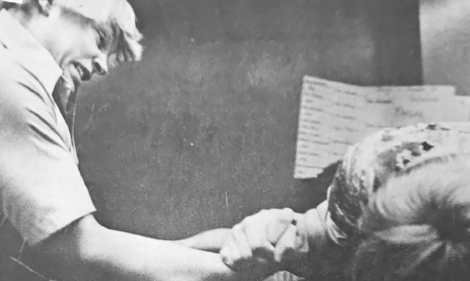
Arm Wrestling Heavyweight champ took it seriously
ALL SET FOR CITY ELECTION TUESDAY
Poll Will Be Open at the Different polling Places From 6 A.M. Until 8 ...