
MRS. WILHELMINA ALWIN ALMOST 99 YEARS WHEN DEATH CALLS

Mrs. Wilhelmina Alwin Peacefully Enters Final Sleep at Son’s Home,
Saturday Afternoon.
——–
MOTHER OF FIRST WHITE SON BORN IN BROWN CO.
——–
Lived Through Many
Tribulations and Perils
of Early Pioneer Life
in This Section.
——–
A long, active, eventful and highly interesting life closed its final chapter in this city, Saturday afternoon at 4o’clock, when Mrs. Wilhelmina. Alwin, nee Gruening, New Ulm’s oldest inhabitant, passed away at the home of her son, Ed. L. Alwin, North State street. Exactly one week prior to her demise, Mrs. Alwin had suffered a stroke of apoplexy, which paralyzed the right side of her body. Until two weeks before her death, she was quite robust, considering her advanced age, and was able to sit up in her easy chair. She remained conscious until the end, which came peacefully, recognizing her children and other relatives gathered about her deathbed, and a short time before passing away was heard to repeat the word “Home”several times, indicating that she was about to enter her heavenly abode.
Nearly 99 Years Old.
Deceased was born in Putzig province of Posen, Germany, February 14,1825, and was, therefore, nearly 99 years of age when the final summons came. She was married in the Fatherland, December 8, 1853, to Wm. F. Alwin, and in April, 1854, they landed in New York harbor, after an ocean voyage of seven weeks. From New York City, Mr. and Mrs. Alwin traveled the Great Lakes route to Milwaukee, Wis.,where they spent a year before removing to Chicago,Il1.
Came Here Via Ox-Team.
In the latter city, they joined a party of relatives and friends -fourteen families in all – and started out on a trip via an ox-team to New Ulm, crossing the state of Illinois to Dubuque, Iowa, thence up along the Mississippi river valley through Winona and Red Wing, at that time only small settlements in the great wilderness, finally reaching St. Paul and Fort Snelling, coming up the Minnesota river through Henderson, Le Sueur, St. Peter, Traverse des Sioux and Mankato, and reaching New Ulm four weeks after leaving Chicago. It was a long and tedious journey, fraught with many perils, as the Indians greatly outnumbered the white settlers along the entire route.
Few Log Cabins Here.
Upon nearing New Ulm, they met a Mr. Kaus, who at that time lived on the present Herm. Pfaender farm in Milford township, and asked him the way and distance to their destination. Mr. Kaus replied that the prairie, as far as they could see, composed the little settlement, which at that time consisted of a few humble log cabins. Upon hearing this, the women of the party commenced to cry, as they were greatly disappointed, having expected to find a flourishing colony of white settlers here.
Mother of First White Son.
The day following their arrival here was the nation’s birthday (July 4,1855) and a Sunday, besides, so the newcomers celebrated the glorious occasion in their temporary camp on the hill north of the present site of the Loretto hospital, overlooking the city. They lost no time in selecting homesteads, and the Alwin family, with others of their party, located in Cottonwood township, about three miles distant from New UIm. It was there that Mrs. Alwin gave birth to the first white male child born in Brown county, July 5, 1855. She was confined in the prairie schooner with which they had made the journey to New Ulm, and which served as their temporary abode while the modest log cabin was being built. Upon its completion, the latter was covered with strips of bark, which had been removed from the cabin logs, and during the following winter, Mr. Alwin fashioned sufficient board shingles of butternut wood by hand to cover the roof.
Barely Escaped Indians.
In the autumn of 1862, when the Indians massacred as many unfortunate whites as fell into their hands or came within range of their guns and bows, Mr. Alwin was busy stacking grain on their homestead. Suddenly Mrs. Christ. Kumm, a neighbor lady, approached along the ravine which skirted the Cottonwood river, and excitedly warned him that the Indians were on the war-path and were killing the settlers and burning their homes. Mr. Alwin immediately hitched up the faithful ox-team and brought his wife and six children, the youngest less than four weeks old, to New Ulm, arriving here only a short time before the red men surrounded the settlement for their first attack. Mrs. Alwin and the children found refuge in the Erd (now Wd. Eibner) building on North Minnesota street, where other women and children were huddled together in fear. During the attack of the Indians, many bullets entered the building through the windows, but inflicted no injury.
Mrs. Alwin often related the gripping incidents of those harrowing times. Mr. Kastor, who conducted a bakery here then, made nightly rounds with a supply of bread for the women and children who had found refuge in various brick buildings, which he gave to them gratuitously. One night, while engaged in this philanthropic activity, Mr. Kastor was mistaken for an Indian and shot to death by the white defenders, owing to the fact that he always wore a fur robe to deceive the red men.
Deluge of Kitchen Ware.
When New Ulm was visited by the disastrous cyclone, July 15, 1881, the meadow on the Alwin farm was literally covered by a deluge of various kitchen utensils, stove pipes and large board shingles, blown from New Ulm homes and other buildings here, but no damage was done to the structures on the homestead, which were not in the storm’s path.
Charter Member
M. E. Church.
Mrs. Alwin was one of the charter members who organized the Methodist congregation here in May, 1858.The first church, a frame structure, on the site of the present edifice at the corner of State and Third North streets, was destroyed by the Indians, in 1862, when about half completed. In 1865 a brick church was built, which the cyclone destroyed in 1881. The following year, work on the present church was begun.
Mother of Nine Children.
Deceased was the mother of nine children, all of whom survive. They are: Fred. Alwin, Leavenworth township; Herm. Alwin, St. Paul; Ad. A. and Rud. E. Alwin, New Ulm; Emil Alwin, Milnor, N. D.; A. J. Alwin, Mound, Minn.; Ed. L. Alwin, New Ulm; Wm. G. Alwin, Rochester, and Mrs. Herm. Breitkreutz, Arlington.There are also 36 grandchildren and 35 great-grandchildren to mourn her. In December, 1903, Mr. and Mrs. Alwin were able to observe their golden wedding anniversary, which proved a very auspicious occasion. For a number of years, the children arranged a pleasant birthday celebration in her honor annually. Mr. Alwin died here February 6, 1910.
Funeral Tuesday.
Funeral services for Mrs. Alwin were conducted at the Methodist church here, Tuesday afternoon at 1:30 o’clock, the pastor, Rev. C. G. Hohn, being assisted by Rev. A. Biebighauser of Minneapolis, an old-time family friend. All of the children were present to attend the obsequies. Interment was made in the City cemetery.
Brown County Journal
Sept. 28, 1923
————————
13,000
CELEBRATE BIG CATHOLIC DAY
——–
Parade, Composed of 4,000 Marchers, Including 11 Bands, Staged in New Ulm Sunday.
——–
PRESENT-DAY PROBLEMS
DISCUSSED BY SPEAKERS
——–
Tendency of Ignoring Christian Ideals and Neglect in Rearing Children Are Scored.
——–
Under the most favorable weather conditions, approximately 13,000 people from many sections of Minnesota, as well as from points in North and South Dakota, gathered in New Ulm, Sunday, to celebrate Catholic day, and participate in and view a monster parade, composed of some 4,000 marchers, which was divided into 11 divisions, each headed by a band. A special train on the M. & St. L. road brought the Cretin High School band of St. Paul and 1,000 delegates and visitors from the Twin Cities.
Impressive Pageant.
The parade formed on North State street, with its base in front of the Holy Trinity Catholic school, and wended its way along the line of march as outlined in detail in last week’s issue of the Journal. The parade formation also was carried out as stated in the Journal last week. Most of the societies participating in the monster pageant were represented by large delegations.
Meeting at Armory.
Following the parade, the marchers disbanded at the Armory, where a large Catholic day celebration was held. The spacious auditorium was filled to overflowing, and thousands were unable to gain entrance. The program, as printed in the Journal last week, was presented at the Armory. The delegates and visitors were welcomed by Rev. R. Schlinkert, festival president, and Mayor L. A. Fritsche, following an overture by the Pioneer band of New Ulm. The addresses were interspersed by music, including a song by a male chorus under direction of Rev. J. A. Kern, organist and choirmaster of Holy Trinity Catholic church, and two vocal solos by Miss Mildred Eibner of this city. The singing of “Te Deum” by the assemblage marked the close of the celebration.
World in Travail.
Rev. Schlinkert based his opening call of Pope Pius XI, entitled “The Peace of Christ in the Reign of Christ,” which also formed the themes upon which the other speakers discoursed. Rev. Schlinkert called attention to the travail and misery which is causing untold suffering throughout the world. A just and lasting peace is one of the physical necessities of war-torn Europe, and this happy stage can only be brought about by spreading Christian ideals into every section of the earth. It is every Christian’s solemn duty to become an integral part of the movement for the spreading of these ideals.
Welcomes Delegates.
A hearty welcome to the delegates and visitors was extended by Mayor L. A. Fritsche, on behalf of the people of New Ulm, in a brief address. He complimented the societies upon their steady and healthy growth, which he likened to the development of a young tree, and congratulated the Catholic church upon its friendly attitude toward movements for the betterment of social and economic conditions.
Speakers Score Evils.
Jos. Matt, editor of the Wanderer of St. Paul, delivered an address in which he deplored the present-day tendency of ignoring Christian ideals, and also the so-called victory for democracy as promulgated in the Versailles treaty of peace, declaring that this pact resulted in nations reaching out to obtain worldly possessions with its attendant siege of hunger and despair ravaging many nations. Individuals, as well as nations, are too prone to follow the course of least resistance, Mr. Matt continued. The present laxity of morals, he said, had become a national scandal. A return to the fundamental teachings of true Christianity would greatly ameliorate present disorganized social and economic conditions, he added.
Divorce Menace Flayed.
Rev. Wm. Wey of Rush City spoke of the disturbed condition in our present-day home and family life as serious menace in rearing children to good citizenship. The social relations now in force lead to extravagance, rather than to frugality, the speaker averred, and disrespect for parents, as well as constituted authority, have lead to many social evils.
The alarming rapidity with which the divorce evil is enveloping our state and country was forcibly brought to light by Rev. Geo. W. Rolves of St. Paul, who showed the results of the social evils condemned by the previous speaker. Rev. Rolves cited statistics regarding the divorce, evil, stating that in 1916 there were 22,800 marriages and 1,956 divorces in Minnesota, as against 24,248 marriages and 2,588 divorces in 1922. He spoke about the remedies as suggested by Pope Pius XI in his encyclical for the restoration of peace in the world.
Streets Decorated.
In anticipation of the coming of Sunday’s hosts, Minnesota street put on a gala attire. The National Emblem, as well as the papal colors, yellow and white, were profusely in evidence all along the thoroughfare, which was brilliantly illuminated by thousands of incandescent electric lights suspended from arches that spanned the street at brief intervals. It was, indeed, an imposing spectacle, especially at night. Large flags and bunting were suspended from ropes across Broadway and State street at intervals in the heart of the city.
Large Booths Erected.
For the accommodation of the delegates and visitors, large refreshment booths were erected alongside the Armory and on the Holy Trinity school grounds. These were also decorated with flags and bunting.
Plays Went Over Big.
The entertainment arranged at the Armory, Sunday evening, drew record attendance, every available seat, as well as all standing room being occupied half an hour before the curtain went up at 8 o’clock. The home talent theatrical sketches scored a decided hit, and the vocal and instrumental numbers were also roundly applauded.
Brown County Journal,
Sept. 28, 1923
————————
FLAMES
DESTROY MILL AT ST. JAMES
——–
Property Valued at $45,000,
Including Contents of $10,000.-
Insurance, $35,500.
——–
BLAZE OCCURRED EARLY HOUR SUNDAY MORNING
——–
Spectacular Scene Witnessed
by Townspeople. Building
Sixty Feet High in Ruins.
——–
The St. James Roller mills with all its contents was burned to the ground early Sunday. The building was valued at $35,000 and contents $10,000, which consisted of four cars of flour and a quantity of grain. The building was insured for $26,500 and $7,000 carried on its contents.
Fire Discovered.
The fire was discovered at two o’clock in the morning. It was seen that the building was doomed so the entire fire fighting apparatus of the city was used to protect adjacent structures. The Great Western elevator is situated across the road to the north and the S. Hage Lumber Co .yards joins this on the west. A strong south wind threw a mass of sparks against the elevator. This building and adjoining sheds were covered with a sheet of water for more than an hour and was saved.
Fire Threatened to Spread.
The fire threatened to spread to the Omaha railroad lumber supply yards to the south of the building, and it took strenuous efforts on the part of the firemen to save them.
The high power line of the Northern States Power company passes to the north of the mill. Current from the east was shut off at Madelia and power was supplied St. James from a line west of town. Part of the electric current of the city was cut off when the wires went down.
Was Spectacular Scene.
The building stood sixty feet high. One of the spectacular scenes of the fire was the falling of the huge roof. The crash sent a shower of burning timbers across the road on to the elevator.
North Half of City in Danger.
The whole north half of the city was seriously threatened for a time.The valiant efforts of the fire fighters and the use of a new pressure pumping fire truck which made it possible to throw a stream of water to the top of the elevator saved it from destruction. A switch engine from the Omaha railroad was sent around onto the Minneapolis and St. Louis tracks and pulled a string of box cars to safety. Had the elevator caught fire,the lumber yards would undoubtedly have gone and the north side of the city might have been wiped out.
Brown County Journal,
Sept. 28, 1923
————————
NARROW ESCAPE ON COURTLAND ROAD
——–
Mr. and Mrs. C. L. Peterson
and Two Children and Miss Reta Donovan of Waseca in Smash.
——–
COMING TO NEW ULM TO VISIT RELATIVES SAT
——–
Car Turns Over, Pinning
Occupants Under. Nobody
Seriously Injured.
——–
A miraculous auto accident occurred on the Trunk highway some two miles east of Courtland Saturday afternoon about 4:30 o’clock, when a Reo five-passenger touring car, driven by C. L. Peterson of Waseca, took the ditch instead of colliding with another machine. The car turned over, pinning its occupants, Mr. and Mrs. Peterson, their children, Cleve, 12 years, and Leona, 16 years, and Miss Reta Donovan, all of Waseca underneath. After the accident they all crawled out and took stock of themselves, and found that none were seriously injured, which was almost a miracle.
Called H. H. Berg.
H. H. Berg, cashier of the Courtland State bank, a brother-in-law of Miss Donovan, was called and immediately went out with his car to the scene of the accident. He assisted in righting the machine and it was brought to New Ulm and placed in a garage here for repairs. The occupants of the car were taken to Courtland and later to New Ulm. The Peterson family visited at the home of Wm. Lindemann, Sr., father of Mrs. Peterson.
Car Damaged.
The Reo was damaged considerably. The top was torn off, the windshield smashed and the steering wheel broken. One of the hind wheels was smashed and the fenders badly bent on both sides of the car. Mr. Peterson was elated over the fact that none of the occupants were injured to any great extent and stated the damage to the car was but a minor item.
Congested Highway.
The accident occurred near where the four-year-old child of Mr. and Mrs. Fred. Precht of St. Clair was killed several weeks ago. The Waseca car was coming towards New Ulm and was passing a gravel wagon. A Ford coupe was ahead and another car was also coming from the opposite direction. It is said that Mr. Peterson found it necessary to take the ditch to avoid a collision.
Brown County Journal,
Sept. 28, 1923
————————
History
PERMANENT PAVING INJUNCTION GRANTED
Judge 1. M. Olsen Files Decision Against Proposed Minnesota Street Improvement, Monday. ———— CASE ...
West Point discipline is necessary, cadet says
West Point Cadet Dan Zimmerman walks erect in his immaculate gray uniform. The short black brim of his hat is ...
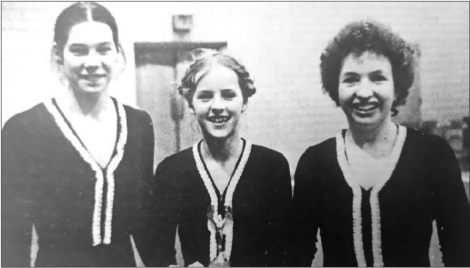
Turner girls win gym meet here
ARRANGE SPECIAL PROGRAMS EASTER SUNDAY SERVICES
Churches Will Be Decorated In Splendor With Lilies And Spring Flowers ———— UNUSUAL OFFERINGS BY ...
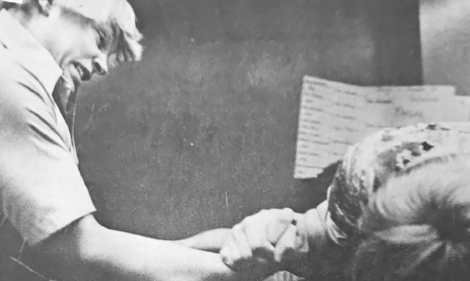
Arm Wrestling Heavyweight champ took it seriously
ALL SET FOR CITY ELECTION TUESDAY
Poll Will Be Open at the Different polling Places From 6 A.M. Until 8 ...