
Wiltscheck welcomed challenges in the Marine Corps
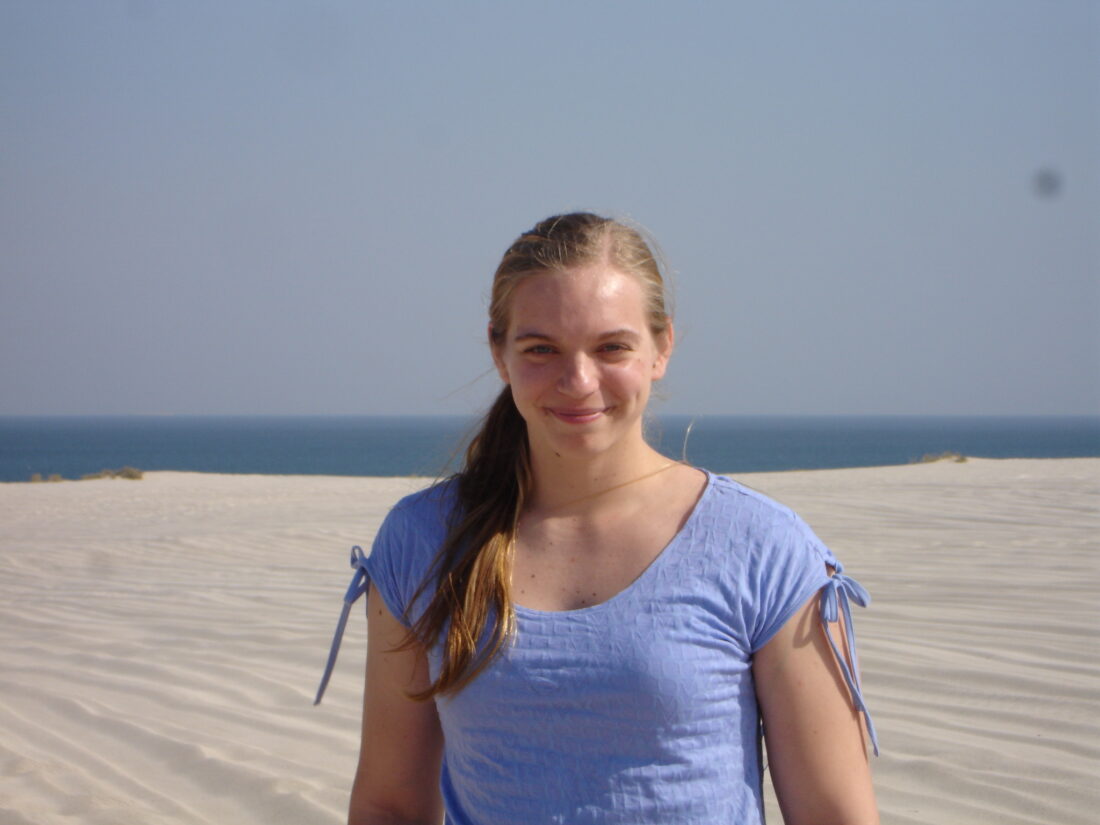
Submitted photo Being a Marine is a strenuous job; here Erin Wiltscheck was able to enjoy some sand dunes in Qatar on some days off. Wiltscheck said learning about different cultures and experiencing them was one of her favorite parts while being deployed.
NEW ULM — The Marines are a branch who require dedication and hard work for their members to succeed. When Erin Wiltscheck joined the Marines, she said the challenging atmosphere was what she was looking for.
“I came from a family that didn’t have savings for college,” she said. “I had spent my last two years in high school attending MSU Mankato. [I wanted] to get a feel for if that’s what I wanted, and [it was] not what I wanted. [The military] was the next option. And since I love a challenge, I went with the Marine Corps.”
Wiltscheck said she didn’t have any expectations for what the Marines would be like. On the day she signed up, she found out an opportunity she was hoping to seize had passed her by.
“I was a musician growing up,” Wiltscheck said. “The day I enlisted, I realized I had missed the tryouts for the Marine Corps Band. It was a mixed experience because that might have been more what I wanted to do [initially].”
From 2004 to 2014, Wiltscheck traveled the world with the Marine Corps. Her first deployment was with the Marine Expeditionary Force (MEF) in Okinawa, Japan. There she planned transportation deployments of units, personnel, and equipment for the MEF. Wiltscheck said these deployments varied in destination and time spent.
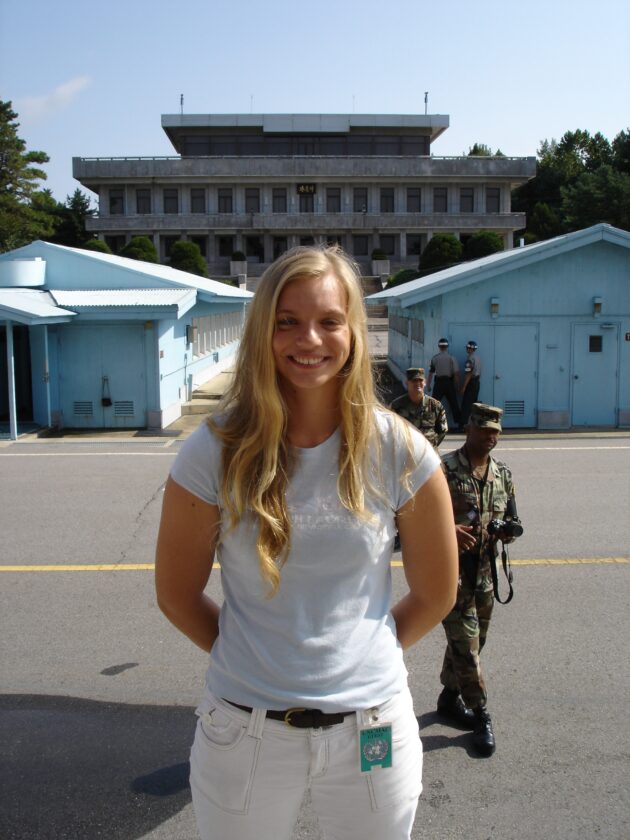
Submitted photo Former Marine Erin Wiltscheck stands on the border of North and South Korea during her first deployment to Okinawa, Japan. She worked with the Marine Expeditionary Force, helping to plan transportation deployments involving personnel and equipment.
“Most of our deployments were in the form of exercises in the Pacific. They would be anywhere from a couple of weeks to a couple of months. We did a two-day trip to the Philippines on US Aid missions. A lot of them were training exercises with the local militaries in the region. When we were in Korea, we would train with their marine branch. When we were in Australia, it was much larger. It was a whole Pacific training exercise. Those are generally a little smaller.
Then she did this line of work with the Third Marine Aircraft Wing out of San Diego. During her time there in 2008-09, she was deployed with them into Iraq during the Iraq war. Wiltscheck described what work was like while deployed there.
“We weren’t on the front lines,” she said. “We were at Al-Asad Air Force base at the time. We were bringing equipment in and out of aircraft. That’s when we switched from Operation Iraqi Freedom to Operation Enduring Freedom. That’s when we started moving everything around over there.”
Wiltscheck said she was doing essentially the same thing as in Japan but with a heightened involvement in the day-to-day operations. Her job became more detail-oriented in an area of heightened military activity.
“The one unit I was at, they joked it was where people went to retire. It was a lot of support to forward-deployed units back from home because we always had units over there,” she said. “This job was a little more relaxed. It wasn’t relaxed, but compared to the other places [it was].”
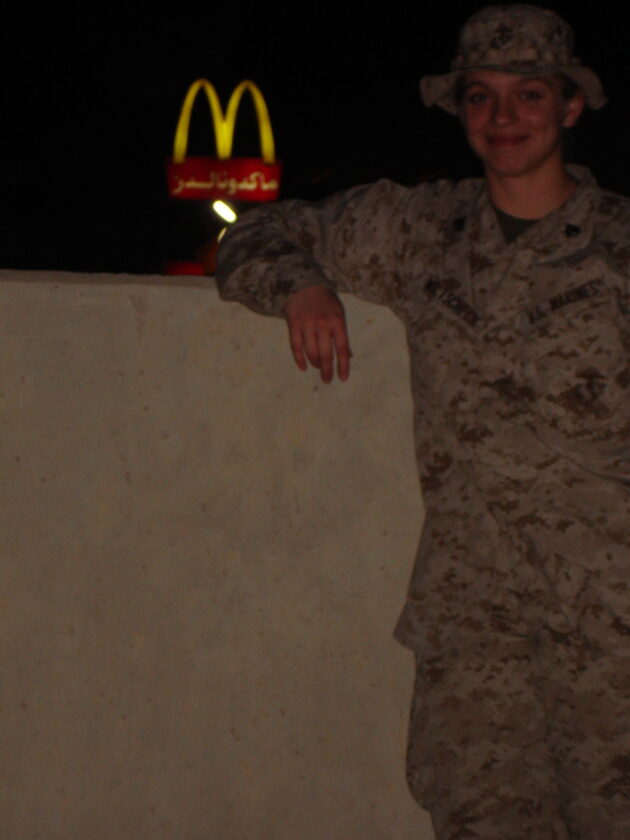
Submitted photo A McDonalds stands outside Al-Asad Airbase in Iraq, as Erin Wiltscheck is in her second deployment. She was stationed in San Diego, and made her way to Iraq as a part of the Third Marine Aircraft Wing.
Her final deployment was at Camp Lejeune in North Carolina. After many dedicated years of service, Wiltscheck was selected to be part of the Marines’ Special Operations Command (MARSOC). She said MARSOC gave her the biggest challenge of her military career, exactly what she was looking for when she joined.
“I was part of the support service,” she said. “We did a lot of training like the [operators] do. I was involved a lot farther down the chain of command. We did a lot of the day-to-day training for all the units and lining up all the local stuff. When you train units to deploy, they have to be up to date on their qualifications. We were involved in all the little day-to-day stuff, a lot of the combat driving. Every year they have to pass all their sworn qualifications. We were there conducting analysis. For our unit, you had to be physically ready to deploy at any time.”
During her time there, Wiltscheck was chosen to be embedded in a Special Operations Unit. While this was the initial plan, Wiltscheck said she was unable to participate for an important reason.
“That’s the time I had my now 10-year-old, so it didn’t pan out,” she said. “The military’s gotten good about [maternity leave]. You get full-time pay and when I was in it was 12 weeks. I believe it is a lot longer now. They take care of you. You don’t have the medical bills. You don’t have to worry about losing your job. It’s tough when it’s time to come back to work. There’s no part-time option. You go back to work, back at training, and back up for deployment. It’s tough mentally.”
Wiltscheck left the service in 2014, going to college in North Carolina to finish up her degree. She now works from home for Scholarship America and has two daughters, her most recent born in May of this year. Wiltscheck said her experience with the military and their support post-service has been positive. For those exiting the service, she said it works best for those who have a plan when they are finished.
“Get in touch with your local office,” Wiltscheck said. “In my experience, I didn’t know there were things I was supposed to do to use whatever services you’re entitled to. They will help you and then anyone who’s about to get out. I know a lot of people want to move back home, but this is your chance [to branch out]. If there’s a job you want, [go for it]. When you get out, you can choose where to go.”
For those looking to enter the military, Wiltscheck stressed putting a lot of thought into your choice. Within the military itself, there are many different specialties people can choose from. She said some specialties translate into a set job after the military, while others will leave people at square one when they get out.
“You have to know what you’re good at,” Wiltscheck said. “You have to be able to speak to it. That helps in the job world when you get out. If there’s something you’re interested in, [wait for an opening]. Some people want to join right away and get on the first [opening]. If your specialty is not available, put thought into what you want later. It might be worth a three-month wait because it’s a four to five-year [commitment] of your life depending on what specialty you choose.”
-
- Submitted photo Being a Marine is a strenuous job; here Erin Wiltscheck was able to enjoy some sand dunes in Qatar on some days off. Wiltscheck said learning about different cultures and experiencing them was one of her favorite parts while being deployed.
-
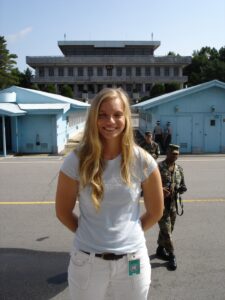
- Submitted photo Former Marine Erin Wiltscheck stands on the border of North and South Korea during her first deployment to Okinawa, Japan. She worked with the Marine Expeditionary Force, helping to plan transportation deployments involving personnel and equipment.
-
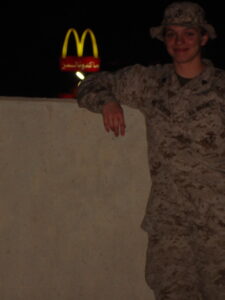
- Submitted photo A McDonalds stands outside Al-Asad Airbase in Iraq, as Erin Wiltscheck is in her second deployment. She was stationed in San Diego, and made her way to Iraq as a part of the Third Marine Aircraft Wing.