State water plan draws questions
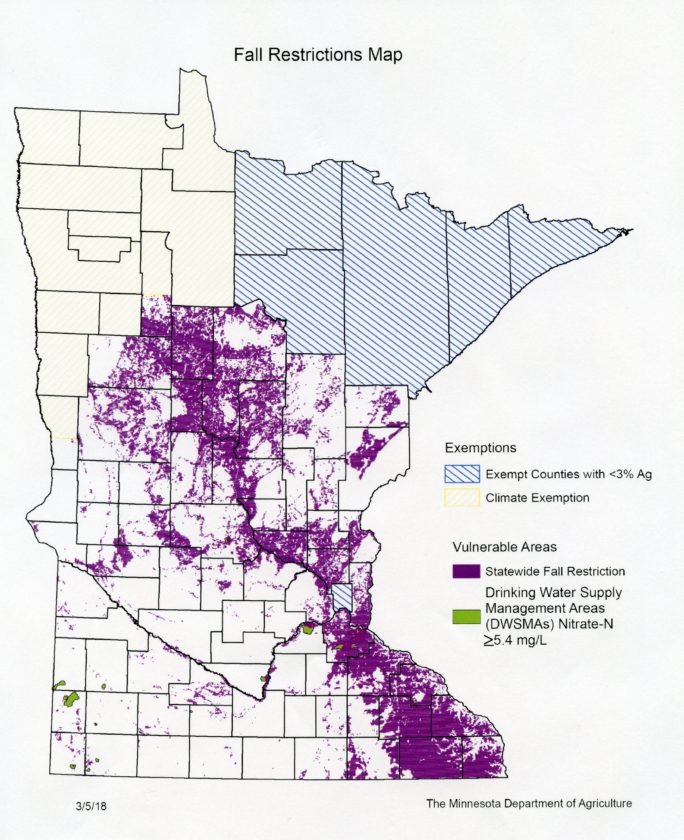
Submitted graphic The Minnesota Department of Agriculture’s fall fertilizer restrictions map includes more porous soils areas denoted by the darker shaded areas of Minnesota. The proposed measure would restrict fall fertilizer in Drinking Water Supply Management Areas (lighter shaded areas) where the nitrate concentration exceeds 5.4 mg/L.
ST. PAUL — A new groundwater protection measure proposed by Gov. Mark Dayton and Minnesota Agriculture Commissioner Dave Fredrickson March 6 has been questioned by a number of officials and organizations.
The proposal would apply to vulnerable areas and areas with high nitrate levels in public drinking waters. It would create a system of voluntary and mandatory mitigation practices in areas with high nitrate concentrations in public water supplies.
The measure would restrict fall fertilizer application in Drinking Water Supply Management Areas where the nitrate concentration exceeds 5.4 mg/L. Those areas are confined mostly to extreme southwest Minnesota (see map on page 8A).
Fertilizer application exceptions include crops like winter grains, grass seed and cover crops that require fall nitrogen, areas with low leaching potential based on precipitation rates and a short spring planting season and counties where less than 3 percent of the land is used for row crops (Ramsey County and northeast Minnesota).
The proposal is based on public meeting input from 1,500 farmers and landowners. It would help reduce elevated nitrate levels in groundwater and ensure more Minnesota residents have clean, safe, reliable drinking water supplies, according to the Minnesota Department of Agriculture (MDA).
Nitrate is one of the most common Minnesota groundwater contaminants, and elevated levels of it in drinking water can pose serious human health concerns, according to the proposal. Nitrate is a naturally occurring compound and is found in lakes, rivers, and groundwater across the state.
The MDA reported that 10 percent of private drinking water wells in vulnerable areas have high nitrate levels and exceed drinking water standards.
Conservation Minnesota, a non-partisan organization, released a public survey of 530 Minnesota voters done by Public Policy Polling of Raleigh, N.C., that showed that 57 percent of respondents strongly support reducing nitrate groundwater pollution. In addition, it revealed that 25 percent somewhat supported the measure, 10 percent somewhat opposed it, 5 percent strongly opposed it and 5 percent were not sure.
The measure is expected to be published for formal comment in mid to late May. Hearings are to be held this summer, with final adoption in late 2018. The Office of Administrative Hearings will review comments and give the MDA 180 days to make revisions to the groundwater protection rule based on administrative law judge and public hearings.
In December 2018, the Department of Agriculture submits the final protection rule to the Office of Administrative Hearings, the Office of the Revisor of Statutes and the governor.
Minnesota District 16B Rep. Paul Torkelson, R-Hanska, Chairman of the Environment and Natural Resources Policy and Finance Ethics Committee, commented on the measure.
“As a farmer, I’m concerned about the state of Minnesota getting into my business and trying to run my farm. I’m hoping it’s not overly prescriptive,” Torkelson said. “I want to make sure the map is appropriate and doesn’t restrict our ability to raise a crop. With prices so low, farming can be really challenging. I’d say the problem is not widespread. I’m nervous about a broad rule that has too much of a negative impact on agriculture.”
Torkelson said there can be many nitrogen sources on the landscape and called the situation, very complicated. He encouraged producers to participate in the public comment gathering process.
Sleepy Eye farmer and Brown County Farm Bureau President Greg Bartz said he’s surprised the state of Minnesota is trying to regulate fertilizer when he said it hasn’t been shown that fertilizer relates to high nitrates in groundwater.
“What about regulations for storm water and sewer water? I think they’re off on the wrong tangent. Agriculture is an easy punching bag. Let’s see the research about fertilizer raising nitrate levels.” Bartz said. “Natural nitrates come from soil breakdown and other things. I think they’re blaming agriculture for something that isn’t causing this. Beet juice is good for your heart. It’s mainly nitrates. So is lettuce salad. Actually, your body needs nitrates.”
The Minnesota Soybean Growers Association (MSGA) called the measure an “attempt to rebrand the Nitrogen Fertilizer Rule as a groundwater protection rule.”
“We appreciate the work done by MDA to modify the rule based on concerns heard. Many of the changes are steps in the right direction,” said MSGA President Michael Petefish. “However, the changes announced (March 6) do not address some of the biggest concerns MSGA has with the Nitrogen Fertilizer Rule… The bottom line is the definition proposed for ‘nitrogen fertilizer’ is overly broad and inclusive.”
The MSGA believes the rule is based on a private well testing regime rather than one based on dedicated monitoring wells. It added that the proposal means a farmer would be unable to irrigate their crop in a sensitive area after Aug. 31 regardless of weather conditions, drought, crop need, or even the level of nitrogen in the water.
The MSGA added that although nitrogen fertilizer isn’t used on soybeans, the rule could have a devastating effect on Minnesota’s 28,000 soybean farmers since soybeans are a legume and can fix nitrogen from the air into ammonia, where is can be used to build proteins.
“We welcome the opportunity to further engage with the governor and MDA to find a common sense solution,” Petefish said.
For more information, visit mn.gov/governor/newsroom/#/detail/appld/1/id/328382.
Fritz Busch can be emailed at fbusch@nujournal.com.
Local News
What do you like most about Flandrau State Park?
Susan Dalsgaard, Springfield: “Driving down in the park entrance, seeing the park in all its beauty.” Sofia ...

Running, walking to support rural healthcare

Concord Singers open New Ulm’s Music in the Park

John Kellen brings ‘Water is Life’ exhibition to Twin Cities

Flandrau swim pond reopens