Sister Cities Commission — a Legacy of cultural exchange and lasting friendships
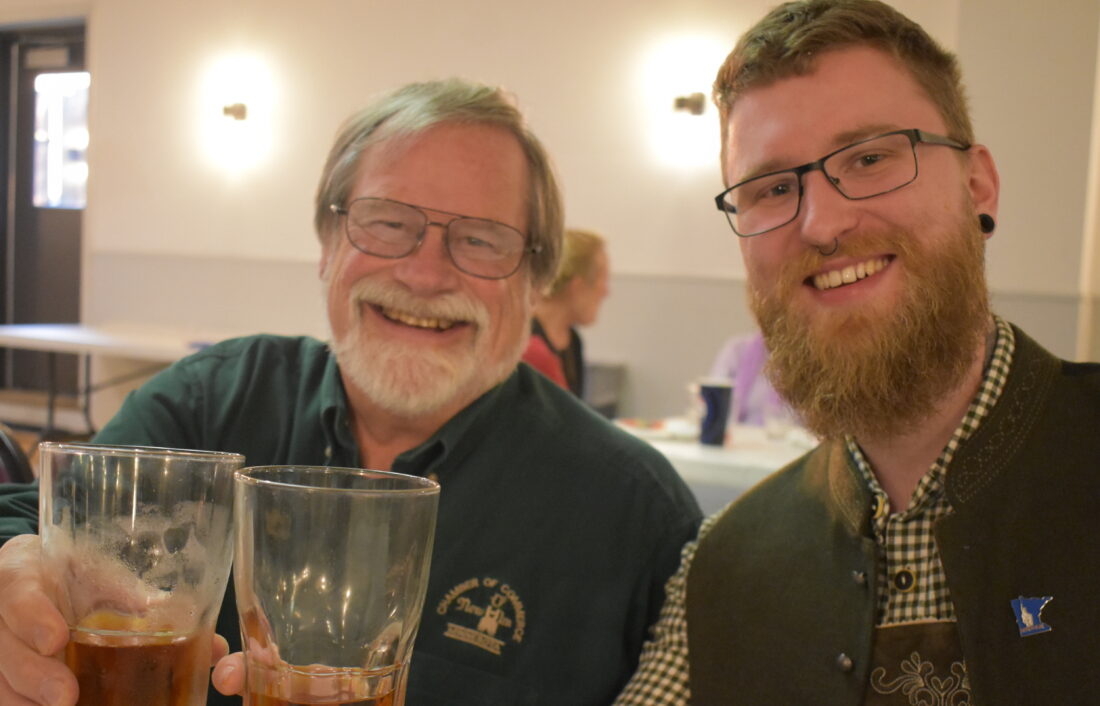
Richard Seeboth (left) shares a toast with Hans-Joos Exchange intern Samuel Knoops during a Sister Cities Commission welcoming event in New Ulm last September. Seeboth, a longtime commission member, has hosted numerous exchange participants and played a key role in shaping the program’s modern practical training exchanges. Photo by Clay Schuldt
NEW ULM — The New Ulm Sister Cities Commission has long been a cornerstone of cultural exchange, fostering connections with its German partner cities of Ulm and Neu-Ulm through a variety of programs.
Richard “Dick” Seeboth, a longtime member of the commission and former Brown County commissioner, recently concluded his service after approximately 14 years across two distinct periods.
His experience reflects the evolution of the commission itself, from its early days to its current collaborative role in promoting international understanding and community-based exchange.
Seeboth served an initial eight-year term beginning around 1982, followed by a more recent six-year term. He noted that the commission’s culture has changed significantly over time.
“It used to be in the ’70s, ’80s and ’90s a somewhat closed organization,” Seeboth explained.
Appointments were typically reserved for socially elite individuals such as mayors and council members, reflecting a largely government-level exchange.
Over time, the commission has become more accessible and people-focused. Today, it includes individuals who understand the value of cultural exchange and global friendship, aligning closely with the founding principles of Sister Cities International.
During his first tenure, the time commitment was notably greater for Seeboth and his wife, Sharon. As some of the youngest members, they frequently assumed much of the work.
“If we wanted something done, we pretty much had to do it ourselves,” he said.
He chaired the commission for six years during that period, noting that leadership structures in the 1980s differed greatly from today’s internal committee model, in which all commissioners now participate in planning and decision-making.
Seeboth said his motivation for rejoining the commission more recently was to help facilitate a visit from Neu-Ulm’s city band following his Concord Singers group’s trip to Germany in 2019, hoping to ensure a rewarding experience for both the band and the accompanying official delegation.
A major focus of Seeboth’s involvement was the evolution of the exchange program itself. The original high school exchange, which began in the 1960s, eventually ended due to language barriers and social challenges faced by American students.
In its place, the Practical Training Exchange Program was developed, now known as the Hans-Joos Practical Exchange Program. The program focuses on young adults pursuing career experience through three-month internships.
Now, participants are older and arrive with a higher level of linguistic and social skills. As a result, interns are able to “hit the ground running,” maximizing the value of their three-month experience while gaining professional skills that strengthen their resumes.
Seeboth believes the success of this revitalized program contributed to New Ulm receiving the Sister Cities International award for Best Sister City Program for a community under 50,000 people in 1988.
Among his most memorable experiences was representing New Ulm in Portland, Oregon, to accept the national award. Beyond recognition, he values the lasting personal relationships formed through the program.
One such connection is with Annette Kunz, among the earliest participants in the practical exchange, who stayed with the Seeboth family.
“She knows our kids. We have visited her and her family in Europe,” he said, adding that Kunz also visited them in Florida two years ago. These, he said, are friendships that last a lifetime.
Dick and Sharon Seeboth have hosted individuals through the training exchange program and more than 30 visitors during events such as Heritagefest. Dick emphasized that hosting is always a shared effort.
“You don’t do things on your own, especially when you’re involved in hosting someone,” he said.
Sharon played a central role, assisting with meals, transportation and coordination with other host families.
“She’s thoroughly immersed in the experience and has as fond memories as I do,” he added.
As someone who moved to New Ulm from Milwaukee, Seeboth said the smaller community made it easier to become involved in cultural activities. He strongly supports the commission’s core mission of building understanding through personal connection.
“It’s awfully hard to go to war with good friends,” he said.
His advice to those considering involvement with the Sister Cities Commission or hosting a visitor is simple: “Give it a try.” He encourages residents to respond when host families are needed, calling it an opportunity to form meaningful international friendships.
The Seeboths describe their decades of involvement as both enjoyable and fulfilling, and they are confident the 50-plus host families they have worked with over the years would agree.
The Sister Cities Commission is currently accepting and reviewing applications for the 2026 exchange program. Individuals interested in participating may contact Lisa Pelzel at City Hall to request an application and to confirm whether a participant has already been selected.
Local News
Sister Cities Commission — a Legacy of cultural exchange and lasting friendships
Flu rates still trending high across state
NEW ULM — Brown County Public Health Director Jaimee Brand told Brown County commissioners Tuesday that there is ...
Designed to win
Volunteers spruce up State Street Theater
‘Wild land, wild life’ exhibition opens at 4 Pillars Gallery