
Sharing memories of WWII POW camp research
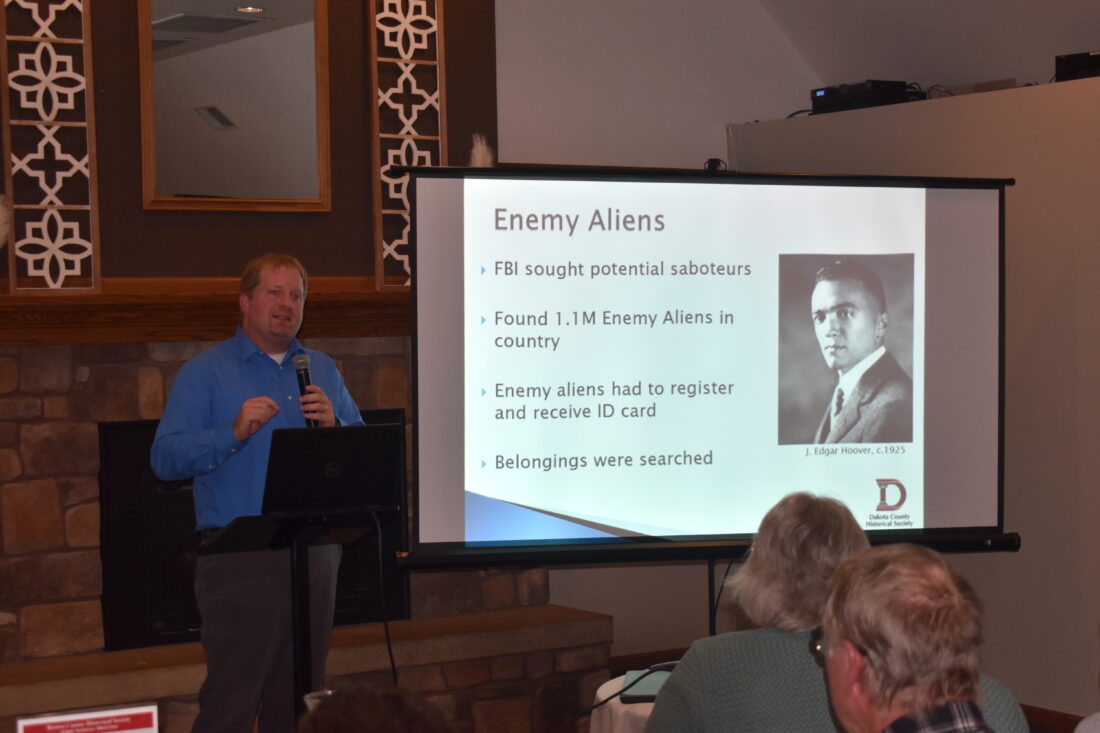
Matthew Carter discusses how the American government looked for potential saboteurs during WWII at the Brown County Historical Society annual meeting Friday. He noted the difference between POW camps that housed prisoners of war, and internment camps that housed potential enemy spies who lived in the U.S.
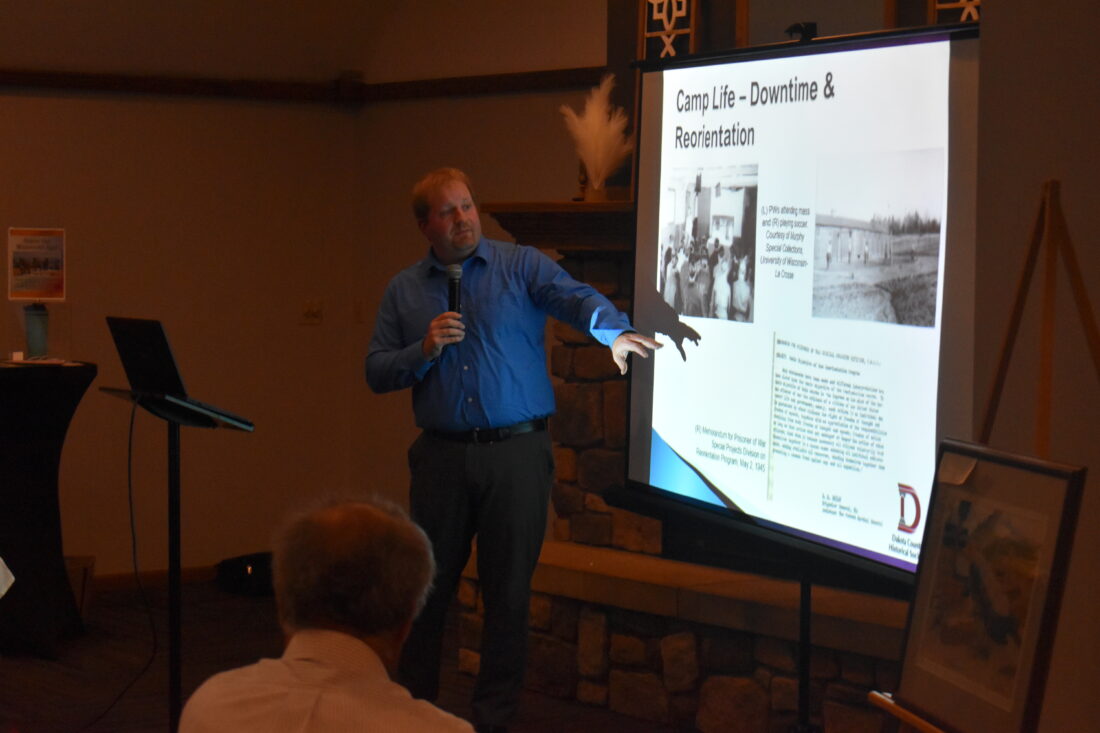
Matthew Carter points out some photos and descriptions as he discusses WWII POW camps with the Brown County Historical Society. Carter said the prisoners earned money when they worked, which they could exchange for goods or save up.
Matthew Carter discusses how the American government looked for potential saboteurs during WWII at the Brown County Historical Society annual meeting Friday. He noted the difference between POW camps that housed prisoners of war, and internment camps that housed potential enemy spies who lived in the U.S.
Matthew Carter points out some photos and descriptions as he discusses WWII POW camps with the Brown County Historical Society. Carter said the prisoners earned money when they worked, which they could exchange for goods or save up.
Trending
NEW ULM -- Executive Director of the Dakota County Historical Society Matthew Carter presented his research in front of the Brown County Historical Society Friday at their annual meeting.
The subject of Carter's presentation was prisoner of war (POW) camps during WWII. This includes a camp operated in New Ulm that housed Nazi prisoners. He opened the talk by explaining how he originally became invested in the subject, as a senior in college looking for a senior thesis topic.
"I started looking into local history," Carter said. "I came across the centennial book that mentioned a POW camp in Reedsburg, [Wisconsin]. I never heard about it going through school and it piqued my interest. Since then, I’ve done several research projects related to it. I’ve done freelance stuff on the side and worked with the Reedsburg Area Historical Society. We put together a new exhibit for them on the POW camps."
Carter said these camps were different from internment camps during the war. Internment camps were meant for mainly Japanese, Italian, and German citizens who were identified as potential spies or enemy agents against the United States. POW camps were intentionally made to house captured enemies from battles.
Minnesota camps used POWs for labor, either in fields tending to crops or to canning plants who were desperate for workers. Carter said the Geneva Convention required certain regulations in the camps to benefit the prisoners.
"Whatever we offered at our base camps, we had to offer to prisoners. And if we had them work, we had to pay them. The prisoners were paid in chits. They could work for 10 cents an hour, up to 80 cents per day. They could then go back to the canteen and buy goods and supplies. If they didn’t buy anything, they wanted to save it. As they came over, a Treasury account was created. They could put the money into an account. At the end of the war, whatever you put in there and saved you could take back with you."
Carter ended his talk by discussing the New Ulm POW camp. He said it was open continuously for one and a half years until it was closed in December 1945. He shared a photo of a set of twins named Hans and Werner, shown using a plowshare while doing manual labor. The commander of camp New Ulm shared his findings as the camp came to an end.
"He presented to a Kiwanis club; he did a lot of presentations and the newspaper was more than happy to publish them," Carter said. "At the end of the stay here at Camp New Ulm, he said the Nazis in the camps still believed they were the superior race, but overall, most of the prisoners were good prisoners. They were hard workers, and they showed little inclination to escape."
After his presentation, Carter opened the floor for questions. In attendance was Denny Warta, who was alive when the POW camp was open in New Ulm. He shared his experiences with the POW's.
"I was a senior in high school and worked part-time for Eibner’s bakery," Warta said. "And on occasion, I would drive our van out there with bakery buns. Because I could speak German I visited [with the prisoners] and I got to know [some of them]. That camp, by the way, was built in the 1930s as a [Civilian Conservation Corps] camp. Many of the [prisoners] came to town at night. There was a shortage of men in New Ulm."