Taking a bite of history
Historical presentations focus on New Ulm in the ‘gilded age’
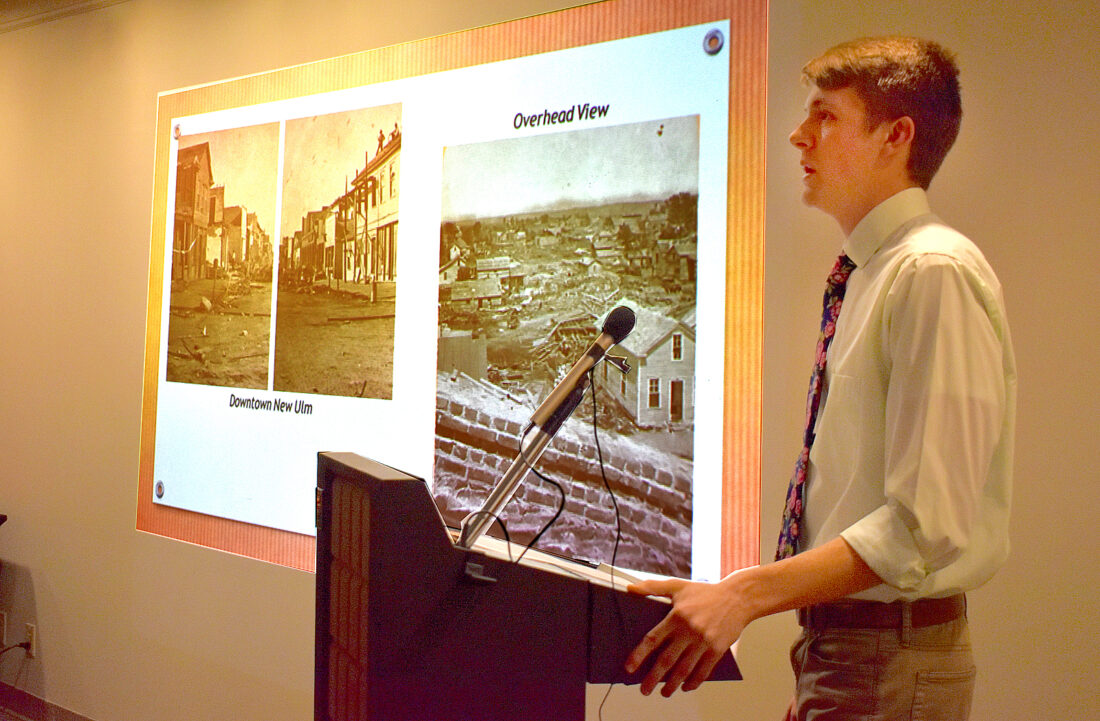
Staff photo by Clay Schuldt Martin Luther College (MLC) teaching student Noah Worster gives the first in a series of short historical presentation on New Ulm in the ‘gilded age.’ His topic was the tornado of 1881 and its aftermath.
NEW ULM — The Brown County Historical Society (BCHS) kicked off its 2023 historical programming Thursday with a series of three bite-size history lessons from New Ulm’s ‘gilded age.’
The gilded age was the period from 1870-1920 in the United States and it was a time of tremendous growth in Brown County. BCHS partnered with Martin Luther College (MLC) to present on local topics from this time period. Three MLC students gave 15-minutes presentations.
The first presentation was from Noah Worster on the New Ulm tornado of July 15, 1881, and the hospital created in its aftermath.
The Tornado of 1881 and its aftermath
Worster began his presentation with an overview of other natural disasters from the era and the public response. In most situations, the natural disaster led to the creation of a hospital. In New Ulm, the 1881 tornado led to the creation of the St. Alexander Hospital.
Around 3 p.m. July 15, 1881, New Ulm residents saw two separate storms forming on the western horizon.
507.359.9616The two storms combined into a larger storm that headed for town, forming a tornado. The tornado tore through much of Brown County before hitting New Ulm at around 4:45 p.m.
Worster said the storm was over New Ulm for only 15 minutes, the tornado likely less time, but the destruction was devastating. Eyewitnesses reported people being lifted dozens of feet in the air and animals being carried miles. Meteorologists studying this incident believe this tornado would have been rated EF5, the most powerful tornado.
It was estimated $250,000 worth of damage occurred, which is equivalent to $10 million today. The cost of human life was higher. Six lives were lost in New Ulm and others outside of town were killed. There were 53 injuries in New Ulm, some left crippled.
Worster said that despite the damage, clean-up efforts were impressive. Within weeks, citizens cleaned up New Ulm enough to make it functional. Aid arrived in New Ulm from many cities across the country. Milwaukee, Chicago, New York and others all sent money to New Ulm. A New York City Council member made a call to support New Ulm.
The disaster made it clear a hospital was needed, but it was a rough start. Meetings at Turner Hall led many citizens to feel a hospital would not be self-sustaining and economically impractical. However, Fr. Alexander Berghold stepped in to revitalize the effort. He began a fundraiser and the people of New Ulm rallied around him.
By August 1883 a contract to build the hospital was sold and a few months later on Nov. 7, a dedication ceremony was held. The hospital was built on New Ulm’s western bluff, where the New Ulm Medical Center currently stands. It was named St. Alexander Hospital after Berghold. Unfortunately, the hospital failed within the first year. The prediction that it would not be self-sufficient proved accurate.
The Poor Handmaids of Christ bought the hospital for $7,000 and registered it with the state and received nursing licenses. The hospital would thrive for many years, going through remodels and rebranding. The NUMC is built on the site today. A statue honoring Berghold stands on a hill north of NUMC.
Editor’s note: The next article in this series will be published on Monday, Feb. 13, and will cover a presentation from Emma Hotlzen on the creation of Dr. Martin Luther College (DMLC) in New Ulm.
Local News

NU Bicycle Group shows up in cold, cleans trail
Boettger, Schmig, Klawitter endorsed
A trio of Democratic candidates received their party’s endorsement in races for Minnesota state Legislature over ...
Thinking outside of ‘Boxes’

Driven by detail

Confer crowned as Miss Sleepy Eye