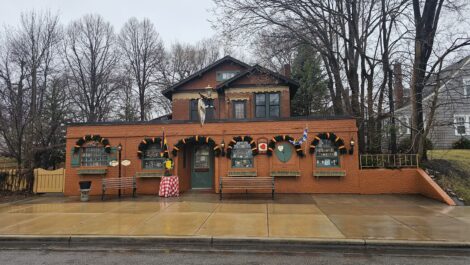
Council gives building owner more time to start repairs
Has six months for building repairs at 307 N. Minnesota St.
NEW ULM — The New Ulm City Council has given the owner of the building at 307 N. Minnesota six months to start necessary repairs or face its demolition.
The city has been dealing with maintenance issues associated with the property since July 2015. Currently, the north wall of the building is crumbling. Previously the building owner, Robert Van Zile, stated he did not have the money to fix the wall, but that may have changed.
The council was prepared to accept one of the recent bids to repair or demolish the building at 307 N. Minnesota, but during the meeting, New Ulm Building Inspector Ellwood Zabel informed the council Van Zile may have secured the necessary funds to make repairs through an inheritance. He asked the city for a year to take care of the repair on his own.
City Councilor David Christian said he wanted the council to take action that if the owner did not begin repairs within six months, the council would move forward with the repairs or demo.
“We’ve dealt with this for two and half years,” he said. “I’ll give the benefit the doubt, six months show [us] the plan or we tear it down or fix it ourselves.”
City Manager Chris Dalton said this was the staff’s recommendation as well. The council could approve an action if the property owner does not make the six-month deadline.
Council President Andrea Boettger had concerns about whether the owner had sufficient funds to make the repairs.
Zabel said repair of the building is estimated at a minimum of $125,000 but the cost could rise if additional work is needed. The estimate is only for the first 20 feet of the wall, but other repairs might be necessary. There is a similar problem with demolition. If the building is taken down, the city might need to cover the cost to secure the newly exposed north wall of The Journal. It is unknown if the 307 North building and the Journal share a common wall.
Boettger was willing to give extra time to allow Van Zile to repair the building but wanted a concrete plan with a specific deadline for the council to take action.
“I really do not want to see this come back again,” she said.
Councilor Larry Mack was in favor of setting an Aug 1. deadline for the owner to make repairs before the city moved forward with demolition. Christian seconded the motion.
The final motion clarified that a plan to fix the building needed to be in place within three months, with repairs starting before Aug. 1, or the city would order demolition. The motion was passed by the council.
——
The council accepted the New Ulm Zoning Map and directed staff to include the document in the proposed new zoning ordinance.
The New Ulm Planning Commission unanimously recommended the zoning map during their Jan. 27 meeting.
The city’s zoning ordinance consists of two parts: the ordinance text and the map. The text was previously recommended to the New Ulm City Council. The map shows the various zoning districts and uses that are described in the text of the city’s zoning ordinance.
The zoning map is always kept current with any change in zoning districts approved by the city council. Zoning districts are generally divided along public streets or alleys but sometimes may follow a property line if there is a distinct change in uses between properties.
The new zoning map depicts 21 zoning districts; eight residential, four commercial, three industrial, and six special. An agricultural/open-space district is also included on the map.
City Councilor David Christian was concerned that many people were unaware the city was seeing a major rezoning. The city published notices about the changes, but Christian said most people do not read the notices.
“Some of these rezoned districts, people don’t have a clue we’re doing that,” he said.
Christian’s biggest concern was with the General Industrial (I-2) and the Limited Industrial District (I-3) in New Ulm’s First Ward. The I-3 zoning district is an addition to the city’s zoning ordinance that allows for storage buildings and small service businesses. Several of the storage buildings on the south end of New Ulm are being reclassified from I-2 districts to I-3 districts.
Christian’s concern was that this reclassification would take away potential property uses in this district. The I-2 districts allowed for several industrial uses, Christian said the switch to I-3 removed almost 30 uses for the property.
Businesses that already exist in this district can continue to operate in the district, but if the property were ever sold it would be limited to I-3 uses.
Christian said he was going to request that at least contracting and office uses be put back into the I-3 district.
City Planner John Knisley said as the city is holding public hearings and readings for the ordinance change, the council could be asked to make changes like the one suggested by Christian.
Knisley further explained the reason for the I-3 change is many of these properties were across the street from residential property. Limited industrial use, like storage units, is not anticipated to conflict with residential property usage, but an I-2 district would allow heavy industrial uses across from residents. This I-3 creation was intended to create a buffer between residential and general industrial.
Christian said the city’s last comprehensive study called for the residential district in this area to be removed. This is one of the reasons Christian was uncomfortable with changing the industrial districts for the residents when the comp plan called for taking a residential district in the middle of an industrial district.
Councilor Larry Mack suggested methods of alerting the community of the zoning changes, such as contacting the realtors or submitting notices with utility bills.
Councilor Eric Warmka believed the public was aware of these zoning changes as local media had reported on the changes multiple times.
Council President Andrea Boettger agreed to say “this should not be taking anyone by surprise.”
Boettger encourage everyone to spread the word of the rezoning; especially to those who could be impacted, but believed there was a personal responsibility to owners of the businesses.
“I think we need to continue to move through this process and take the feedback,” she said. “We can’t be the hand-holders, there needs to be some personal responsibility from the property owners.”
Community Developer Director David Schnobrich noted the districts identified I-3 is already built out as limited industrial. He said these are not vacant properties that the city is taking away uses.
“I don’t see this being a major issue,” Schnobrich said. Usage in this district has remained mostly the same over the years. Schnobrich added that if it did become a problem in the future, the city could amend the ordinance later. The zoning map and text of the ordinance can always be changed through amendment and public hearings.
Council Mack made a motion to accept the zoning map to include in the new zoning ordinance with a second from Christian. The motion was carried.
The first consideration of the zoning map and the zoning text will be considered at the next city council meeting. Before that meeting, staff could make adjustments to the map to discuss during the first consideration.
——
The council approved a permit from Nicole Elsawaf and Rich Draheim allowing the conversion of the back half of the New Ulm Event Center into 22,000 square feet of climate-controlled self-storage units and converting the detached warehouse building into 7,200 square feet of non-climate controlled storage units. The property is at 301 S. 20th Street.
With this permit, the remainder of the building will continue as an event center.
This plan has approximately 53 units on two floors in the event center for 106 units total and 32 units in the warehouse building.
The council believed it was a good use of the space and approved the permit.
——
The council approved preliminary plat in the Milford Heights 5th Addition. The plat was recommended by the planning commission.
The plat applicant is Al Poehler on behalf of S & P Development and is for a project at 648-685 Waraju Drive with a total area of 5.48 acres.
The plat would create 20 new lots to accommodate 10 twin homes; five on each side of Waraju Avenue.
—-
The council approved the purchase of a 2022 Crestliner rescue boat, trailer and motor for the New Ulm Fire Department for $57,882. The new boat would replace the current 1988 Lund used by the NUFD.
This was not requested for the 2022 budget, however, there are sufficient funds in the Fire Truck/Equipment Replacement account. The city would declare the 1988 boat as surplus and sell it. This boat is valued at approximately $5,500.
Two quotes were obtained from Mapleton Marine and Northstar Powersports & Marine. Staff recommended the quote from Mapleton Marine, which was slightly higher, but Mapleton Marine was able to deliver the boat by May 2022. Northstar Powersport stated delivery would be in summer 2023.
—-
The council held a public hearing on the proposed 2022 Utility, Street and Alley Improvements. The improvements include:
•Jacobs Street and Somsen Street Utility and Roadway Extension. The project consists of the extension of water main, sanitary sewer main, storm sewer main, construction of water and sewer end services, grading, aggregate base, bituminous base, concrete curb and gutter, concrete sidewalk, concrete driveway pavement, bituminous surfacing, boulevard restoration and street lighting in the Airport Industrial Park Third Addition.
•German Street from 7th North Street to 12th North Street. The project consists of the reconstruction of the existing water main, sanitary sewer main, sewer and water end services, storm sewer extension and modification, and reconstruction of the existing roadway section. It includes excavation and replacement of subgrade, aggregate base, bituminous paving, pavement sub drains, concrete curb and gutter, pedestrian sidewalk ramps, street lighting and selective replacement of concrete driveway pavement and sidewalk.
•Alley Block 174 South of Center Street. Alley from 7th South Street to 8th South Street between Payne Street and Jefferson Street. The project consists of the reconstruction of the existing alley pavement section including grading, aggregate base, bituminous surfacing, seven-inch (7?) concrete alley approach pavement, underdrain, miscellaneous removals and restoration.
• Alley Block 196 North of Center Street. Alley from 14th North Street to 15th North Street between Garden Street and Payne Street. The project consists of the reconstruction of the existing alley pavement section including grading, aggregate base, bituminous surfacing, seven-inch (7?) concrete alley approach pavement, underdrain, miscellaneous removals and restoration.
•Alley Block 190 North of Center Street. Alley from 8th North Street to 9th North Street between Garden Street and Payne Street. The project consists of the reconstruction of the existing alley pavement section including grading, aggregate base, bituminous surfacing, seven-inch (7?) concrete alley approach pavement, underdrain, miscellaneous removals and restoration.
• Sanitary Sewer Repairs. The project consists of repairing damaged sanitary sewer piping on 19th North Street at the intersection of State Street and lining the sanitary sewer manhole at 1st South and Broadway.
•Concrete Sidewalk and ADA Improvements. The project consists of ADA pedestrian ramp improvements to complement the improvements scheduled within the 2022 Surface Reconstruction Project to meet the current ADA requirements as per New Ulm’s adopted ADA Transition Plan and another deficient concrete sidewalk at locations determined by the city engineer.
No comments were received during the hearing. The council closed the hearing and authorized moving forward with the projects.
Local News
Wabasso water project delayed
WABASSO — A water treatment project in the city of Wabasso is temporarily on pause due to “unforeseen ...

NU native “Swede” Wagner joins MN Music Hall of Fame

Wabasso wrestling future bright, 6th-grade team wins state

Aqua‑Bunny makes big splash
No one carries their cross alone