
New Ulm Area Foundation awards grant for river sampling program
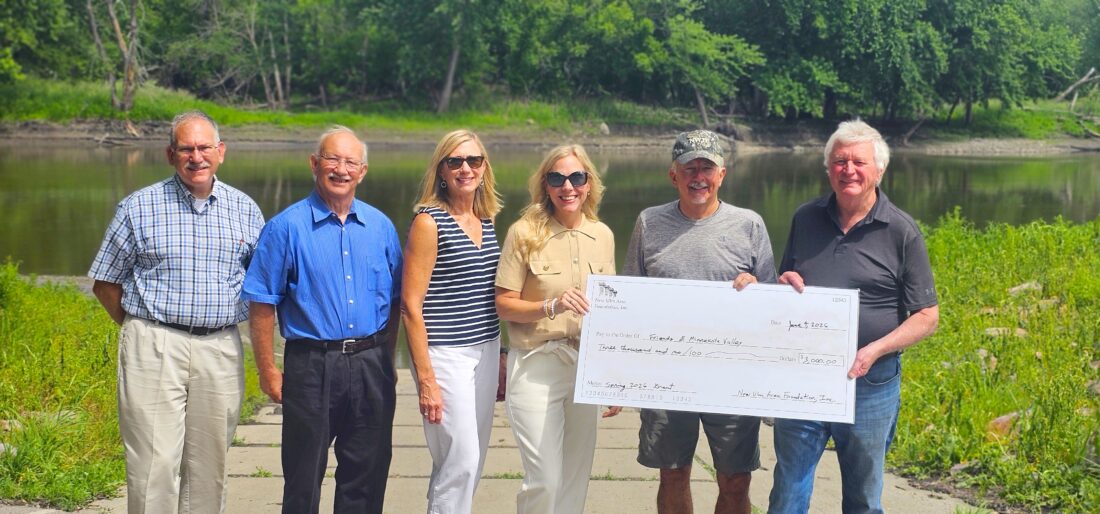
From left to right: John Illikman, NUAF board member; Pete Neigebauer, NUAF board member and farmer; Kathy Van Roekel, NUAF board member; Shannon Hillesheim, president of NUAF; Don Wendel, Friends of Minnesota Valley board member; and Ted L. Suss, president of the Friends of Minnesota Valley, hold an oversized check at the grant presentation for the river sampling Program at Minnecon Park in New Ulm Thursday.
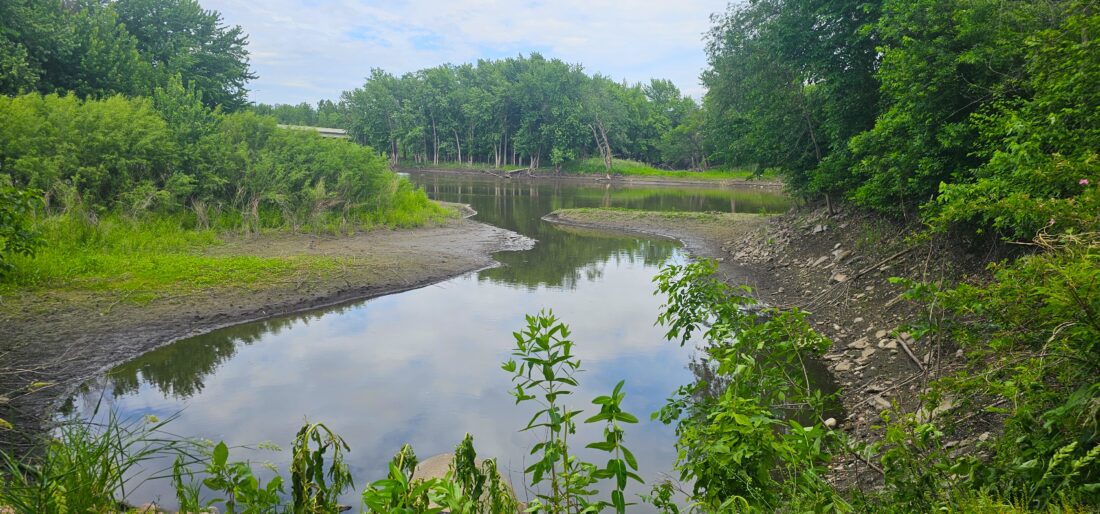
The Minnesota River at Minnecon Park in New Ulm, site of Thursday’s grant presentation from the New Ulm Area Foundation to Friends of Minnesota Valley for its student river sampling program. (Photo by Amy Zents)
From left to right: John Illikman, NUAF board member; Pete Neigebauer, NUAF board member and farmer; Kathy Van Roekel, NUAF board member; Shannon Hillesheim, president of NUAF; Don Wendel, Friends of Minnesota Valley board member; and Ted L. Suss, president of the Friends of Minnesota Valley, hold an oversized check at the grant presentation for the river sampling Program at Minnecon Park in New Ulm Thursday.
The Minnesota River at Minnecon Park in New Ulm, site of Thursday’s grant presentation from the New Ulm Area Foundation to Friends of Minnesota Valley for its student river sampling program. (Photo by Amy Zents)
Trending
NEW ULM -- The New Ulm Area Foundation awarded a grant to Friends of Minnesota Valley to support its River Sampling Program for student water quality testing.
The check presentation took place at Minnecon Park along the Minnesota River on Thursday. Ted L. Suss, president of Friends of the Minnesota Valley, accepted the grant. He was joined by Friends of the Minnesota Valley board member Don Wendel.
Shannon Hillesheim, president of NUAF, presented the grant along with foundation board members Pete Neigebauer, John Illikman and Kathy Van Roekel.
The grant will provide trainers, testing equipment, test agents and transportation for the program, Suss said.
The Friends of Minnesota Valley has roots in a advocacy campaign that began in the 1960s to establish the Minnesota Valley National Wildlife Refuge. The group formally organized as The Friends of Minnesota Valley and gained tax-exempt status in 1986.
Suss said the river sampling program partners with schools along the Minnesota River and its tributaries. Students collect water samples under adult supervision from a teacher or Friends staff member. The data supplements monitoring by the Minnesota Pollution Control Agency.
Suss said water quality in the Minnesota River has improved since the 1980s and 1990s.
"Compared to decades ago, it's far less phosphorus," Suss said. "Primarily because cities like Duluth putting in new sewage treatment plants or upgrading the sewage treatment plants."
Challenges remain, including rising nitrate levels in some areas. Heavy rains cause flashing, or rapid rises and falls in water levels, which erode river bluffs and add sediment.
Neigebauer, a NUAF board member who farms about 400 acres in Waseca County, has used cover crops, primarily cereal rye, and no-till practices, a conservation method that leaves soil largely undisturbed and plants seeds directly into untilled ground for four years.
"Cover crops help retain nitrogen and reduce erosion," Neigebauer said. "Soil structure improves after several years."
Neigebauer said he plants straight into green cover. He terminates the rye before planting corn and after planting beans.
"The reason for raising rye primarily in this area is it holds nitrogen so it doesn't leach into the water," Neigebauer said.
He said the transition to no-till and cover crops takes time. Soil organic content increases, which improves the soil's ability to handle water.
Neigebauer said he did research before starting the practices. He looked at work from Penn State and researchers in North Dakota.
"You still gotta try innovative things. You gotta try different things," Neigebauer said. "And you use your sense of reason. You're not just doing it 'cause everybody on the bandwagon is telling you to."
The program reaches older students. Hands-on fieldwork connects land use to river conditions, Suss said.
"If you go into an elementary school, you talk to the kindergarten, first-, second-, third-graders, science is almost always their favorite subject," Suss said. "By the time you get to 10th, 11th, 12th grade, it's like, I have to take biology. I have to take chemistry. This gets these older students back out into the hands-on environment."
Suss said students can tie field data into classroom lessons and see real-world impacts.
"There's real stuff going on that affects my life and I affect things by how I live my life," he said.
Wendel, a the Friends of Minnesota Valley board member, has a background in chemistry and biology. He participates in sampling events.
New Ulm Area Foundation supports the project under its education and community enhancement efforts. Additional funding comes from the New Ulm and Mankato Lions Clubs and individual donors.
“The river sampling program costs about $3,000 per school each year for equipment, test agents, staff and transportation,” Suss said.
Suss said the group receives some state money. He is scheduled to meet with the Clean Water Council to seek additional support. The group seeks 50-50 matches for some funding.
Suss said a financial contribution qualifies someone as a member for the year. The organization has a website at friendsmnvalley.org.
The Minnesota River is a tributary of the Mississippi, that starts south of the Twin Cities, traveling southwest to Mankato. At Mankato, the river turns northwest and concludes at Big Stone Lake on the Minnesota/South Dakota boarder.
Mississippi River in Minneapolis. Data from the program contributes to watershed assessments.
Suss said the river contributes to the Gulf of Mexico dead zone through nutrients and soil loss.
The group discussed individual responsibility. Actions by farmers, homeowners and developers affect surface water quality.
"You can get water too clean," Suss said, referencing zebra mussels in Lake Mille Lacs that filter water and impact the food chain.
The conversation included invasive species such as buckthorn. Suss cited past problems with trash in the river, including tires and old cars.
Suss said the river is cleaned up compared to 20 years ago. Education and financial incentives for recycling helped reduce dumping.
Neigebauer said his cover crop work grew from a desire to prevent soil loss.
"I didn't want to see soil washing," Neigebauer said. "I've done enough reading and studying that I'm comfortable with making it."
Suss lives near Faribault but previously lived near Wabasso, where he served as a school superintendent.
Hillesheim presented the grant on behalf of the foundation.
Suss encouraged more community involvement in river protection efforts. The organization sends a newsletter and holds some gatherings, though Suss said they would like to do more.
The MPCA has long-term monitoring sites. The student program provides more frequent data, often four times per year at selected locations.
Suss said the data becomes a significant portion of information used in some watershed reviews.
Suss expressed appreciation for the support from local foundations and service clubs. He said that every contribution helps sustain the student program.
The river sampling program operates up and down the Minnesota River.
The NUAF awarded the grant as part of its spring cycle. The foundation supports various local projects that enhance community life.
For more information on NUAF, or to contribute visit newulmareafoundation.org.