
Remembering early family design firms
Father’s Day is a good time to remember that many design firms of the 19th and 20th centuries were family businesses. Some of the most famous glassmakers, ceramicists and metalsmiths followed their fathers into business, and many famous company names end in “and Sons.”
This coin silver coffee pot, which sold for $1,860 at an auction by Leland Little, was made by S. Kirk & Son of Baltimore, one of the best-known American silversmiths. Samuel Kirk opened his first silver store in 1815. He started partnering with his sons in 1846; the company was known as S. Kirk & Son from 1846 to 1861 and S. Kirk & Sons from 1861 to 1868. The firm was known for its coin silver.
Samuel Kirk is credited with introducing hand-hammered repousse designs to America. His decoration style, with allover designs like landscapes, flowers or architecture in low relief, is still known as Baltimore silver. After his death in 1872, his son and grandson continued the company. The name changed to S. Kirk & Son Co. in 1896. The company was bought by the Stieff Company in 1979, and Kirk Stieff, as it is now known, is still active today.
* * *
Q: I have items from Japan and China, pre-WWII, collected by a missionary and sent home. There are linens, a watercolor from 1928, two matching small handpainted bottles, a small brass box similar to a jewelry box, old postcards, photos, etc. I would like to know if they have any value or possible interest from collectors.
A: Yes, there is plenty of collector interest in the kinds of items you mentioned. They sell at general antiques auctions and shops, so you may want to look for a shop in your area or auction that deals in Asian art. You may also want to find a specialist for the postcards and photos. If you are planning to sell the items, you may want to seek a professional appraisal. You can find a qualified appraiser through the American Society of Appraisers (www.appraisers.org), the International Society of Appraisers (www.isa-appraisers.org) or the Appraisers Association of America (www.appraisersassociation.org). If you have any documentation of the item’s provenance, it will increase the value.
* * *
Q: My dad collected a number of limited-edition wildlife prints produced by mostly Sallie Ellington Middleton, Guy Coheleach and Charles Frances. Most were signed by the artist and/or were numbered. My dad has since passed away and my mom is interested to see if any of these are of value, how to determine a fair price and where to find potential buyers. I tried to use rareartfinder.com or invaluable.com to determine estimated values, but was curious if you could give me directions on how to proceed.
A: Wildlife prints are always popular among collectors and decorators. Prints by the artists you mentioned have sold for anywhere from about $25 to more than $200 at recent auctions. Check to see if your library has a subscription to databases like Artnet or MutualArt where you can look up prices. Some art museums or galleries have appraisal days open to the public; check if there are any near you. If you are planning to sell the prints, we recommend contacting an antiques dealer or auction gallery that sells similar artwork.
* * *
Q: I have 10 King’s Crown cranberry red flashed goblets, as well as eight King’s Crown ruby flashed sherbet dishes. I would appreciate any information on possible avenues to pursue for disposing of them.
A: The King’s Crown glass pattern, also known as Ruby Thumbprint, has been made by many companies since 1891. The best-known maker is probably Tiffin Glass Company of Tiffin, Ohio. You could sell your dishes on consignment, to an antiques dealer or to a matching service. Pressed glass, cranberry glass and ruby glass are popular with collectors. There are many glass collectors’ clubs throughout the U.S., like the National American Glass Club (www.glassclub.org) and Early American Pattern Glass Society (www.eapgs.org), that may be able to help you find more resources or connect you with potential buyers. There is also a Tiffin Glass Museum and collectors’ club (www.tiffinglass.org).
Lifestyle Feature
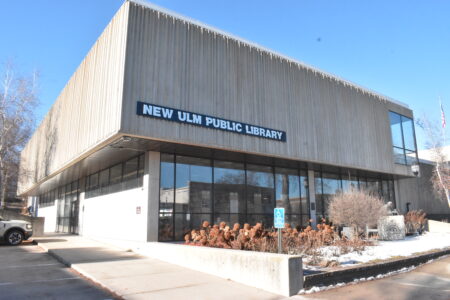
New Ulm Public Library turns 50

‘A walk through history’

Hulke hitting stride, fitting in with Vikings

Citizens State Bank celebrates 150 YEARS

Looking back at the ‘heart’ of AMPI’s dairy operation
Fight for the land DNR, New Ulm farmer battle
The fight between wildlife supporters and farmers over use of land has come to Clear Lake, southwest of New ...