
The wonderful world of monarchs
Following monarch migration to Mexico

Deb Steinberg (back) and Julie Gartner (front) pose in front of a monarch butterfly sculpture outside of the Sierra Chincua sanctuary in Central Mexico. Photo provided by Deb Steinberg
Last month, Deb Steinberg and Julie Gartner of New Ulm took an early spring break to Mexico for a trip of a lifetime.
The two first traveled to Mexico City. From there, they traveled four hours to Central Mexico to visit the largest monarch butterfly sanctuaries in the world.
Mexico is home to four monarch butterfly sanctuaries. Steinberg and Gartner visited three of the sanctuaries. The reason the sanctuaries exist in Mexico is because 99% of the world’s monarchs migrate there during the winter.
Steinberg said monarchs cannot survive harsh winters, forcing them to travel south to warmer and drier climates. The butterflies also prefer to gather on oyamel fir trees, which are native to central and southern Mexico.
Steinberg said that only in the last 50 years have biologists realized monarchs were migrating to this narrow section of the world. In 1986, the Mexican government created what is now known as the Monarch Butterfly Reserve (MBBR) to protect the Monarchs overwintering forest. It became illegal to log the forest parcels. However, this did not stop the removal of the trees, as many did not see the value in preserving the monarchs.
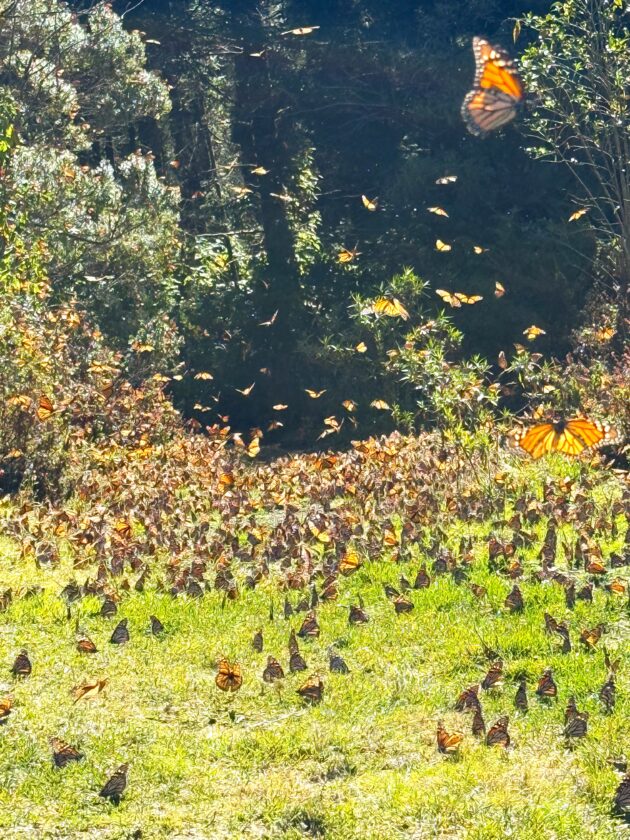
A kaleidoscope of monarch butterflies take flight in one of central Mexico’s monarch sanctuaries. Deb Steinberg and Julie Gartner said they were fortunate to arrive at the sanctuary under the right conditions to see the monarchs fly. Steinberg said to see the color in persons was unbelievable. Photo by Deb Steinberg
In 2000, the Mexican government tried to again expand and restructured the reserve with community participation. To compensate for the loss of timber revenue, the Monarch fund was established with a collection of government and private money from Mexico and is divided among the landholders of the reserve.
Gartner said the monarch sanctuaries are still at risk as the oyamel tree forests are shrinking, but public opinion on the butterflies has shifted.
Gartner said Mexico is now seeing the potential for tourism surrounding the monarchs. She and Steinberg are not the only people traveling to Mexico to visit the monarch sanctuaries. There is a high demand to visit the monarch site. Gartner and Steinberg advised visiting the sanctuaries, but they need to book a guided tour nearly a year in advance.
To reach the sanctuaries, Steinberg and Gartner were required to follow guides on a hike through the mountains to secluded locations; however, the two agree that the trip was worth it.
“It’s like a wonder of the world,” Steinberg said. “And we weren’t disappointed.”
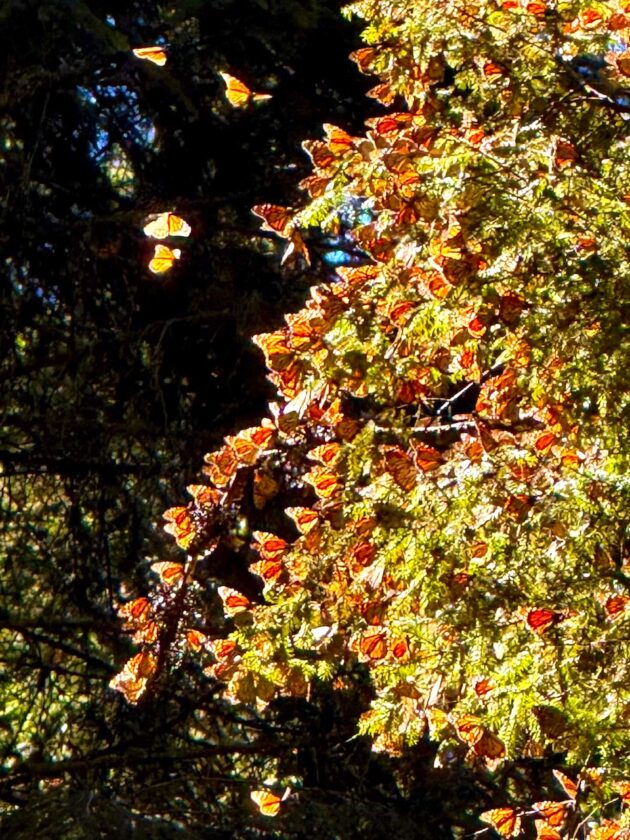
Thousands of monarch butterfly cluster on oyamel fir trees located in a monarch preserve in Central Mexico. Around 99% of the world’s monarchs migrate to Mexico for the winter. Deb Steinberg and Julie Gartner visited three of Mexico’s monarch sanctuaries in February and saw millions of butterflies firsthand in their winter havens.
“It was the best trip I’ve ever been on,” Gartner said.
Steinberg said the experience was unbelievable. At times, there were millions of monarchs clustered on the trees in the sanctuaries or puddled on the ground, drinking water or nectar.
“If the weather was right, they would start flying around,” Steinberg said.
There were a few times when the weather was perfect and the two were able to see the monarchs flying all around them.
Steinberg said one of the hardest parts of touring the sanctuaries was the need to be quiet. To avoid disturbing the monarchs, they were advised not to make a lot of noise. Steinberg said it was hard to be quiet when seeing all the monarchs together.

A group of monarch butterflies puddle together on the ground at the El Rosario monarch butterfly sanctuary. Photo by Deb Steinberg
Steinberg and Gartner are both regular volunteers at New Ulm’s Pollinator Park. Steinberg helped kickstart the local park ten years ago in part to help educate youth on the importance of pollinating insects.
Steinberg said for years, she has been teaching children about all pollinators, but the monarch butterfly has always taken a central focus. She said as the name suggests, monarchs are the kings of the pollinator world. It is relatively easy to teach kids about the lifecycle of the butterfly.
“They are fascinated by them,” she said. “Studying monarchs creates a lasting memory for kids.”
Steinberg’s visit to the sanctuaries in Mexico was one of the items on her bucket list. The trip allowed her to witness firsthand one of the most important parts of the butterflies’ lifecycle. While in Mexico, the monarchs will mate and the females will travel north to lay eggs.
Steinberg said they only lay eggs on the milkweed plant and this is the only food monarch caterpillars can eat, which is why they stress the importance of planting milkweed.
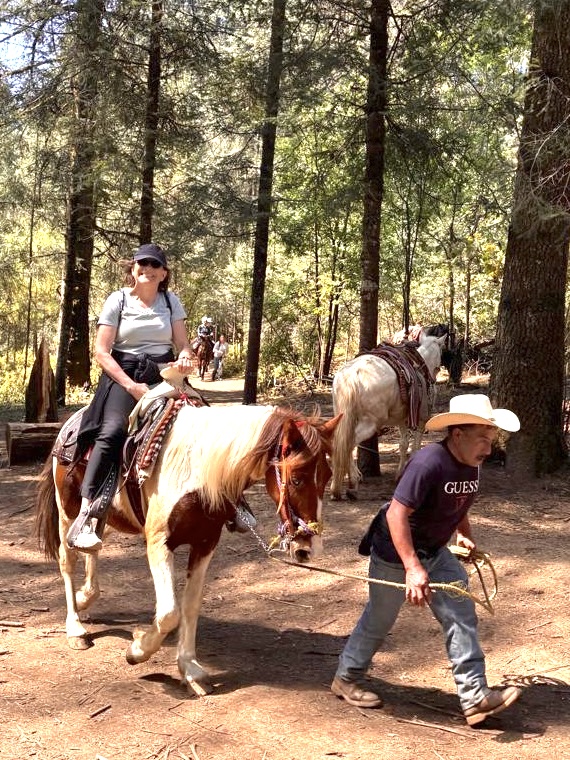
Deb Steinberg is led on horseback to one of the Mexico’s monarch butterfly sanctuaries. The monarch preserves are located in secluded areas of Mexico’s central mountain ranges. Photo by Julie Gartner
Monarchs typically live four to six weeks. The monarchs that arrive in Minnesota are usually fourth– generation butterflies from the ones departing Mexico. However, the monarchs born in late summer tend to have a longer lifespan, living up to eight months. It is these monarchs that make the 3,000 mile journey back to Mexico to hold out the winter.
Steinberg said some of the monarchs she and other volunteers have released in New Ulm have reached Mexico. She confirmed that one of the tags she placed on a New Ulm butterfly was later found at one of the sanctuaries.
Steinberg and Gartner said the trip was a great reminder of the beauty and importance of the monarch butterfly. It is also a reminder of the dangers the butterflies face in terms of climate change and loss of habitat.
“That’s why we encourage everyone to plant pollinators,” Gartner said.
Steinberg and Gartner, now back in Minnesota, are now patiently waiting for the monarch population to return to Minnesota for the summer. It is estimated that the monarchs should arrive in Minnesota around mid-May.
-

- Deb Steinberg (back) and Julie Gartner (front) pose in front of a monarch butterfly sculpture outside of the Sierra Chincua sanctuary in Central Mexico. Photo provided by Deb Steinberg
-

- A kaleidoscope of monarch butterflies take flight in one of central Mexico’s monarch sanctuaries. Deb Steinberg and Julie Gartner said they were fortunate to arrive at the sanctuary under the right conditions to see the monarchs fly. Steinberg said to see the color in persons was unbelievable. Photo by Deb Steinberg
-

- Thousands of monarch butterfly cluster on oyamel fir trees located in a monarch preserve in Central Mexico. Around 99% of the world’s monarchs migrate to Mexico for the winter. Deb Steinberg and Julie Gartner visited three of Mexico’s monarch sanctuaries in February and saw millions of butterflies firsthand in their winter havens.
-

- A group of monarch butterflies puddle together on the ground at the El Rosario monarch butterfly sanctuary. Photo by Deb Steinberg
-

- Deb Steinberg is led on horseback to one of the Mexico’s monarch butterfly sanctuaries. The monarch preserves are located in secluded areas of Mexico’s central mountain ranges. Photo by Julie Gartner