Housing development, best sign of progress in New Ulm

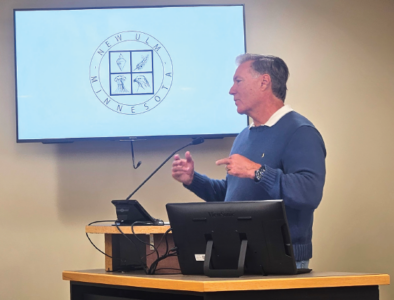
Photo by Clay Schuldt City Manager Chris Dalton discusses the progress made with expanding residential properties.
NEW ULM — For the second year in a row, City Manager Chris Dalton cited increased housing projects as the city’s greatest source of progress.
He specifically pointed to the start of the Kuepers Highland Apartment project at 901 N. Highland as the number one sign of progress.
The Kuepers project, when completed will feature four three-story apartment buildings with eight detached garages, along with a sports court, children’s playground, dog park, parking lots and stormwater ponds.
Dalton said the city has a many housing projects in development, but the Kuepers project has moved the quickest. Construction began in August 2025 and has continued through the winter.
“The Kuepers projects actually starting is huge,” Dalton said. He is very pleased to see construction moving at this pace.
The next biggest sign of progress for Dalton was the Economic Development Authority (EDA) finally selling the Garden Terrace building, which has been a long process. He said in 2025, the stars finally align allowing Rebound Real Estate and Oak Hills Living Center to partner on the community project. Rebound Real Estate purchase the two Garden Terrace buildings with plans to build a third Garden Terrace. The buildings will be leased and eventually sold to Oak Hills Living Center who will be able to expand assisted living housing.
Dalton said Oak Hills Living Center a big asset to New Ulm and this project will keep them sustainable for the future.
Like the Kuepers project, work on the third Garden Terrace building has started this winter. Due to the soil conditions in the areas it is actually easier to start construction in the cold months. The goal is to get the footings in before spring.
Dalton was also pleased to see the final demolition of George’s Ballroom. The building started to come down in Dec. 2024 but was completely removed by early 2025. It marked the end of a very long process as it took years to remove the former ballroom. Though George’s was considered an icon, Dalton said it was beyond repair and represented a health and safety hazard.
“Something will take its place and I think it will be a big asset to the community,” he said.
Looking into next year, Dalton believed housing would continue to be a focus. Several of the two to three projects the city has been developing are expected to come to fruition this year.
Dalton is hoping they could begin prepping the George’s site this year. The plan for the site is to build downtown apartment units.
Other housing developments potentially starting this year include the River Haven project at 1800 N. Highland Avenue and 1425-1625 Maplewood Drive. The project will include the creation of six town homes, six single-family dwellings, five twin homes and two four-story apartment buildings with a total of 48 units in each structure for a total of 118 units. Dalton said the plan is grade the property this year.
The bardominiums in the Land Haven Addition at 2211 Jacobs Street will begin construction this year. Bardominiums are traditional barn-like structures with dwelling features. The Land Haven Addition will features 22 bardominiums when complete and offer an alternative form of housing new to New Ulm. Dalton said he is confident this will be an awesome feature for the community.
The Marktplatz Mall site could see also redevelopment in the near future. The project managers are seeking funding for partial demolition of the building. The footings will remain in place with the above mall section removed to make way for condos. This project is dependent on the property owners securing grant funding for the demolition.
In terms of legislation, Dalton said the city would be working on a proposed federal housing bill that he believes will pass this year. The bill is called Housing for the 21st Century Act. As written, a city will be required to have 33% of residential areas zoned four-units or less. The intent of the bill is give communities a greater ability to increase housing.
“I have an issue with the 33%,” Dalton said. “I think it’s too much for rural Minnesota.”
Currently, 12.9% of New Ulm residential areas meet this requirement. The city would need to increase the residential density on more of its single-family lots to meet his requirement. This would not effect current residents, but it could hurt future development.
Dalton is working to get legislators to reduce the requirement or introduced a tiered system.
Dalton said New Ulm’s greatest challenges were tied to uncertainty of state and federal funding. Minnesota is expected to have a deficit by 2028 and makes it a challenge to budget on the city level.
However as the new residential properties open up, New Ulm could begin to see revenue increases through its tax rolls.
Dalton said the city’s greatest asset is the community itself.
“I think everything we’re doing is driven by the community,” he said. That makes it easier to sell to businesses and developers. “The community really sells itself.”
He believes the city’s park system and community events have helped put New Ulm on the map as place people want to visit and stay.
Special Sections

CRC, UFC members OK plan to merge
The Backerei & Coffee Shop continues tradition while growing for the future
NEW ULM — The Backerei & Coffee Shop has long been a fixture in downtown New Ulm, known for its fresh breads, ...

Tech Unlimited expands services, plans future interactive spaces
FUSION BAR & GRILL
Tavern 507 continues to expand menu