Working the Night Shift at NUMC
A Calling After Dark
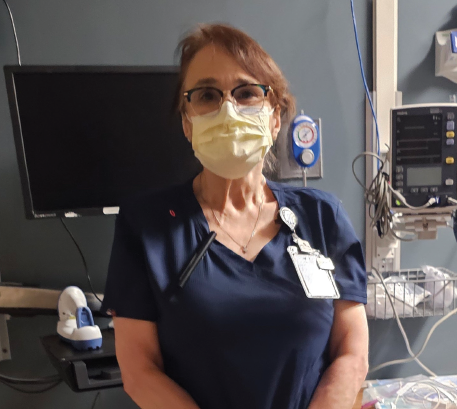
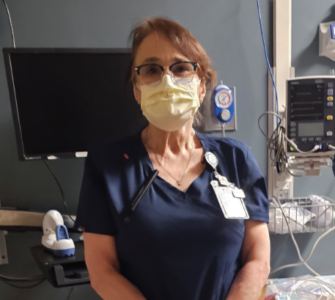
Laurie Edick
NEW ULM – Laurie Edick did not set out to become a nurse, but once she did, she knew exactly where she wanted to work.
“Nursing found me,” she said. “I had a friend who was a public health nurse, and she more or less pushed me into it. I think she saw something in me.”
That encouragement, along with support from her husband, led Edick to return to college at age 38. She graduated in December 2002.
“Once I started, it just felt right,” she said. “I realized I was where I was supposed to be.”
As of this past December, Edick has been a nurse for 23 years.
“When I made the decision to go into nursing, the only place I really wanted to be was NUMC,” she said.
She completed her final clinical rotation in the OB department at New Ulm Medical Center and was hired upon graduation, before taking her nursing boards. She has remained there ever since.
“I choose NUMC because I feel like I belong here,” Edick said. “I have a connection to New Ulm and the patients I meet here. My coworkers are my second family. I can’t imagine working anywhere else.”
During her career, Edick has worked every shift, but it was the night shift that ultimately fit her best.
“I liked nights because it’s more of a challenge,” she said. “You don’t have the ancillary help you have during the day.”
At night, there is no in-house pharmacy, which means nurses mix IV medications themselves.
“I have to mix them and make sure the patient is getting the right medication and the right dose,” she said. “You really have to know what you’re doing.”
Her nights begin with receiving reports from outgoing nurses and reviewing patient charts.
“I look through everything to see what they’re going to need during the night,” she said. “I assess them to make sure they’re stable, and if something changes, I have to decide what to do next.”
That can mean administering medications, arranging testing or contacting a physician.
“Sometimes it’s obvious,” Edick said. “Sometimes it’s not. Sometimes it’s just a gut feeling that tells me they need further testing or intervention.”
She said night-shift nurses play a critical role in patient safety.
“We’re the ones the doctors rely on to make sure the patient stays safe,” she said.
In addition to caring for patients, Edick also works as a charge nurse overnight, handling admissions, assigning rooms and managing staffing levels.
“I decide who takes the admissions or if I take the patient myself,” she said. “I have to make sure we have the right number of nurses for the number of patients we have.”
One common misconception, she said, is that patients sleep through the night.
“They don’t,” she said. “Some patients are awake all night and need close observation.”
She also spends part of her nights mentoring new nurses, many of whom begin their careers on night shift.
“I really enjoy that part,” she said. “New nurses have to build their self-confidence, and that takes time. It took me at least a year.”
Patient safety, she said, is always at the forefront.
“If I make a mistake with medications or miss an important change in my patient, it could harm someone,” she said. “I always check and double-check what I’m doing.”
The hardest part of night-shift work, she said, is its effect on family life and sleep.
“I’m awake while my family sleeps,” Edick said. “When I have a day off, I try to make up for what I couldn’t do when I was working.”
She has two daughters and a daughter-in-law who are also nurses, which can make family schedules difficult.
“Trying to have family functions is very hard,” she said.
One night-shift experience has stayed with her for years. Edick once cared for a terminally ill patient whose daughter had traveled from out of state to be with him during Christmas. The patient was depressed and had begun to give up.
“Santa had come to visit, and we had a plate of treats,” she said. “One of them was called ‘reindeer poop.'”
Later, she joked with the patient.
“I told him he was on Santa’s naughty list and that Santa left him some reindeer poop,” she said. “I didn’t think much of it.”
After the patient passed away months later, his daughter contacted Edick.
“She told me they thought he was going to pass that Christmas,” she said. “But after I took care of him, he perked up.”
The patient went on to visit his daughter in her home state and lived another five months.
“She told me they wouldn’t have had that time if it wasn’t for me,” Edick said. “He told her I was his angel.”
Caring for people in the New Ulm area, she said, is what keeps her returning night after night.
“I’ve met people who knew me when I was young, or knew my parents or my grandparents,” she said. “Some have given me old letters my mother wrote or pictures from when they were younger.
Edick’s mother died when she was 5 years old, making those unexpected connections especially meaningful.
“That wouldn’t happen in a hospital anywhere else,” she said.
Even after difficult shifts, moments of appreciation make the work worthwhile.
“Sometimes a shift can feel overwhelming,” she said. “Then a patient or family member tells you how much they appreciate what you did, and it makes all the difference.”
At the end of the night, it often comes down to teamwork.
“When my coworkers and I look at each other and say, ‘We did it,’ that’s what makes me proud,” she said. “Night shift isn’t for everyone. You need a lot of teamwork. And I’m proud of our night-shift team.”