
Panel challenges traditional stigmas surrounding Autism
New Ulm HRC series continues with focus on autism
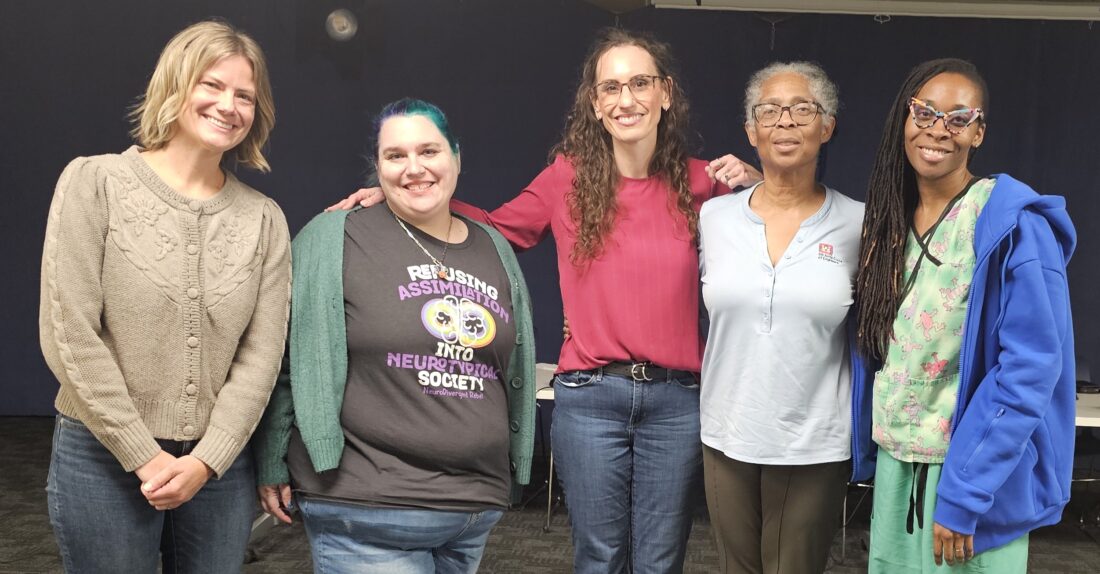
Panelists and organizers of the "Living Without Limits" autism forum gather at the New Ulm Community Access Television (NUCAT) studio following Tuesday’s event. From left to right: Jefferson Elementary special education teacher Alicia Hinkle; Autism Society of Minnesota Policy Director Jillian Nelson; Human Rights Commissioner and moderator Sarah Leslie; architect Lisele Okojie; and New Ulm pediatrician Dr. Obehi Okojie. (Photo by Amy Zents)
NEW ULM — An autism diagnosis rarely changes a person’s identity but instead serves to explain their lifelong experiences, according to advocates and professionals at Tuesday’s “Living Without Limits” panel held in the meeting room at the New Ulm public library.
Hosted by the New Ulm Human Rights Commission, the event featured educators, parents, and medical experts who challenged traditional stigmas surrounding Autism Spectrum Disorder (ASD) and called for increased community inclusion and awareness.
Jillian Nelson, policy director for the Autism Society of Minnesota (AuSM) and an autistic adult, told the audience that the “spectrum” is frequently misunderstood as a linear scale moving from “less” to “more” autistic.
Nelson described the experience instead as a color wheel or a sound mixing board.
“It’s like one of those mixing tables that you see in recording studios, where you can turn up the bass and turn down the saxophone,” Nelson said.
She explained that an autistic person can present in seven different ways on seven different days based on the stressors impacting them.
“Getting an autism diagnosis rarely changes anything; it just explains everything,” she said.
Nelson argued against the use of functioning labels, which she believes limit the potential of individuals on both ends of the scale.
“We’re either going to label someone high functioning and ignore all their support needs, or we’re going to label them low functioning and ignore all their talents,” she said.
This perspective shifted the focus from “fixing” individuals to providing the specific supports necessary for them to thrive in their unique environments.
The panel highlighted the prevalence of neurodiversity in high-stakes professional fields, including medicine.
Dr. Obehi Okojie, a New Ulm pediatrician diagnosed with autism, ADHD, and dyslexia, described her neurodivergence as a distinct asset in clinical settings.
“To keep those many plates spinning at the same time and keep everybody alive. I think it’s easier for a neurodivergent brain to do,” Okojie said.
She explained that a neurotypical brain that focuses on one thing at a time might struggle with the multitasking required in an emergency room or a busy pediatric unit.
However, Okojie was candid about the social toll and the misconceptions she faces. Without a formal label or diagnosis, she said “people would just get annoyed with me and say that I was arrogant and intimidating.”
She said the social battery of an autistic person is often shorter than that of neurotypical peers, leading to a need for isolation and recovery after long periods of being “forward-facing” in the community.
Lisa Ojeda, the mother of Dr. Okojie and a younger son also on the spectrum, urged families to view the diagnosis as a beginning rather than an end.
“Just because you hear someone has a disability or autism, it is not a sentence,” Ojeda said. “There is joy.”
She admitted to an initial period of mourning for the advanced degrees she expected her children to achieve, but said her son taught her that value is judged by the heart rather than brilliance.
“Snap out of it as swiftly as possible,” she advised other parents. “Stop focusing on it and focus on getting your child ready as much as possible.”
Educational challenges within the local district were a primary focus, particularly regarding sensory regulation tools known as “chewies.”
Alicia Hinkle, a special education teacher at Jefferson Elementary, described these safe, non-toxic silicone items as essential for students who require “proprioceptive input” to the jaw to focus and manage anxiety.
These tools provide a hygienic alternative to chewing on clothing or school supplies.
Hinkle reported that because these items are often viewed as extracurricular rather than medical or educational necessities, they frequently fall through the funding cracks.
“It’s very frustrating when you know little things like that will help them, and there’s just not the money to buy them,” Hinkle said.
She said teachers often pay for these tools personally to ensure their students are comfortable and regulated in the classroom.
The “invisible” nature of autism frequently leads to significant barriers in accessing legal and social accommodations.
Nelson shared her personal experiences, noting that while physical disabilities like mobility impairment are readily understood, cognitive and sensory needs often trigger resistance.
“Every autistic adult also carries trauma from existing in a world that isn’t made for them,” Nelson said.
She advocated for a shift in the Americans with Disabilities Act to include more specific guidance on sensory and intellectual accessibility.
The panel also addressed the discrepancy between “educational” and “medical” diagnoses.
Hinkle said a school-based diagnosis is specifically designed to determine what services a child needs to succeed in a classroom, whereas a medical diagnosis focuses on clinical health.
This distinction can sometimes cause confusion for parents.
“They’re not ‘not autistic’ anymore,” Hinkle clarified when discussing children who move out of special services. “They are just able to do what they need to do to be successful in school.”
New Ulm Human Rights Commissioner Sarah Leslie, who moderated the session, stated the commission would use the findings to advise the City Council and the Chamber of Commerce.
One major hurdle identified was the lack of awareness surrounding local resources.
Hinkle pointed out that the director of a “differently-abled” gymnastics program in town reported low participation.
“Nobody knows about it!” Hinkle said.
Better communication and a welcoming attitude were cited as the most impactful tools for reducing barriers.
The forum concluded with the panelists reinforcing that vaccines do not cause autism and being autistic is not a lack of empathy but a different way of processing the world.
For those looking to learn more, Nelson highlighted upcoming virtual online programs from the Autism Society of Minnesota, including a free “Understanding Autism” class on Monday, April 13, from 10 to 11 a.m. and the 2026 Minnesota Autism Conference, which will be held virtually April 15-16.
Nelson also encouraged residents to observe the remainder of April as a time for advocacy and directed the public to ausm.org.
The website features a diagnostic comparison tool for those navigating the differences between medical and educational findings.
Nelson emphasized supporting local organizations over national groups throughout the month.
Full recordings of the “Living Without Limits” series are available on the New Ulm City YouTube channel via New Ulm Community Access Television (NUCAT).
Local News

For the love of trout
City seeks bids for new trap range building
NEW ULM – Plans and specification for a new Trap Range building were approved by the New Ulm City Council. In ...
Sleepy Eye school board OKs Class of 2027 trip
SLEEPY EYE — After hearing about the recent Class of 2026 trip to Florida, the Sleepy Eye School Board ...
BCHS exhibit on Wanda Gág opens Saturday
Panel challenges traditional stigmas surrounding Autism
NU City Council awards crosswind runway project
New Ulm City Council awarded the Crosswind Runway project to Duinick, Inc for $1.6 million Tuesday. The city ...