
BCHS exhibit on Wanda Gág opens Saturday
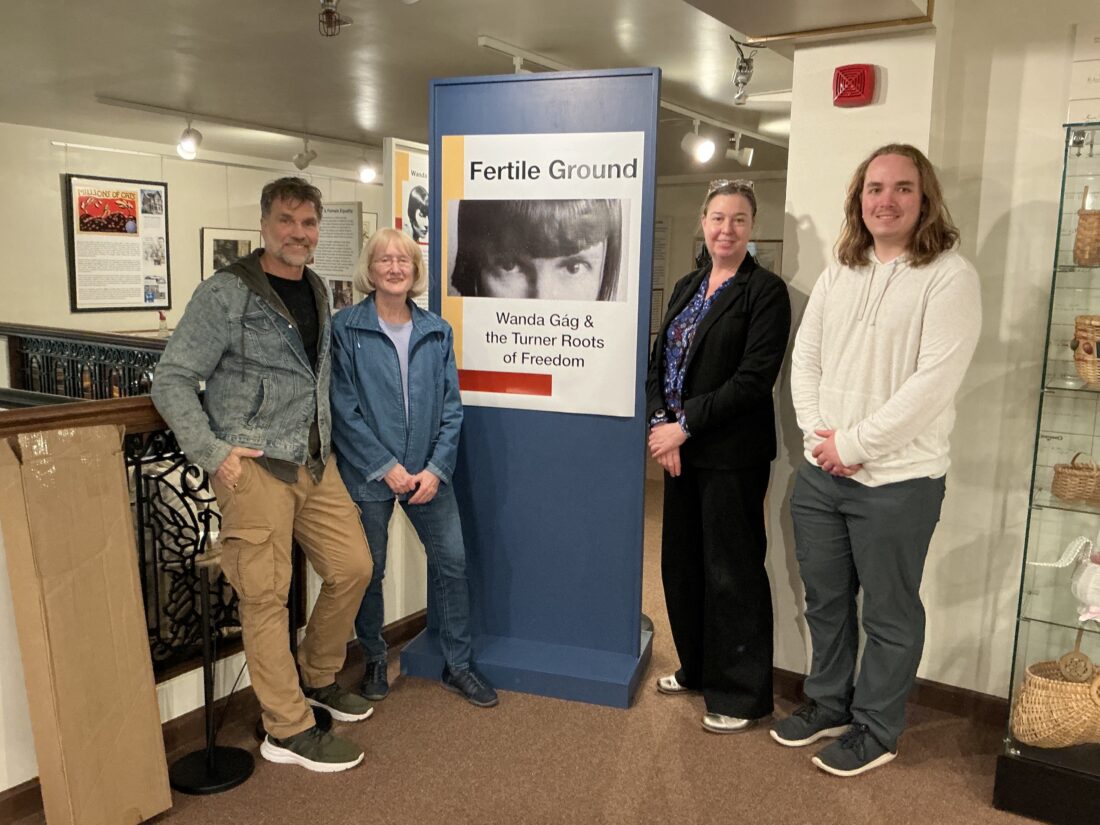
From left, Alexander Roth, Darla Gebhard, Amy Johnson and Logan O’Neill gather at the Brown County Historical Society Museum ahead of the opening of a new Wanda Gág exhibit Saturday. (Photo by Amy Zents)
NEW ULM — A new exhibit celebrating the life and work of Wanda Gág will open to the public Saturday at the Brown County Historical Society Museum, bringing original works and newly sourced materials back to the artist’s hometown.
The exhibit begins with a members-only preview from 5 to 7 p.m. today, followed by a free public grand opening from 10 a.m. to 3 p.m. Saturday.
Curated in partnership with the Wanda Gág House, the exhibit is largely shaped by the vision of Alexander Roth, curator for the historic site, who emphasized the importance of experiencing original artwork in person.
“It’s great to move around this space and to see all of this and to have time,” Roth said. “These are the original works that we have.”
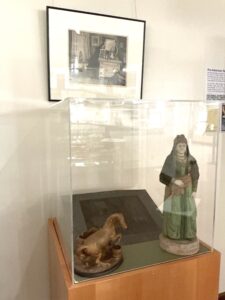
The second-floor gallery features a wide range of Gág’s work, including etchings, prints made from zinc plates, and rare color pieces. Among the highlights is “Grandma’s Parlor,” displayed over a display case containing the original plate used and personal objects used in its production, offering an intimate insight into Gág’s printmaking process.
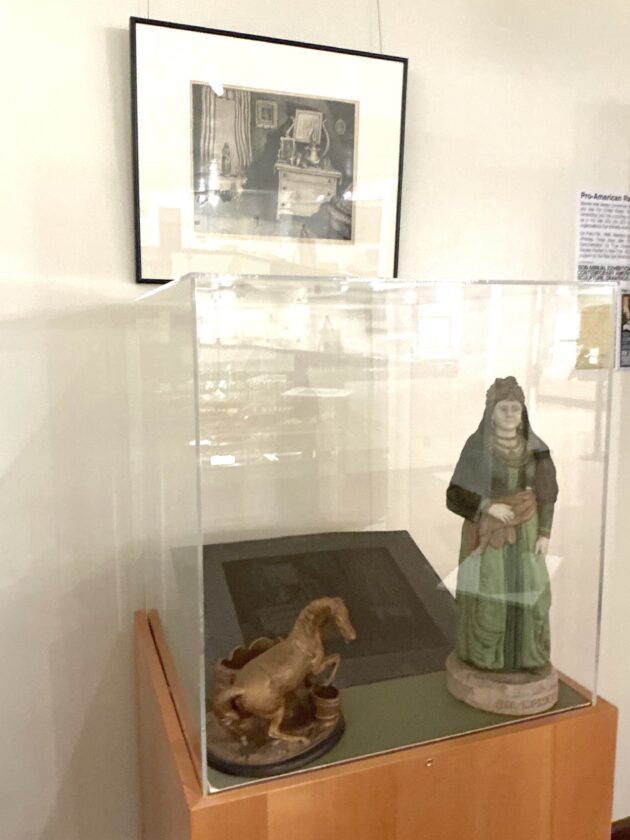
Roth pointed to the technical and visual originality of Gág’s work, including her use of unconventional materials.
“This is the real deal,” he said, referring to works such as Winter 1927, which was inked directly onto sandpaper. “When you see it in person, it shimmers.”
He described Gág’s artistic voice as distinct from traditional movements.
“If you look at surrealism and all that, she’s not really that,” Roth said. “She has her own style.”
The exhibit also explores connections between Gág’s work and later artists. Roth noted that archival evidence suggests Dr. Seuss owned Gág’s books, and similarities can be seen in the rhythmic qualities of their work.
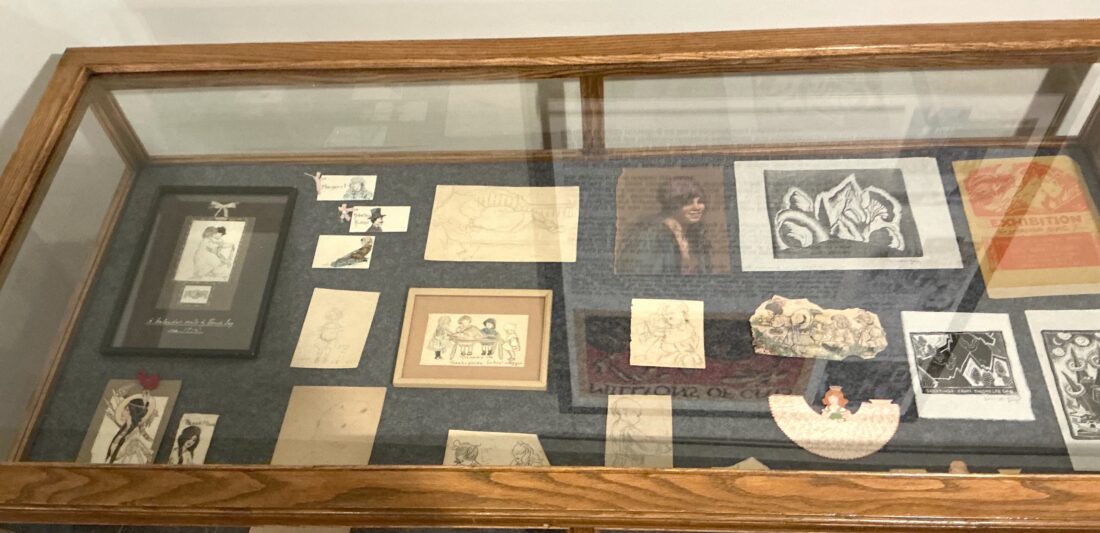
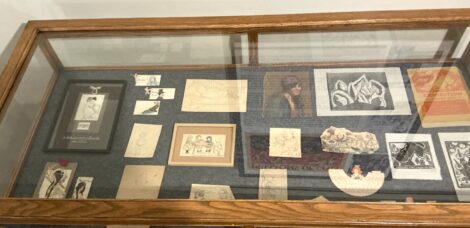
Wanda Gag's boundless creativity meant 'she drew on everything she could draw on,' including 'little drawings and little scraps of paper,' as noted by Alexander Roth, curator at the Wanda Gag House." (Photo by Amy Zents)
“You can see that when you start looking at his,” Roth said.
Beyond her artistic contributions, Roth highlighted Gág’s personal philosophy and humanitarian efforts, describing her as someone who acted on her beliefs without seeking recognition.
“She lived by her own rules,” he said.
According to Roth, Gág quietly supported a number of causes, including providing financial assistance connected to the Scottsboro Boys case and other legal defenses.
“She wasn’t necessarily out front with it,” he said. “But she did something about it.”
Roth also addressed the broader historical context of Gág’s life, including challenges she faced as a woman artist in the early 20th century. He noted that she maintained creative and financial control over her work, a rarity at the time.
“That enabled her to not end up destitute like many artists did,” he said.
The exhibit further examines Gág’s experiences with the medical system later in life, including what Roth described as dismissive treatment of her health concerns prior to her cancer diagnosis.
“It was very patronizing,” he said, noting that such issues continue to resonate today.
While Roth’s curatorial direction shaped the exhibit’s narrative, assembling the collection required extensive research and coordination led in part by Darla Gebhard, research librarian at the Brown County Historical Society.
Gebhard worked to locate, authenticate, and secure pieces from both institutional and private collections, combining archival research with local connections.
“Probably finding and pulling different pieces, and then deciding which one fits where,” she said.
Some works were sourced through long-standing relationships with collectors and the Gág family estate, while others emerged unexpectedly. In one case, a privately owned piece was identified through a local conversation about the exhibit.
Authenticating newly acquired materials required detailed analysis. Gebhard confirmed the authenticity of original storyboards for Gág’s book “Gone Is Gone” by comparing handwriting samples and tracing ownership history.
“I looked at her handwriting and compared it,” she said. “Then I tracked where it came from.”
The storyboards for “Gone Is Gone” can be viewed at the Wanda Gág House, a chapter of the Brown County Historical Society.
The materials were ultimately linked to Florida, where members of Gág’s family once lived, helping establish provenance.
Gebhard said the effort reflects a long-term goal of returning Gág’s work to New Ulm. Many pieces left the area following the death of her father, Anton Gág, when the family sold artwork to support themselves.
“A lot of it got sold,” she said. “So it’s always been in my mind, where are they all?”
The exhibit includes both permanent collection items and loaned works, with some pieces requiring permission for reproduction due to private ownership.
Amy Johnson, executive director of the Brown County Historical Society, said the exhibit offers visitors a chance to connect presentation and object.
“You could hear about it, and now you can come here and see it,” Johnson said. “The color is so rare, and we have a large amount of color.”
The exhibit also coincides with the arrival of a new curator for the Historical Society. Logan O’Neill, who began in March, said the position combines hands-on work with collections and detailed documentation.
“I would say an interest in history and a passion for community really helps,” O’Neill said.
O’Neill, who has lived in New Ulm for about a decade, said working directly with historical objects has been a highlight.
“Being able to work with the objects is very enchanting,” he said.
Roth said the exhibit represents both a culmination of ongoing work and a starting point for future expansion. He outlined a vision for a larger gallery space that could house a permanent Gág collection alongside rotating exhibits and international collaborations.
“We want to make a proper art gallery,” Roth said.
Organizers said the exhibit provides a rare opportunity to view original works by Gág in the place where her artistic journey began, while also reflecting the collaborative effort required to bring those works together.
The exhibit will remain on display at the Brown County Historical Society Museum, but a planned closing date has not been listed. Visitors are encouraged to attend soon to see the works in person.
-
- From left, Alexander Roth, Darla Gebhard, Amy Johnson and Logan O’Neill gather at the Brown County Historical Society Museum ahead of the opening of a new Wanda Gág exhibit Saturday. (Photo by Amy Zents)
-
- Wanda Gag’s boundless creativity meant ‘she drew on everything she could draw on,’ including ‘little drawings and little scraps of paper,’ as noted by Alexander Roth, curator at the Wanda Gag House.” (Photo by Amy Zents)
Local News

For the love of trout
City seeks bids for new trap range building
NEW ULM – Plans and specification for a new Trap Range building were approved by the New Ulm City Council. In ...
Sleepy Eye school board OKs Class of 2027 trip
SLEEPY EYE — After hearing about the recent Class of 2026 trip to Florida, the Sleepy Eye School Board ...
BCHS exhibit on Wanda Gág opens Saturday
Panel challenges traditional stigmas surrounding Autism
NU City Council awards crosswind runway project
New Ulm City Council awarded the Crosswind Runway project to Duinick, Inc for $1.6 million Tuesday. The city ...