
‘We feel like we know him’
MN Military Radio discusses Capt. Bianchi with family
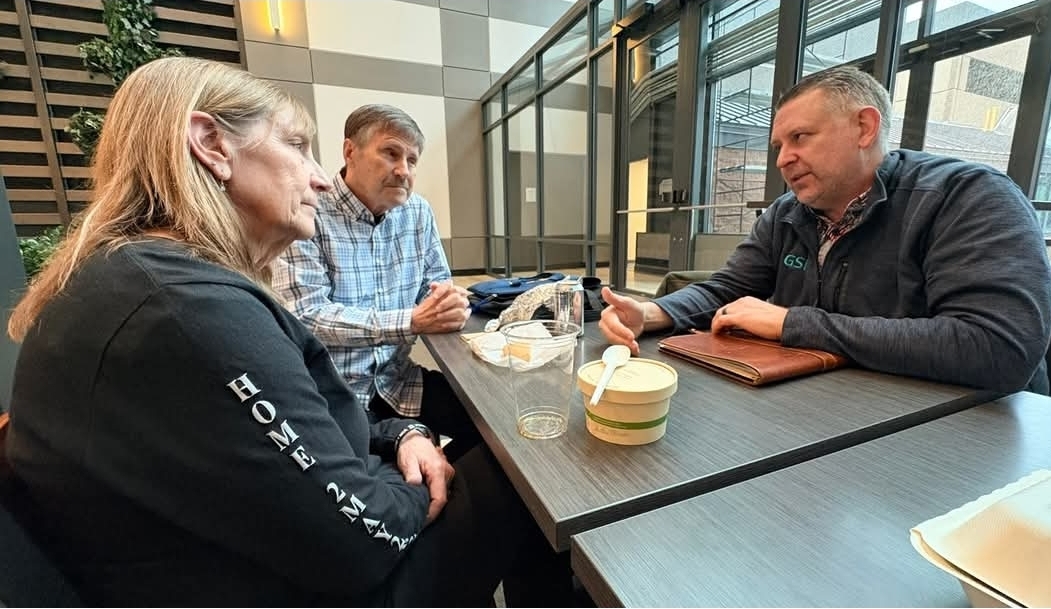
Sue and Steve Marti speak with Doug Wortham of Minnesota Military Radio about the identification and ceremonial honoring of their uncle, Medal of Honor recipient Captain Willibald “Bill” Bianchi. (Photo by Greg Peterson)
NEW ULM — A recent appearance on Minnesota Military Radio by Sue and Steve Marti has brought renewed public attention to Captain Willibald “Bill” Bianchi, the New Ulm native and Medal of Honor recipient whose remains were identified more than 80 years after his death during World War II.
In their interview with host Doug Wortham, the siblings described the notification process, the Pentagon ceremony honoring their uncle, and the memorial events now planned in Minnesota.
Bianchi was born March 12, 1915, to Joseph and Caroline Bianchi and grew up on the family’s poultry farm. As the only son among five children, he helped his father with daily work until his father died in a farming accident while Bianchi was in high school.
He left school to run the farm, later completing his education at the University of Minnesota Farm School and enrolling at South Dakota State University, where he studied animal science, played football, worked multiple jobs and participated in ROTC.
He was commissioned as an Army second lieutenant in June 1940 and requested overseas duty. In April 1941, he was sent to the Philippines to serve with the 45th Infantry and the Philippine Scouts. When Japanese forces attacked Pearl Harbor and invaded the Philippines, Bianchi’s unit was pushed to the Bataan Peninsula as part of Gen. Douglas MacArthur’s defensive campaign.
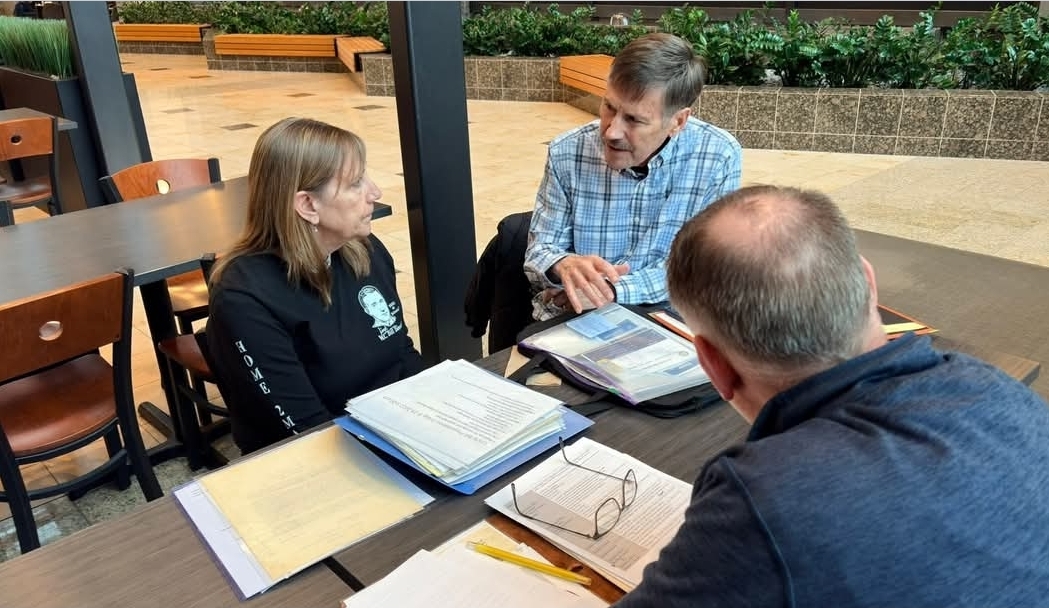
Sue and Steve Marti share their family’s story with Doug Wortham of Minnesota Military Radio about their uncle, Medal of Honor recipient Captain Willibald “Bill” Bianchi. ((Photo by Greg Peterson)
On Feb. 3, 1942, Bianchi volunteered to lead men from another company in an assault on two enemy machine‒gun nests. He was shot twice through the left hand but continued fighting with his pistol, destroying the first nest with grenades. Shot twice more in the chest, he climbed onto a U.S. tank and manned its anti‒aircraft gun until he was hit again and knocked off the vehicle. He survived his wounds, returned to duty a month later and was promoted to captain.
When Bataan fell on April 9, 1942, he was among the 75,000 American and Filipino troops forced into the Bataan Death March. Survivors later wrote to his mother describing how he encouraged others to keep moving and bartered with captors for food. He spent more than two years in multiple POW camps before being loaded onto a Japanese transport ship in late 1944. On Jan. 9, 1945, the ship was bombed by U.S. aircraft, unaware it carried American prisoners. Bianchi was 29.
Stories of his valor reached home. His mother received the Medal of Honor on his behalf in June 1945 at Fort Snelling.
MacArthur later wrote to her, saying Bianchi’s courage “gave us the time to arm ourselves for our return to the Philippines and the final defeat of Japan.”
Because his body was never recovered, Bianchi’s name was inscribed on memorials in Honolulu and Manila. His family preserved his letters and donated his Medal of Honor and decorations to the Brown County Historical Society Museum.
New Ulm later named a street after him and renamed its American Legion post in his honor. South Dakota State University established a memorial, scholarship, and monument to recognize his service.
In their interview on Minnesota Military Radio, Sue and Steve Marti described the moment they learned that his remains had been identified.
“After we got the call and found out that they identified ‘Remain16,’ we were making arrangements,” Sue Marti said. “Four of us were allowed to go, three sisters and me, and we flew to D.C.”
At the Pentagon, the family attended a ceremony alongside service members from all branches.
“We walked in through a gauntlet of soldiers, 30 or 40 standing at attention, and it was just breathtaking,” Sue Marti said.
“It was so unique and surreal. We were trying to take it all in, just standing there, introduced formally, everything happening in front of us,” Steve Marti
The ceremony included a jet flyover, military music and a pass‒in‒review of troops. “People behind us were tapping us on the shoulder and congratulating us after they announced that he had recovered,” Sue said. “We even met someone from New Ulm who had attended the ceremony.”
A second ceremony at the Minnesota State Capitol followed, organized in part by U.S. Sen. Amy Klobuchar.
“The senator read a congressional record that she wrote on the Senate floor,” Steve Marti said. “The press was there, interviews were done, and it was just another kind of surreal moment that was really happening to us.”
Sue Marti said the family has felt connected to Bianchi through the letters he wrote home.
“We feel like we know him,” she said. “We have so many letters he wrote to our mom, to our sister, to others. Those letters are in his writing, and they tell you so much about him.”
The family also met people who had served alongside him.
“Capt. Spalding was at one of the memorial dedications,” Steve Marti said. “He was on the ship with Uncle Bill when they brought him up after we had dropped the bomb, and he met our mom. I just remember her eyes welling up with tears.”
Sue Marti said Bianchi’s actions reflected his character.
“He didn’t need to be down below,” she said. “He was down there because that was the kind of caring and compassionate man he was, taking care of the men.”
The family shared documents from a great‒nephew that Bianchi had signed while stationed in the Philippines.
“You just can’t imagine the breadth of this thing,” Steve Marti said. “It’s so big, and to find people that actually were with him or knew him, that was really meaningful.”
Additional memorial events are planned in Minnesota this May. Members of the Minnesota Patriot Guard Riders will participate. Craig Ugland, state coordinator, said the group will provide a flag line.
“Our mission across Minnesota is to honor fallen service members, veterans and their families with dignity, respect and unwavering support,” Ugland said.
The public is welcome to attend all the memorial events.
Sue said the family has been struck by the level of care shown throughout the process.
“Everything was handled with incredible attention to detail,” she said. “From the Pentagon ceremony to the State Capitol, it was just amazing how much thought went into every part of it.”
Steve Marti said meeting people connected to Bianchi deepened their understanding.
“It really highlighted the scope of what Uncle Bill accomplished and the respect people still have for him,” he said.
Sue Marti said the letters, documents and recollections shared with the family illustrate Bianchi’s leadership and his commitment to protecting fellow soldiers.
“They show a man who cared for others and put himself in harm’s way,” she said.
Sue and Steve Marti said attending the ceremonies reinforced the significance of recognizing service members who were missing or unaccounted for.
“Through all of the letters, documents, personal recollections and ceremonial honors, we feel like we’ve pieced together the final chapter of his life,” Steve Marti said. “It’s something that will resonate for generations.”
-
- Sue and Steve Marti speak with Doug Wortham of Minnesota Military Radio about the identification and ceremonial honoring of their uncle, Medal of Honor recipient Captain Willibald “Bill” Bianchi. (Photo by Greg Peterson)
-
- Sue and Steve Marti share their family’s story with Doug Wortham of Minnesota Military Radio about their uncle, Medal of Honor recipient Captain Willibald “Bill” Bianchi. ((Photo by Greg Peterson)
Local News

‘Running to be proud of MN’

‘Fun before Easter’
‘We feel like we know him’
Sleepy Eye named in honor of Sisseton Dakota tribe chief
Bake sale held for animal shelter
Wabasso water project delayed
WABASSO — A water treatment project in the city of Wabasso is temporarily on pause due to “unforeseen ...