
Sleepy Eye named in honor of Sisseton Dakota tribe chief
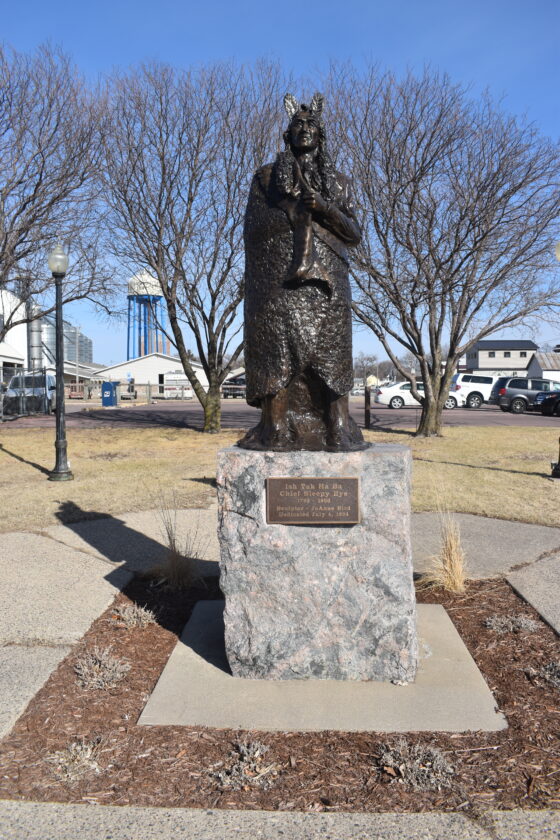
File photo by Fritz Busch An eight-foot high, bronze sculpture of Chief Sleepy Eye is pictured in Wooldrick Park, on First Avenue, a block north of U.S. Highway 14 in downtown Sleepy Eye. The artwork was sculpted by JoAnne Bird, a member of the Sisseton/Wahpeton band of Dakota (Sioux) Native Americans.
SLEEPY EYE — An eight-foot high, bronze sculpture of a Native American honored for his friendliness instead of his heredity, is displayed in a park on First Avenue, just north of U.S. Highway 14 near the center of the city.
Sleepy Eye was commissioned an Sisseton Dakota tribe chief by the Bureau of Indian Affairs in 1824.
Born around 1780 in a tribal village at nearby Swan Lake, Nicollet County, Chief Sleepy Eye, known as Ish Tak Ha Ba in his Dakota band, was known for making friends with explorers, settlers, traders, missionaries, and government officials.
He met President James Monroe in Washington, D.C., and signed four treaties with the U.S. government. Some historical accounts read that Chief Sleepy Eye objected to the treaties, but signed them.
Sleepy Eye’s band hunted over a broad area between Swan Lake and the prairies of southwestern Minnesota and southeastern South Dakota.
From 1857 to 1859, he lived near where his monument and plaque are located in the center of Sleepy Eye.
Chief Sleepy Eye died in 1860 while hunting in Roberts County, South Dakota. His original grave was found in 1898. In 1902, his remains were re-buried underneath where his monument now stands, next to the Sleepy Eye Depot Museum.
The chief is not to be confused with his nephew, also named Sleepy Eye, who was involved in the U.S.-Dakota War of 1862.
The City of Sleepy Eye was platted and named after Chief Sleepy Eye in 1872.
Lazarus Adams, the great-great-grandson of Chief Sleepy Eye, was the grand marshal in the Sleepy Eye Centennial Parade in 1972. The centennial event lasted nine days in Sleepy Eye.
In September 2011, the seventh-generation grandchild of Chief Sleepy Eye, Karyn Douglas Cissel donated a peace pipe he formerly owned, to the Sleepy Eye Depot Museum.
Local News

‘Running to be proud of MN’

‘Fun before Easter’

‘We feel like we know him’
Sleepy Eye named in honor of Sisseton Dakota tribe chief
Bake sale held for animal shelter
Wabasso water project delayed
WABASSO — A water treatment project in the city of Wabasso is temporarily on pause due to “unforeseen ...