Minnesota’s Bataan hero showcased
New Ulm prepares to unveil exhibit for Willibald Bianchi
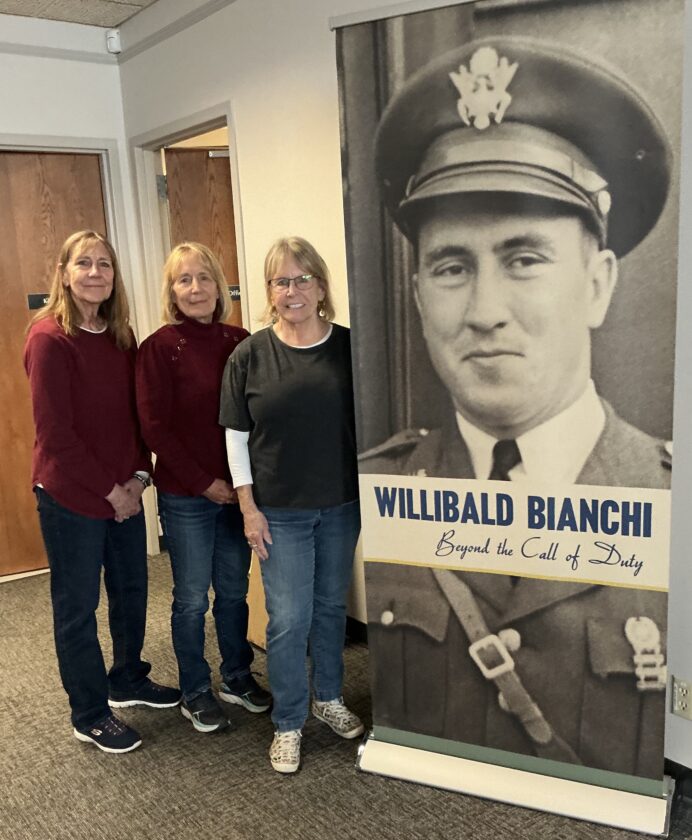
Willard Bianchi's nieces, (from left to right) Sue Marti, Jean Wenk, and Carolyn Marti Smith, stand in front of a sign for the "Willibald Bianchi: Beyond the Call of Duty" exhibit. (Photo by Amy Zents)
NEW ULM — The Brown County Historical Society conducted a public screening of the Lakeland PBS documentary “The Boys of Bataan” Tuesday, serving as a preview for the upcoming permanent exhibit, “Willibald Bianchi: Beyond the Call of Duty.”
This is more or less a teaser for people to start thinking about the exhibit which opens up May second,” Curator,” Dan Hoisington said.
The exhibit will be on the second floor of the Brown County Historical Society Museum.
Hoisington presided over the post-screening proceedings, providing technical context for the 56-minute film and the broader Bataan campaign.
The film’s focus was on the 194th Tank Battalion and Company A from Brainerd and establishes a specific regional framework that the upcoming exhibit will expand upon to provide a comprehensive historical analysis.
The timeline centers on April 9, 1942, the date of the surrender on the Bataan Peninsula, which remains the largest surrender in United States military history.
Following the Japanese invasion of the Philippines, American and Filipino forces executed a tactical withdrawal to the peninsula to establish the defensive Orion-Bagac Line.
Operational failures during the four-month siege resulted in reduction of rations to half-rations and subsequently quarter-rations.
Hoisington cited primary source accounts regarding the extreme scarcity of supplies, noting that troops were forced to consume local wildlife.
As he recalled one soldier’s account, “The story was that they were eating the monkeys, and if you didn’t like monkey, you were out of luck.”
Upon the formal surrender at kilometer 188, American officers were separated from their Philippine Scout units.
The subsequent 65-mile Bataan Death March involved approximately 75,000 to 80,000 American and Filipino troops. Of the estimated 12,000 to 15,000 Americans involved, only 7,000 to 9,000 survived the march and the subsequent years of internment and forced labor to return home.
The upcoming exhibit focuses on Captain Willibald “Bill” Charles Bianchi of New Ulm, who served with the 45th Infantry Philippine Scouts.
Bianchi was instrumental in maintaining the Orion-Bagac Line and was a recipient of the Medal of Honor. Bianchi was later captured and forced to be part of the Bataan Death March where he survived for nearly three years as a prisoner of war. He was known for sharing his rations so others could survive.
Bianchi was killed while being transported in an unmarked Japanese cargo ship with hundreds of other prisoners that was bombed. His remains were buried with other prisoners of war in Taiwan and later at the National Memorial Cemetery of the Pacific in Honolulu.
Last August, the Defense POW/MIA Accounting Agency announced that Bianchi’s remains were positively identified through advances in forensic science and DNA analysis of his family members.
Consequently, full military honors and reburial in New Ulm are coordinated for May 2, to coincide with the exhibit’s opening.
Bianchi’s nieces, Carolyn Marti Smith, Jean Wenk, and Sue Marti, were present at the Tuesday event to witness the ongoing preservation of their uncle’s legacy.
Attendee Naoko Meyer provided testimony on the international standards of remembrance and the cross-generational impact of military sacrifice. Meyer, who was born in Japan and has resided in the United States for the majority of her life, described the era as “just a very sad and horrible time in this world.”
Meyer said the experience was “very touching,” noting that “even like a little town, they have a little memorial,” and emphasized the ongoing appreciation of the French people, stating, “they were still remembered… they actually appreciate us still even after that point of no return.”
The Brown County Historical Society and community remain committed to ensuring these stories endure through annual ceremonies and educational outreach.
The formal schedule for May 2 includes a public visitation from 10 a.m. to 11:45 a.m. at the New Ulm National Guard Readiness Center, followed by graveside services and military honors at the New Ulm Catholic Cemetery from 12:00 p.m. to 12:45 p.m.
A public reception will follow at the New Ulm National Guard Readiness Center from 1 p.m. to 3:30 p.m.
Simultaneously, the museum will be open from 10 a.m. to 3 p.m. for the public opening of the Bianchi exhibit.
As Hoisington said during the session, the objective is to ensure these narratives serve as a foundation for future leadership
“They need to be remembered,” Hoisngton said. “Their names need to be spoken. Their stories need to be told so that we learn from them: leadership, responsibility, commitment for any other walk of life. They are exemplars. They are aspirational, not just as military people, but beyond that in anything that any one of us do.”
Local News
Highway 22 project detour resumes April 15
MANKATO — The Minnesota Department of Transportation 2026 road construction season includes more than 200 ...
Police, bus line praise new safety law
Minnesota’s Bataan hero showcased
NU School Board cuts deep into budget

‘Easy to see the value of the work’