
‘We’re here to serve’
League of Women Voters conclude series with Brown County Commissioners
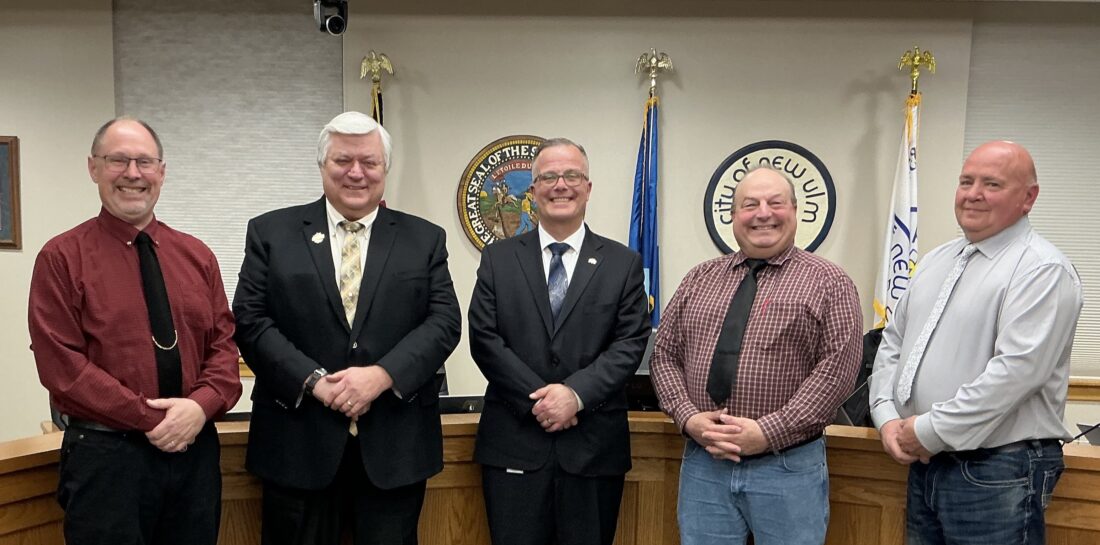
Brown County commissioners gather Monday night at New Ulm City Hall for the League of Women Voters’ “Meet Your Local Officials” forum. From left: Brown County commissioners: Brian H. Braun, Scott Windschitl, David Borchert, Anton Berg and Jeffrey Veerkamp.
NEW ULM — Brown County’s elected officials convened at city hall for a “Meet Your Officials” forum hosted by the League of Women Voters Monday.
The nonpartisan event, part three of the League’s “Empowering Voters” initiative, offered residents an opportunity to hear directly from county commissioners about ongoing projects, emerging challenges and long‒term priorities.
Commissioners discussed infrastructure, emergency services, environmental planning, state mandates and the rural‒urban divide, while emphasizing their statutory role as nonpartisan decision‒makers.
League member Tamara Furth opened the forum by outlining the organization’s mission to promote informed civic participation. She said the League’s recent series of forums, featuring city, school board and now county officials, are intended to help residents understand how local government functions.
League member Heather Bregel said organizers hope to continue the series in non‒election years, noting strong public interest.
Commissioners began by sharing highlights from the past year. Board Chair Scott Windschitl described ongoing work on County Road 10, where erosion along the Minnesota River has created significant safety concerns.
“There was a drop‒off of about 50 to 60 feet straight down at the edge of that road,” Windschitl said.
The county invested about $515,000 in stabilization efforts, with additional work planned to raise a flood‒prone section of the same roadway.
Commissioner David Borchert spoke on the progress with emergency medical services, citing statewide concerns about “ambulance deserts” in rural Minnesota. He said response time in some areas can reach 45 minutes to an hour.
Borchert testified before legislative committees six times, contributing to short-term state funding that helped keep several ambulance services operating.
“It was a lifesaver for a lot of the ambulance services,” he said. “It’s not the long-term solution, but it was necessary.”
Commissioner Anton Berg reported progress in watershed management through the Greater Blue Earth River Basin Alliance and the One Watershed, One Plan initiative. He said more farmers are adopting cover crops, water control basins and reduced-till practices.
“We’re making progress on these things,” Berg said. “I think it’s going to continue. I think it’s going to get better.”
Commissioner Jeffrey Veerkamp announced the adoption of a new comprehensive plan for Lake Hanska County Park, the first update since 1980. He said the plan is essential for securing grants to upgrade aging facilities.
“The first step in getting any grants to update this stuff is getting this plan done,” Veerkamp said.
Commissioner Brian H. Braun emphasized the importance of constituent service, citing a case where residents sought help with erosion and disappearing ditches on a gravel section of County Road 10. Braun said the highway department, under new engineer Andrew Lang, has made significant improvements.
“I really do enjoy that when folks come to me and they say, ‘Hey, what can you do to help us with this?'” Braun said.
Commissioners outlined major concerns for the coming years. Borchert identified the widening “divide between rural and urban Minnesota” as the most significant overarching issue, affecting legislative priorities, population trends and funding formulas.
He cited disparities in Medicaid reimbursement for nursing homes, noting that rural facilities wait “around 18 months longer” than metro counterparts, resulting in “millions of dollars” in delayed payments.
Berg expressed concern about a new state program for out-of-home placement scheduled to begin in 2027, calling the requirements vague and the staffing expectations unrealistic.
“If each county in the state of Minnesota is going to have to come up with five extra workers, they’re not out there,” Berg said.
Budget pressures were a recurring theme. Veerkamp said rising costs leave counties with few options.
“Everything costs so much more, and the only way we get it is by raising that levy,” he said.
He said state claims of increased county program aid often do not benefit Brown County due to population-based formulas.
Braun discussed the African American Family Preservation, Child Welfare and Disproportionality Act, calling it an unfunded mandate. He said the “active efforts” required under the law would more than double the county’s child-welfare staffing needs, costing approximately $1.3 million. He estimated the impact at a 7.5 percent levy increase.
Braun criticized the lack of a fiscal note when the bill was passed, saying it would require taxpayers to fund improvements in an area where the county already performs well.
Windschitl raised concerns about water quality, erosion and the county jail, which he said operates at roughly 50 percent capacity.
“I am quite certain it’s close to a million dollars a year we’re probably losing right now because of the jail population being what it is,” he said, suggesting regional collaboration as a potential solution.
Commissioners also discussed the impact of state and federal funding shifts. Berg said the state “went on a spending spree” and then shifted responsibilities to counties.
Braun said federal changes to SNAP and state disability waivers have increased local costs, projecting a potential 15 to 20 percent levy increase in 2027.
Borchert said Medicaid reimbursement delays have left “$3.5 million locked up” for MRCI, which serves disabled populations across multiple states.
Despite the challenges, commissioners expressed optimism about several initiatives.
Borchert highlighted the potential of Family Resource Centers to support residents across all life stages.
Berg said planned ADA improvements at the courthouse and the possibility of grants for Lake Hanska County Park.
Windschitl said emerging technologies, including artificial intelligence, will bring both opportunities and challenges that require careful oversight.
The evening concluded with commissioners reaffirming their commitment to transparency and public engagement. “We’re here to serve.”
Local News

The farm visits the city
‘We’re here to serve’
Commissioners hear Capt. Bianchi’s repatriation update
More than the sum of our plans
The virtues of pollinating perennials
Five dead in crash on U.S. 71
WINDOM — Five people were killed and eight injured in a head-on crash Friday in Cottonwood County, according to ...